What Is a Galley Kitchen? Definition & Guide for Countertop Fabricators
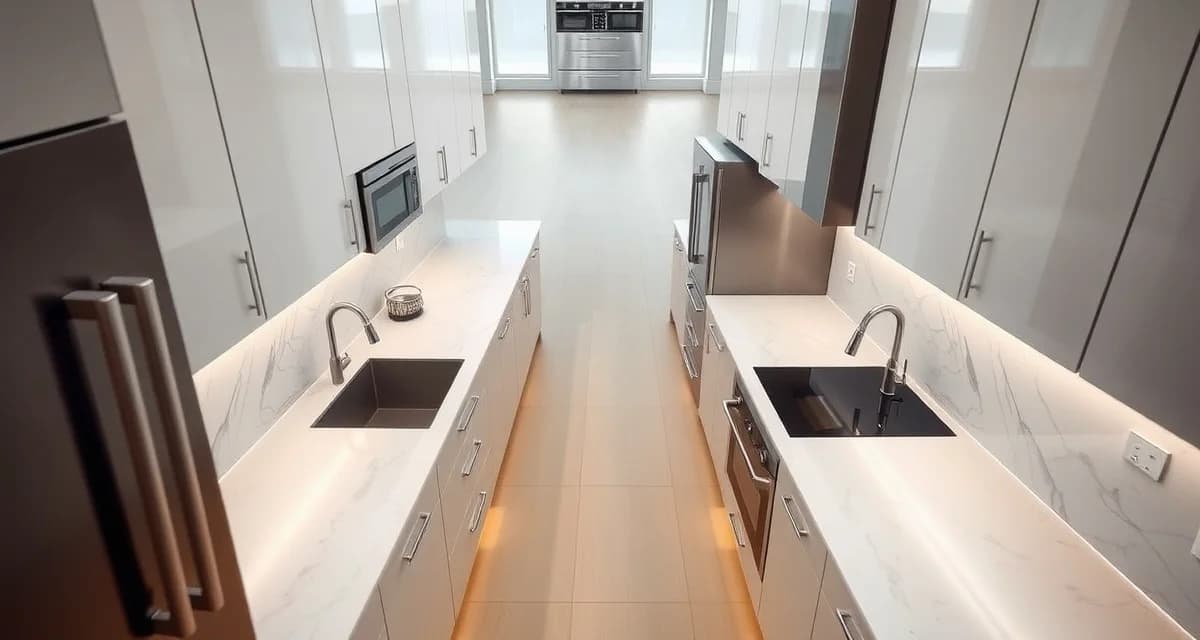
A galley kitchen is a narrow kitchen layout with two parallel countertop runs facing each other across a central walkway. Named after the compact kitchens found on ships, galley layouts are common in apartments, condos, townhomes, and older single-family homes. For countertop fabricators, galley kitchens mean straightforward linear fabrication with minimal seams but tight working conditions during installation.
TL;DR
- A galley kitchen features two parallel counter runs separated by a walkway of 36-48 inches
- Each run is typically 8-14 feet long and 25-25.5 inches deep
- Total countertop area ranges from 25-45 square feet
- Minimal seams needed - often 0-2 per side depending on length
- Both sides can frequently be cut from a single slab
- Installation challenges are physical (tight space) rather than technical
- Galley kitchens represent about 15-20% of residential kitchen projects
Galley Kitchen Dimensions
| Element | Typical Range |
|---|---|
| Run length (each side) | 8-14 feet |
| Counter depth | 25-25.5 inches |
| Walkway width | 36-48 inches |
| Total countertop area | 25-45 sq ft |
| Number of seams | 0-4 total |
| Typical pieces | 2-4 |
The National Kitchen & Bath Association recommends a minimum walkway width of 42 inches for a one-cook galley and 48 inches for a two-cook galley. In practice, many older galley kitchens have walkways as narrow as 36 inches, which complicates installation logistics.
Calculate your material waste savings
See exactly how much slab material and money you could save with optimized cutting layouts.
Try the free Waste CalculatorWhy Fabricators Like Galley Kitchen Jobs
Simple Geometry
Galley counters are straight runs. No corners, no miters, no complex angles. Each side is a rectangle (or near-rectangle, accounting for wall variations). This simplicity translates to:
- Faster templating (30-45 minutes vs. 1-2 hours for complex layouts)
- Straightforward nesting on the slab
- Fewer seams and less epoxy work
- Quicker installation
Efficient Material Use
Two parallel rectangular pieces nest efficiently on a standard slab (120" x 65"). If each run is 10 feet long and 25.5 inches deep, both pieces fit on a single slab with room for backsplash strips or small remnants. This means:
- One slab purchase instead of two
- Less material waste (often 15-25% of the slab is usable remnant)
- Lower material cost for the customer, making the sale easier
Predictable Pricing
Because galley kitchens have consistent geometry, quoting is straightforward. There are few surprises in fabrication complexity, and labor estimates are reliable. A typical galley kitchen countertop quote:
| Component | Cost Range |
|---|---|
| Material (25-45 sq ft) | $1,000-$5,400 |
| Fabrication | $200-$500 |
| Seams (0-2) | $0-$200 |
| Edge profiling | $150-$400 |
| Sink cutout | $150-$250 |
| Installation | $300-$500 |
| Total | $1,800-$7,250 |
Galley Kitchen Fabrication Considerations
Wall Straightness
Galley kitchens in older buildings often have walls that bow, lean, or taper. The templater must measure along the full length of each wall, capturing any deviation. A wall that bows 1/2 inch over 10 feet creates a visible gap between the backsplash and wall if not accounted for in the scribe.
Cabinet Alignment Between Sides
The two counter runs should be at the same height. If the floor slopes (common in older buildings), one side may sit higher than the other. The templater should note any height differences so the installer can shim accordingly.
Sink and Appliance Placement
Most galley kitchens place the sink on one side and the range on the other. The sink side requires an undermount cutout and possibly a faucet hole. Verify exact placement during templating - moving a sink cutout even 2 inches after fabrication is not possible.
End Conditions
Each counter run has two ends. Common end conditions include:
- Wall-to-wall: The counter runs the full length of the galley, butting against walls on both ends
- Open end: One or both ends are exposed, requiring a finished edge
- Return/wrap: The counter wraps around a corner into an adjacent space
Each end condition affects edge profiling requirements and material layout.
Installation in Tight Spaces
The biggest galley kitchen challenge is physical, not technical. A 36-inch walkway with cabinets on both sides leaves barely enough room for two installers to maneuver a 10-foot slab.
Tips for Galley Kitchen Installation
- Measure doorways and hallways on the path from the truck to the kitchen. A 10-foot countertop piece does not fit through a standard 32" doorway without angling.
- Consider piece breaks for access. If the path to the kitchen has tight turns, it may be better to fabricate each run as two pieces with a mid-span seam rather than risk damage during transport.
- Set one side at a time. Install the side without the sink first, then handle the heavier sink-side piece.
- Protect existing counters. When carrying one piece past the already-installed opposite side, use padding to prevent chips or scratches.
Galley Kitchen Trends Affecting Fabricators
Open Galley Conversions
Many homeowners remove the wall at one end of a galley kitchen, creating an open galley or converting to a galley-with-peninsula layout. For fabricators, this means:
- The existing countertop may need modification or replacement
- A peninsula extension adds a seam and possible overhang support
- The job scope increases from a simple re-top to a partial remodel
Waterfall Ends
Adding a waterfall end to a galley counter - where the material runs down to the floor on an exposed end - transforms a basic galley into a design statement. This adds material cost and fabrication complexity but commands premium pricing.
Mixed Materials
Some designers specify different countertop materials on each side of the galley (for example, quartz on the prep side and butcher block on the other). While this halves the stone fabrication, it also halves the revenue. Be prepared to quote just one side.
Galley Kitchen vs. Other Layouts
| Feature | Galley | L-Shaped | U-Shaped |
|---|---|---|---|
| Counter runs | 2 parallel | 2 perpendicular | 3 connected |
| Corner seams | 0 | 1 | 2 |
| Typical area | 25-45 sq ft | 25-45 sq ft | 40-70 sq ft |
| Slabs needed | 1 | 1 | 1-2 |
| Fabrication complexity | Low | Medium | High |
| Installation difficulty | Medium (access) | Medium (seaming) | High |
FAQ
What is the minimum width for a galley kitchen?
The minimum walkway between counter runs is 36 inches, making the minimum total kitchen width about 8 feet (including the depth of both counter runs and cabinets). NKBA recommends 42-48 inches for the walkway.
How many pieces are needed for a galley kitchen countertop?
Typically 2-4 pieces. If each run is under 10 feet, you may only need one piece per side (2 total). Longer runs or access limitations may require breaking each side into two pieces.
Can both sides of a galley kitchen come from one slab?
Yes, in most cases. Two runs of 10 feet at 25.5 inches deep total about 35 square feet, well within the capacity of a standard slab. Efficient nesting makes single-slab galley jobs common.
Are galley kitchen countertops cheaper than other layouts?
On a per-square-foot basis, no - material costs are the same. But galley kitchens are often less total area than L- or U-shaped layouts, and the simpler geometry means lower fabrication and installation labor. Total project cost is typically 20-40% less than a comparable U-shaped kitchen.
How do I handle a galley kitchen with uneven walls?
Template both sides independently, capturing wall profiles along the full length. The fabrication software adjusts the backsplash scribe and counter depth to match the actual wall contour.
What edge profiles work best in galley kitchens?
Eased and beveled edges are the most practical for galley kitchens. Elaborate profiles like ogee collect crumbs and can catch hips in narrow walkways. Keep it simple and functional.
How long does a galley kitchen installation take?
A standard two-piece galley installation takes 1-2 hours. Four-piece installations with seaming take 2-3 hours. The tight access can slow things down, so budget extra time.
Do galley kitchens have good resale value?
Galley kitchens are functional and efficient but are generally less desirable than open layouts on the resale market. However, a galley kitchen with quality countertops and modern finishes still adds value.
Should I recommend a peninsula extension to galley kitchen customers?
If the kitchen layout allows it, a peninsula conversion opens up the galley and adds seating. It increases the project scope and revenue while giving the homeowner a significant upgrade.
How does a galley kitchen affect slab waste?
Galley layouts produce some of the lowest waste percentages. Two rectangular pieces nest tightly on a slab, often leaving useful remnant material that can be sold or used for other projects.
Quote Galley Kitchen Jobs in Minutes
Galley kitchens are fast jobs when your quoting and workflow tools keep up. SlabWise generates accurate quotes in about 3 minutes, tracks material from slab to install, and keeps the entire job organized. Start your 14-day free trial today.
Try These Free Tools
- Kitchen Visualizer -- Upload a kitchen photo and preview different countertop materials in place.
- AR Overlay -- See the actual stone pattern on your customer's cabinets using AR.
- Sink Finder -- Search compatible sink models by countertop dimensions and cutout specs.