Templating Adoption 2026
What Is Templating Adoption in Countertop Fabrication?
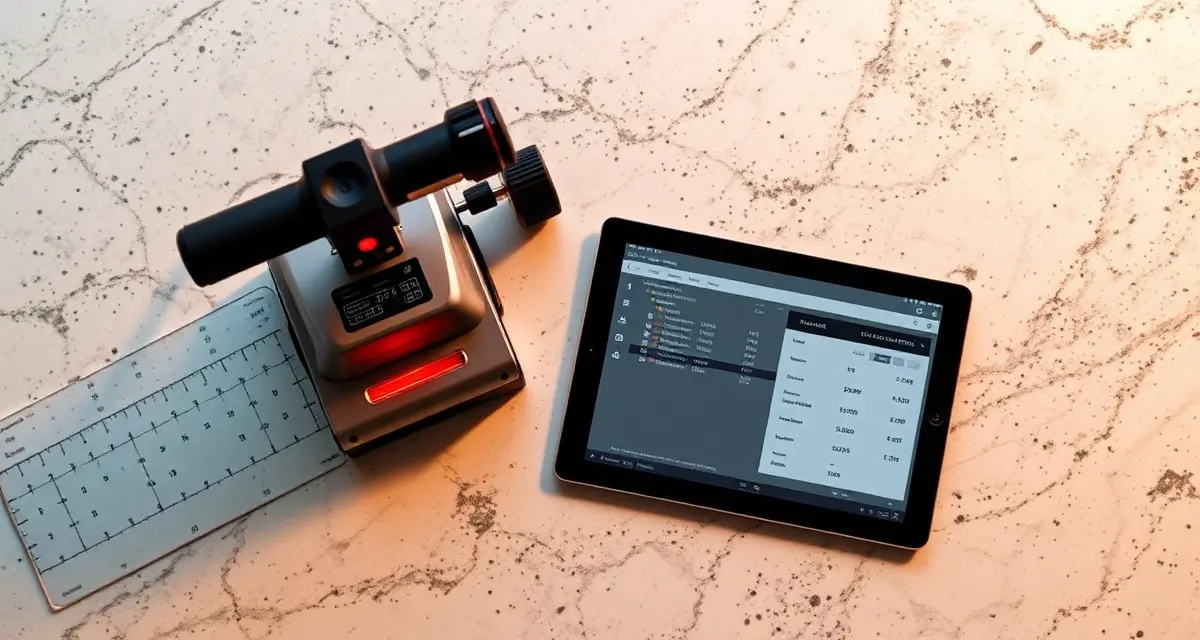
Templating adoption measures how countertop fabrication shops collect and process job-site measurements. The industry is shifting from physical stick templates and manual measurements to digital laser systems and software-based verification. In 2026, roughly 45-50% of US fabrication shops use some form of digital templating, up from approximately 30% in 2022. This shift is driven by accuracy improvements, time savings, and the direct reduction in costly remakes.
TL;DR: Templating Adoption by the Numbers
- 45-50% of US fab shops now use digital templating, up from ~30% in 2022
- Digital templates are accurate to +/- 1/16" vs. +/- 1/8" for physical methods
- Remake rates drop from 4-6% to 1-2% after switching to digital templating
- Average ROI on a laser templating system: 4-8 months based on remake reduction alone
- Shops using digital templates complete jobs 1-2 days faster on average
- 88% of shops that adopt digital templating do not go back to physical methods
- Template verification software adoption sits at 15-20% and is growing fast
Digital vs. Physical Templating: Current Market Split
Here is how the US fabrication market breaks down by templating method in 2026:
Calculate your material waste savings
See exactly how much slab material and money you could save with optimized cutting layouts.
Try the free Waste Calculator| Templating Method | Market Share (2026) | Change from 2022 | Typical Shop Size |
|---|---|---|---|
| Digital Laser (LT-2D3D, Proliner, etc.) | 35-38% | +12% | 10+ employees |
| Digital Photogrammetry | 5-7% | +4% | Varies |
| Tablet/App-Based Digital | 4-6% | +3% | 5-15 employees |
| Physical Stick Templates | 30-35% | -10% | All sizes |
| Manual Measurements (tape + sketch) | 18-22% | -9% | 1-8 employees |
The Adoption Curve
Larger shops (15+ employees) have largely completed their digital transition. Over 70% of shops with 15 or more employees now use digital templating. The current adoption wave is moving through mid-size shops (5-15 employees), where the investment decision weighs more heavily against tighter margins.
Small shops (1-4 employees) remain the most resistant to digital adoption. Many are owner-operators who template jobs themselves and view the $15,000-$30,000 equipment cost as prohibitive, even though the math clearly favors the investment.
Adoption Rate by Shop Size
| Shop Size | Digital Adoption Rate | Primary Barrier | Average Time to ROI |
|---|---|---|---|
| 1-4 employees | 18-22% | Equipment cost | 8-14 months |
| 5-9 employees | 38-44% | Training / change resistance | 5-8 months |
| 10-19 employees | 58-65% | Integration with existing workflow | 4-6 months |
| 20-49 employees | 72-78% | Multi-system coordination | 3-5 months |
| 50+ employees | 85-92% | Standardization across locations | 2-4 months |
The ROI timeline shortens as shop size increases because larger shops process more jobs. A shop running 30 jobs per month recovers its templating investment roughly three times faster than a shop running 10 jobs per month, simply because the per-job savings compound faster.
Accuracy Comparison: The Core Value Proposition
Accuracy is the primary reason shops switch to digital templating:
| Measurement Method | Typical Accuracy | Remake Rate | Cost per Remake |
|---|---|---|---|
| Tape measure + sketch | +/- 1/4" to 3/8" | 6-10% | $1,500-$4,000 |
| Physical stick template | +/- 1/8" to 3/16" | 4-6% | $1,500-$4,000 |
| Digital laser template | +/- 1/16" | 1-2% | $1,500-$4,000 |
| Digital + verification software | +/- 1/16" | 0.5-1% | $1,500-$4,000 |
The Remake Math
Consider a shop running 20 jobs per month with an average remake cost of $2,500:
With physical templates (5% remake rate):
- 20 jobs x 5% = 1 remake/month
- 1 x $2,500 = $2,500/month in remake costs
- Annual: $30,000
With digital templates (1.5% remake rate):
- 20 jobs x 1.5% = 0.3 remakes/month
- 0.3 x $2,500 = $750/month in remake costs
- Annual: $9,000
Annual savings: $21,000 -- on a $20,000-$25,000 equipment investment. The system pays for itself in 12-14 months through remake reduction alone, before accounting for time savings.
For larger shops running 40+ jobs per month, the payback period drops to 5-7 months.
Time Savings from Digital Templating
Beyond accuracy, digital templating dramatically reduces time at multiple stages:
| Process Step | Physical Method | Digital Method | Time Saved |
|---|---|---|---|
| On-site measuring | 60-90 min | 20-45 min | 30-55 min |
| Creating template output | 30-60 min (sketching) | Automatic (5 min) | 25-55 min |
| Transporting template | Physical delivery | Digital transfer | 1-4 hours |
| Digitizing for CNC | 2-4 hours (manual entry) | 15-30 min (import) | 90-210 min |
| Template verification | Visual review only | Software cross-check | Quality improvement |
| Total per job | 5-9 hours | 1-2 hours | 4-7 hours |
At 20 jobs per month, that is 80-140 hours saved monthly. Convert that to labor cost at $25-35/hour and the monthly value is $2,000-$4,900 in recovered labor capacity.
Regional Adoption Patterns
Digital templating adoption varies by geography:
| Region | Digital Adoption Rate | Primary Driver | Notes |
|---|---|---|---|
| Northeast | 52-58% | High labor costs | Labor savings justify investment faster |
| Southeast | 38-44% | Growing competition | New shops entering market push adoption |
| Midwest | 40-46% | Manufacturer partnerships | Equipment financing from suppliers |
| Southwest | 48-54% | New construction volume | High job volume accelerates ROI |
| West Coast | 55-62% | Tech-forward culture | Early adopter mindset |
| Mountain | 35-40% | Smaller shop sizes | Cost barrier in lower-volume markets |
West Coast and Northeast shops lead adoption because their higher operating costs (labor, rent, materials) make efficiency gains more valuable in absolute dollar terms.
Template Verification: The Next Adoption Wave
While digital templating has reached mainstream adoption, template verification software is still early-stage:
| Verification Level | Adoption Rate | What It Catches |
|---|---|---|
| No verification | 50-55% | Nothing -- errors discovered at install |
| Basic manual review | 25-30% | Obvious dimensional errors |
| Software overlay check | 10-12% | Dimensional errors, fixture mismatches |
| 3-layer verification (field + digital + customer) | 5-8% | Virtually all preventable errors |
Shops using three-layer template verification -- where field measurements are cross-checked against digital overlays and customer approvals -- report remake rates below 1%. This represents the next major efficiency gain for shops that have already adopted digital templating.
The three verification layers work as follows:
- Field verification: Templater confirms measurements against physical references on-site
- Digital overlay: Software checks template dimensions against fixture specs, cabinet drawings, and standard tolerances
- Customer confirmation: Homeowner reviews and approves a visual layout showing sink placement, seam locations, and edge details before fabrication begins
Equipment Investment Landscape
Current pricing for digital templating systems in 2026:
| System Type | Price Range | Annual Maintenance | Training Time |
|---|---|---|---|
| Laser (LT-2D3D) | $18,000-$28,000 | $1,500-$3,000 | 1-2 weeks |
| Laser (Proliner) | $20,000-$32,000 | $2,000-$3,500 | 1-2 weeks |
| Photogrammetry | $8,000-$15,000 | $500-$1,500 | 2-4 days |
| Tablet/App | $2,000-$8,000 | $200-$800/yr | 1-3 days |
Financing options have expanded considerably. Most equipment vendors offer 36-60 month leases at $350-$650/month, making the transition feasible for shops that cannot justify a lump-sum purchase.
Barriers to Adoption
Why 50-55% of shops still use physical methods:
| Barrier | Shops Citing This | Reality Check |
|---|---|---|
| Equipment cost too high | 62% | Financing makes monthly cost $350-$650 |
| Current method works fine | 48% | Remake costs are often untracked |
| Staff resistant to change | 41% | Training takes 1-2 weeks |
| Not enough volume to justify | 35% | ROI math works at 8+ jobs/month |
| Owner near retirement | 22% | Valid -- 5+ year ROI horizon needed |
| Tried digital, had issues | 12% | Usually a training problem, not equipment |
The most common barrier -- cost -- is also the most easily addressed through financing. The second most common barrier -- "our current method works" -- usually indicates the shop is not tracking remake costs accurately. When shops begin counting every remake at its full cost ($1,500-$4,000 including materials, labor, scheduling disruption, and customer satisfaction impact), the case for digital becomes clear.
What Early Adopters Report After 2+ Years
Shops that adopted digital templating before 2024 report these outcomes:
- 88% would not return to physical templates under any circumstances
- Average remake rate decreased by 65-75% within the first year
- Template-to-fabrication time reduced by 40-60%
- Customer satisfaction scores improved by 15-25% (fewer delays, fewer errors)
- Crew morale improved -- installers dislike callbacks and remake jobs
- 12% report winning new commercial contracts specifically because of faster turnaround capabilities
Projection: Where Adoption Is Headed
Based on current trends, digital templating adoption in US fab shops is projected to reach:
| Year | Projected Digital Adoption | Primary Growth Segment |
|---|---|---|
| 2026 | 45-50% | Mid-size shops (5-15 employees) |
| 2027 | 55-60% | Small shops via affordable tablet systems |
| 2028 | 62-68% | Industry standard for insured/bonded shops |
| 2030 | 75-80% | Only smallest shops remain physical-only |
FAQ
What percentage of fab shops use digital templating in 2026? Approximately 45-50% of US countertop fabrication shops use some form of digital templating, including laser, photogrammetry, and tablet-based systems.
How much does a digital templating system cost? Laser systems run $18,000-$32,000, photogrammetry systems $8,000-$15,000, and tablet-based apps $2,000-$8,000. Most vendors offer financing at $350-$650/month.
How fast does digital templating pay for itself? Most shops see ROI in 4-8 months based on reduced remakes alone. Shops processing 20+ jobs per month often recover the investment in under 6 months.
Do digital templates really reduce remakes? Yes. Shops switching from physical to digital templates typically see remake rates drop from 4-6% to 1-2%. Adding verification software can push rates below 1%.
How accurate is digital templating compared to stick templates? Digital laser templates achieve +/- 1/16" accuracy vs. +/- 1/8" to 3/16" for physical stick templates. This difference is enough to eliminate most fit-related remakes.
How long does it take to train staff on digital templating? Most laser templating systems require 1-2 weeks of training. Tablet-based apps can be learned in 1-3 days. The learning curve is steeper for older staff but still manageable.
What is template verification software? Template verification software cross-checks digital template data against fixture specifications, cabinet dimensions, and customer approvals before fabrication begins. It catches errors that even digital templating alone can miss.
Why do some shops resist digital templating? The top reasons are equipment cost (62%), satisfaction with current methods (48%), and staff resistance to change (41%). Most of these barriers are addressable through financing and accurate cost tracking.
Which regions have the highest digital templating adoption? West Coast (55-62%) and Northeast (52-58%) lead adoption, driven by higher labor costs and tech-forward business cultures.
Is there a minimum job volume needed to justify digital templating? The investment makes financial sense for shops processing 8 or more jobs per month. Below that volume, the ROI timeline extends beyond 14 months, which may be acceptable but is less compelling.
What is the difference between laser and photogrammetry templating? Laser systems project and measure with a rotating laser, achieving very high accuracy. Photogrammetry uses photographs and software to reconstruct measurements. Laser is more accurate but more expensive; photogrammetry is more affordable and portable.
Will physical templates ever fully disappear? Unlikely in the near term. Small 1-4 employee shops in low-volume markets may continue using physical methods for another decade. But physical templates will become increasingly rare in shops processing 10+ jobs per month.
Verify Every Template Before It Hits the CNC
SlabWise's Template Verification system runs a 3-layer check on every template -- catching dimensional errors, fixture mismatches, and customer miscommunications before fabrication starts. Shops using template verification report remake rates below 1%. Start your 14-day free trial at slabwise.com.
Try These Free Tools
- Photo to Template -- Snap a photo of an existing countertop and get an AI-generated DXF template.
- Template Compare -- Upload two templates and see every dimension change highlighted instantly.
- AI Template Verification -- Cross-check your template against manufacturer specs before cutting.
Sources & Further Reading
- Natural Stone Institute - 2026 Consumer Satisfaction Survey Report
- International Surface Fabricators Association - Customer Experience Metrics in Fabrication
- National Kitchen & Bath Association - Homeowner Satisfaction with Countertop Materials
- Remodeling Magazine - Kitchen Remodel Customer Satisfaction Study