Slabsmith Review 2026: Pricing, Features & Verdict
Quick Definition
A thorough slabsmith review helps fabricators make informed decisions.
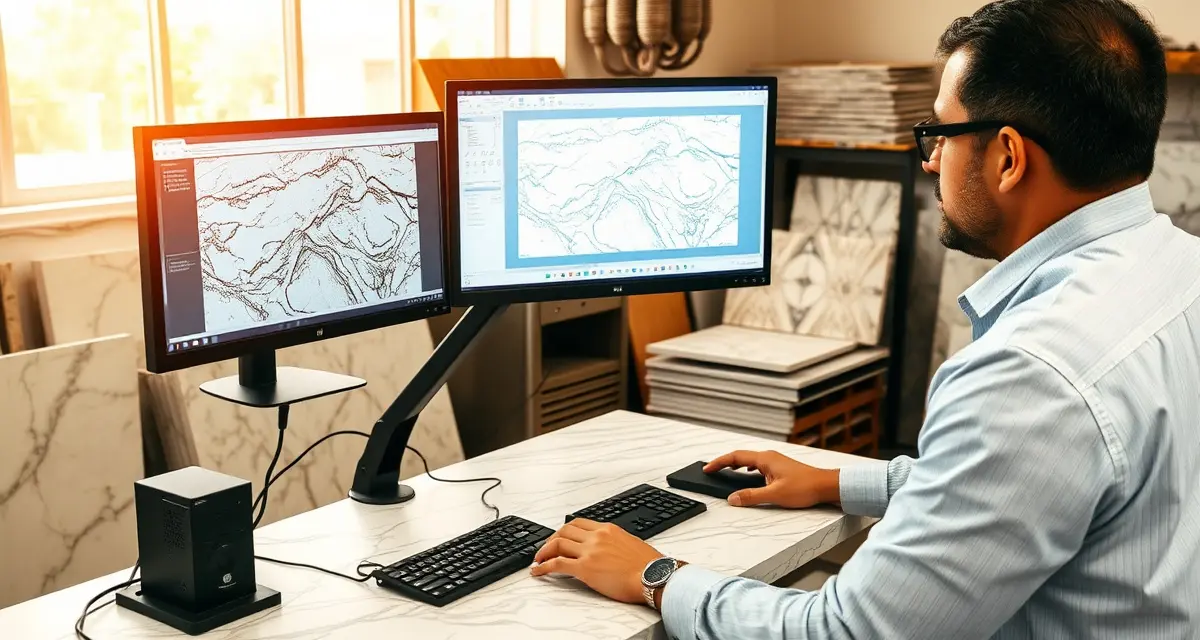
Slabsmith is a slab layout and visualization software used by countertop fabrication shops to photograph slabs, map their patterns and veining, and digitally place countertop pieces onto slab images to plan cuts and show customers exactly how their countertops will look. Slabsmith is widely recognized in the industry for its vein-matching capability, which allows fabricators to align stone patterns across seams for a more natural appearance.
TL;DR
- Pricing: Approximately $5,000-$15,000 for hardware and software, plus annual subscription
- Best for: Shops that want to show customers exactly how their countertop pieces will look on a specific slab
- Biggest strength: Photographic slab mapping with vein-matching across pieces and seams
- Biggest weakness: Focused on visualization and layout, not on optimizing material yield or managing shop operations
- Learning curve: Moderate to steep; slab photography and calibration require training
- Support: U.S.-based phone and email support
- Verdict: The industry leader in slab visualization and customer presentation, but it should be paired with AI nesting for maximum material optimization
What Is Slabsmith?
Slabsmith addresses a specific problem in stone fabrication: customers want to see what their countertops will actually look like before cutting begins, especially with natural stone where every slab has unique patterns, veining, and color variation.
Calculate your material waste savings
See exactly how much slab material and money you could save with optimized cutting layouts.
Try the free Waste CalculatorThe system works in three stages:
- Slab photography: High-resolution photos of each slab are captured using a calibrated camera setup
- Slab mapping: The software maps the slab's dimensions, defects, and pattern features
- Piece placement: Countertop pieces (from templates) are digitally placed on the slab image to show the customer exactly which section of stone will become their countertop
This process serves two purposes: it sells the project (customers love seeing their specific slab layout) and it helps fabricators plan cuts that showcase the stone's best features while avoiding defects.
Slabsmith has been a fixture in the fabrication industry for years, and many shops consider it essential for natural stone work - particularly granite, marble, and quartzite where pattern matching and vein alignment command premium prices.
Slabsmith Features Breakdown
Slab Photography and Mapping
The foundation of Slabsmith is its slab photography system. Each slab in inventory is photographed using a calibrated setup that ensures consistent color reproduction and dimensional accuracy.
| Photography Feature | Slabsmith |
|---|---|
| Resolution | High (adequate for detail visibility) |
| Color calibration | Yes (profile-based) |
| Dimensional accuracy | Calibrated to slab dimensions |
| Defect marking | Manual (operator identifies) |
| Auto-stitch (large slabs) | Yes |
| Photography time per slab | 10-20 minutes (including setup) |
The photography process is the most labor-intensive part of Slabsmith. Each slab needs to be positioned, photographed (sometimes multiple shots stitched together), and calibrated. For shops inventorying 20-50 new slabs per week, this adds 3-17 hours of labor weekly.
Vein-Matching and Layout
This is Slabsmith's signature capability. The software allows fabricators to:
- Position countertop pieces on the slab image
- Rotate and mirror pieces to align veining across seams
- Visualize how patterns will flow from one piece to the next
- Show customers the exact stone section allocated to their project
- Plan seam locations for minimal visual disruption
| Vein-Matching Feature | Slabsmith | Basic Layout Tools |
|---|---|---|
| Photo-realistic preview | Yes | No |
| Seam vein alignment | Yes (manual) | No |
| Pattern flow visualization | Yes | No |
| Bookmatching capability | Yes | No |
| Customer presentation | Professional | Basic |
For natural stone projects where pattern continuity across seams is a selling point, Slabsmith is genuinely valuable. Shops that can show customers a realistic layout with aligned veining close deals more effectively than shops showing generic material samples.
Customer Presentation
Slabsmith generates presentation materials that help close sales:
- Rendered layout showing pieces on the actual slab
- Multiple layout options for customer comparison
- Material specification details
- Seam location visualization
- Print and digital output for customer review
The customer-facing output is where Slabsmith delivers its most direct ROI. Shops using slab visualization in their sales process report higher close rates on natural stone projects - estimated at 10-20% improvement - because customers can see exactly what they're getting before committing.
Inventory Visualization
Beyond individual project layouts, Slabsmith provides a visual inventory of your slab yard:
- Browse available slabs by material, color, and size
- Filter by slab dimensions to find material that fits specific jobs
- View slab photography alongside inventory data
- Track which slabs are allocated to specific projects
Slabsmith Pricing
Slabsmith pricing includes hardware (camera system, lighting) and software:
| Component | Estimated Cost |
|---|---|
| Software license | $3,000-$8,000 |
| Camera and lighting system | $2,000-$5,000 |
| Calibration equipment | $500-$1,000 |
| Installation and training | $1,000-$3,000 |
| Annual subscription/maintenance | $1,000-$2,500/year |
| Total first-year cost | $7,500-$19,500 |
| Annual ongoing cost | $1,000-$2,500 |
The first-year investment includes both hardware and software. Ongoing costs are limited to the software subscription and occasional camera equipment replacement.
ROI Calculation
Slabsmith's ROI comes from two sources: higher close rates on natural stone sales and reduced waste from better layout planning.
- Close rate improvement: 10-20% more natural stone projects closed per month
- Average natural stone project value: $4,000-$8,000
- If closing 2 more projects per month: $8,000-$16,000 additional revenue
- Waste reduction from visual layout planning: 3-5% (modest)
- Monthly material savings at $30,000 material spend: $900-$1,500
For shops doing significant natural stone work, Slabsmith's ROI is strong. For shops primarily working with quartz (where pattern matching is less critical), the value proposition weakens.
Slabsmith Pros
Industry-leading slab visualization. No tool matches Slabsmith for showing customers their exact stone layout with realistic pattern rendering. For natural stone sales, this is a proven closer.
Vein-matching capability. The ability to align veining across seams is unique to Slabsmith and valuable for premium stone installations where pattern continuity matters.
Higher close rates. Shops consistently report that visual slab layouts help customers commit to higher-priced natural stone projects. Seeing the actual stone, not just a sample, reduces hesitation.
Visual inventory management. Browsing slab inventory through photographs makes material selection faster and more accurate than sorting through a text-based inventory list.
Reduces customer disputes. When the customer has approved a specific slab layout before fabrication, complaints about pattern or color are significantly reduced.
Slabsmith Cons
Labor-intensive slab photography. Photographing and mapping every slab takes 10-20 minutes per slab. For high-volume shops with frequent slab deliveries, this represents a significant ongoing labor commitment.
Not an optimization tool. Slabsmith helps fabricators place pieces visually, but it doesn't optimize placement for maximum material yield. A fabricator manually arranging pieces on a slab photo prioritizes aesthetics over efficiency. AI nesting tools like SlabWise optimize yield mathematically, saving 10-15% on material compared to visual placement alone.
Limited quartz value. Quartz countertops (51% of the market) have consistent patterns across the slab. The vein-matching and visualization features that make Slabsmith valuable for granite and marble provide less benefit for quartz, where any section of the slab looks essentially the same.
Not a shop management platform. Slabsmith handles slab visualization and layout. It doesn't manage jobs, schedule production, generate quotes, communicate with customers, or track installations. You need separate software for everything else.
Photography hardware requirements. The camera, lighting, and calibration equipment require dedicated space and maintenance. The photography setup takes up floor space in the slab yard.
No AI-powered nesting. Slabsmith's piece placement is manual - the operator arranges pieces visually on the slab image. AI nesting algorithms can test thousands of placement options in seconds and consistently produce 10-15% better material yield than human visual placement.
Slabsmith vs. Alternatives
| Feature | Slabsmith | SlabWise | Moraware | StoneGrid |
|---|---|---|---|---|
| Slab photography | Yes (core) | Not primary | No | Limited |
| Vein matching | Yes | No | No | No |
| AI slab nesting | No | Yes (10-15% savings) | No | No |
| Customer visualization | Strong | Included | Basic | Basic |
| Job management | No | Yes | Yes | Limited |
| Quoting | No | Yes (3 min) | Yes | Limited |
| Customer portal | No | Yes (70% fewer calls) | Yes | No |
| AI template check | No | Yes (3-layer) | No | No |
| Price | $7.5K-$19.5K first yr | $199-$349/mo | $200-$400/mo | Variable |
The comparison illustrates that Slabsmith and platforms like SlabWise serve complementary functions. Slabsmith excels at visual presentation and vein matching; SlabWise excels at operational management and AI optimization. Some shops use both.
Who Should Use Slabsmith?
Good fit:
- Shops doing 30%+ natural stone work (granite, marble, quartzite) where pattern matching matters
- Showroom-based operations where in-person visual presentations drive sales
- High-end fabricators where vein-matching and pattern continuity justify premium pricing
- Shops that experience customer disputes about stone appearance
Not a good fit:
- Quartz-focused shops (51% of market) where pattern matching provides minimal value
- Shops looking for operational management software (quoting, scheduling, production)
- Budget-constrained operations where the $7,500-$19,500 first-year cost is difficult to justify
- Small shops without dedicated staff for slab photography
The Bottom Line
Slabsmith is the undisputed leader in slab visualization and vein-matching. For shops where natural stone work is a significant revenue source, the tool's ability to close sales and reduce customer disputes provides clear value.
But Slabsmith doesn't optimize material yield - that's not what it was built for. Shops that want both beautiful layout presentations and maximum material efficiency should consider Slabsmith for the visual selling component and AI nesting software (like SlabWise) for the optimization component. The combination delivers both higher close rates and lower material costs.
How much does Slabsmith cost?
Slabsmith's total first-year cost is approximately $7,500-$19,500, including software, camera equipment, and training. Ongoing annual costs are $1,000-$2,500 for the software subscription.
Does Slabsmith optimize material yield?
No. Slabsmith helps fabricators visually place pieces on slab images, but placement is manual and prioritizes aesthetics over yield optimization. For maximum material savings, pair Slabsmith with AI nesting software that mathematically optimizes piece placement.
How long does it take to photograph a slab?
Slab photography takes approximately 10-20 minutes per slab, including setup, capturing, calibration, and uploading to the software. High-volume shops should plan for 3-17 hours per week of photography labor.
Is Slabsmith useful for quartz countertops?
Less so. Quartz has consistent patterns across the slab, so the vein-matching and visualization features provide limited value. Slabsmith is most valuable for natural stone (granite, marble, quartzite) where each slab has unique characteristics.
Can Slabsmith manage my shop operations?
No. Slabsmith is a visualization and layout tool. It doesn't handle quoting, scheduling, production tracking, customer communication, or any other shop management functions.
Does Slabsmith include AI features?
No. Slabsmith uses manual piece placement by the operator. It doesn't include AI-powered nesting optimization, template verification, or automated recommendations.
How does Slabsmith help close more sales?
By showing customers a realistic rendering of their exact countertop layout on a specific slab, including vein alignment across seams. This visual confirmation helps customers commit to projects, with shops reporting 10-20% higher close rates on natural stone projects.
Can Slabsmith integrate with my CNC software?
Slabsmith can export layout files in DXF format for import into CNC programming software. However, the integration is file-based rather than live-connected, requiring manual export and import steps.
Visual Layouts + AI Optimization = Maximum Value
Slabsmith shows your customers what their stone will look like. SlabWise's AI nesting tells your CNC where to cut it for 10-15% better yield. Add AI template verification, quoting, and full shop management starting at $199/month.
Start your 14-day free trial - no credit card required.
Try These Free Tools
- Cost Calculator -- Get instant countertop cost estimates by material, edge profile, and square footage.
- Compare Materials -- Side-by-side material comparison with pricing, durability, and maintenance ratings.
- Edge Profile Selector -- Browse edge profiles with cost impact and visual previews.