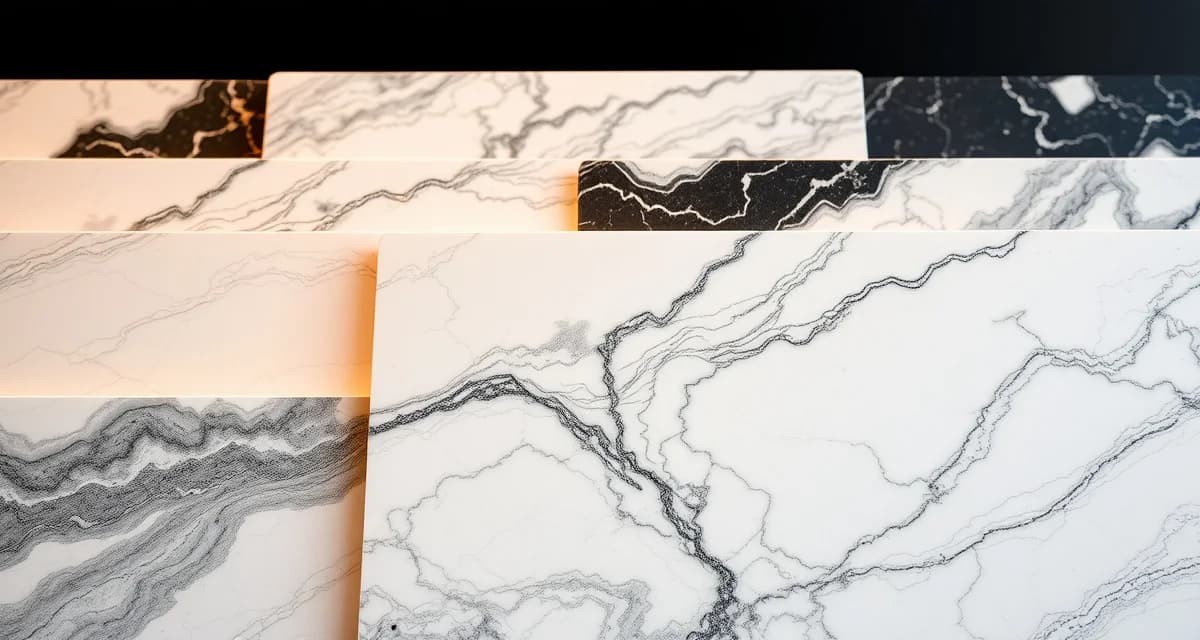
What Is Veining in Countertop Stone?
Veining refers to the linear or branching patterns of contrasting color that run through natural stone and some engineered countertop materials. In natural stone, veins are mineral deposits (typically quartz, calcite, mica, or iron) that filled fractures in the rock millions of years ago. In engineered quartz, veining is added during manufacturing to mimic the look of natural stone. Veining is one of the most sought-after visual features in countertop materials, with heavily veined stones like Calacatta marble commanding premium prices of $100-$200+ per square foot.
TL;DR
- Veining is caused by mineral deposits that filled natural fractures in rock over millions of years
- Marble, quartzite, and some granites display the most prominent veining
- Vein colors depend on the mineral: white (calcite), gold (iron), gray (graphite), green (chlorite)
- Veining direction affects kitchen design and should be planned during slab layout
- Heavily veined stones require more waste (20-30%) due to pattern matching at seams
- Engineered quartz mimics veining using pigments and manufacturing techniques
- Veining is not a structural weakness in most cases, unlike cracks and fissures
How Veining Forms in Natural Stone
Veining forms through geological processes over millions of years:
Calculate your material waste savings
See exactly how much slab material and money you could save with optimized cutting layouts.
Try the free Waste CalculatorIn marble: As limestone undergoes metamorphism (heat and pressure), fractures develop. Mineral-rich water flows through these fractures and deposits minerals that crystallize into veins. The most common vein mineral in marble is calcite (white or clear), but iron (gold/rust), graphite (gray/black), and chlorite (green) are also common.
In quartzite: Similar to marble, but the host rock is sandstone. Quartz-rich solutions fill fractures and recrystallize. Quartzite veins tend to be more subtle and linear than marble veins.
In granite: Veining in granite is less common than in marble but does occur. It results from late-stage mineral injections during the rock's cooling process. Pegmatite veins (large crystal formations) are the most dramatic.
The direction, thickness, color, and density of veins are determined by the geological history of each specific stone block. This is why every slab has a unique vein pattern, even slabs cut from the same quarry.
Types of Veining Patterns
| Vein Pattern | Description | Common In | Example Stones |
|---|---|---|---|
| Bold/dramatic | Thick, high-contrast veins | Marble | Calacatta, Statuario |
| Subtle/fine | Thin, low-contrast lines | Quartzite, some marble | Carrara, Taj Mahal |
| Branching | Tree-like veins splitting into smaller lines | Marble | Calacatta Borghini |
| Linear/parallel | Straight, uniform veins | Quartzite | White Macaubas |
| Swirling | Curved, flowing patterns | Marble, quartzite | Cristallo, Fantasy Brown |
| Web-like | Dense network of fine veins | Marble | Bianco Carrara |
| Bookmatched | Mirror-image veins from consecutive slabs | Any veined stone | Cut from the same block |
Popular Veined Countertop Stones
High Veining (Dramatic Statement)
Calacatta marble: The most famous veined stone. White background with bold gray and gold veins. Prized for luxury kitchens. Price: $100-$250/sq ft installed.
Statuario marble: White with strong gray veining that's more linear and defined than Calacatta. Price: $80-$200/sq ft installed.
Calacatta Borghini: Dramatic, thick gold and gray veins on a white background. One of the most expensive natural stones. Price: $150-$300/sq ft installed.
Moderate Veining (Balanced Look)
Carrara marble: White to blue-gray with fine, feathery gray veining. The most popular marble worldwide. Price: $50-$100/sq ft installed.
Taj Mahal quartzite: Warm white with soft gold veining. A durable alternative to marble. Price: $80-$150/sq ft installed.
Super White quartzite/dolomite: Cool white with flowing gray veins. Varies by slab. Price: $80-$150/sq ft installed.
Subtle Veining (Understated Elegance)
White Macaubas quartzite: Clean white with light gray linear veining. Price: $80-$130/sq ft installed.
Danby marble (Vermont): Very white with minimal veining. Mined domestically. Price: $60-$120/sq ft installed.
Bianco Romano granite: Cream background with subtle gray and brown movement. Price: $50-$80/sq ft installed.
How Veining Affects Countertop Layout
Veining direction significantly impacts how your countertop looks once installed:
Vein Direction Options
Running parallel to the countertop front edge: Creates a calm, horizontal flow that elongates the kitchen visually. This is the most common orientation.
Running perpendicular to the front edge: Creates a bolder statement with veins flowing from front to back. More dramatic but can look busy in small kitchens.
Running diagonally: Some fabricators can orient the slab at an angle to the countertop, creating diagonal vein flow. This is unusual but can be striking.
Seam Matching with Veined Stone
When veined stone meets at a seam, the veins should either:
- Continue across the seam (requires careful alignment and matching slabs)
- Meet at a natural break point (where a seam would look intentional)
Bookmatched slabs (consecutive cuts from the same block) allow fabricators to create mirror-image vein patterns at seams. This is the gold standard for high-end veined stone installations but requires purchasing two specific slabs from the same bundle.
Waste Factor with Veined Stone
Heavily veined stone creates more waste than solid-colored material because:
- Fabricators must align vein direction across all pieces
- Seams need to fall at visually appropriate locations
- The most dramatic vein areas may be positioned over sink cutouts, wasting the visual impact
- Bookmatching requires specific slab orientation, limiting cut flexibility
Budget 20-30% waste for heavily veined stones, compared to 10-15% for solid or minimally veined materials.
Veining in Engineered Quartz
Quartz manufacturers recreate veining using several techniques:
Pigment injection: Colored pigments are injected into the quartz mixture before compression, creating organic-looking veins.
Layering: Multiple quartz mixtures of different colors are layered and compressed together, with the boundaries creating vein-like patterns.
Hand-crafting: Some premium quartz brands (Cambria, Caesarstone) use manual processes to create more natural-looking vein patterns.
Popular veined quartz patterns include marble-look options like Caesarstone Calacatta Maximus, Cambria Brittanicca, and Silestone Calacatta Gold. These achieve 80-90% visual similarity to natural marble at a lower price point and with zero maintenance.
The trade-off: Engineered veining is consistent from slab to slab, which is either an advantage (predictability) or disadvantage (lacks natural uniqueness), depending on your perspective.
Veining vs. Fissures vs. Cracks
These three linear features look similar but have very different implications:
| Feature | What It Is | Structural Impact | Feel |
|---|---|---|---|
| Vein | Mineral deposit in a healed fracture | None; adds strength | Smooth (level with surface) |
| Fissure | Natural separation between mineral crystals | Minimal; normal feature | Smooth or barely perceptible |
| Crack | Structural damage from impact or stress | Significant; may worsen | Rough; catches fingernail |
How to tell them apart: Run your fingernail across the line. A vein is completely smooth and level with the surrounding stone. A fissure may be barely perceptible. A crack catches your fingernail in a visible gap.
FAQ
Does veining weaken the stone? No. Veins are minerals that filled fractures and solidified. They're part of the stone's structure and don't create weakness. In fact, the quartz or calcite in veins is often harder than the surrounding stone.
Can I request vein direction during fabrication? Yes. Tell your fabricator how you want the veins oriented (parallel, perpendicular, or diagonal to the counter front edge). They'll plan the slab layout accordingly. Visiting the slab yard with your fabricator is the best way to discuss vein placement.
Why is Calacatta more expensive than Carrara? Calacatta comes from a smaller quarrying area in Italy and has bolder, more dramatic veining. Carrara is more abundant and has subtler veining. Supply and demand drive the price difference.
Do all countertop stones have veining? No. Many granites have speckles or flecks instead of veins. Solid-color quartz has no veining. Even within marble and quartzite, some varieties (like Thassos marble or Snow White quartzite) have minimal veining.
Can veining be added to plain stone? Not after fabrication. If you want veining, choose a material that has it naturally or select a veined engineered quartz pattern. There's no way to add veining to a solid stone after it's quarried.
Does vein thickness affect durability? Very thick veins (1"+ wide) can sometimes be slightly softer than the surrounding stone, but this doesn't affect countertop durability in any practical way. You won't notice a difference in daily use.
How do fabricators bookmatch veins? Bookmatching uses two consecutive slabs from the same stone block, flipped to create a mirror image. The fabricator aligns the vein patterns at the seam, creating symmetry. This requires purchasing specific slabs from the same bundle at the slab yard.
Can I see the vein pattern before buying? Yes. At a slab yard, you view the entire slab and can see exactly how the veins flow. For engineered quartz, the veining is consistent across slabs, so a showroom sample gives an accurate preview.
Estimate Your Countertop Cost
Choosing between veined marble, quartzite, or veined quartz? Use our cost calculator to compare material options and pricing for your specific kitchen layout.
[Try the SlabWise Cost Calculator →]
Try These Free Tools
- Cost Calculator -- Get instant countertop cost estimates by material, edge profile, and square footage.
- Compare Materials -- Side-by-side material comparison with pricing, durability, and maintenance ratings.
- Edge Profile Selector -- Browse edge profiles with cost impact and visual previews.