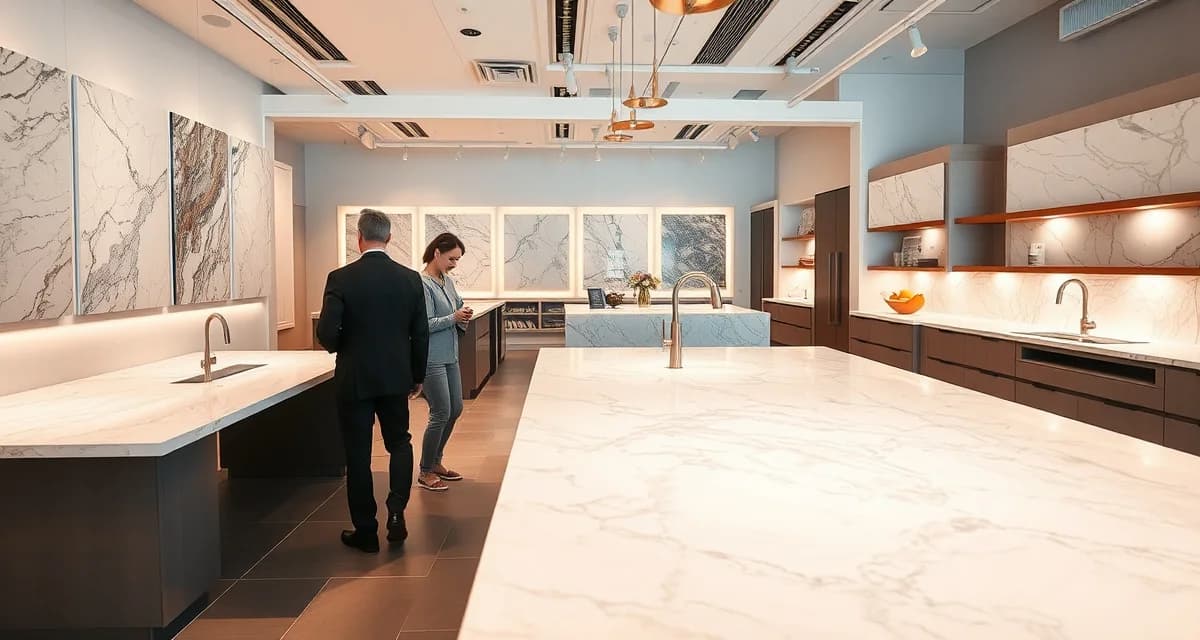
Build a Showroom That Sells
What Makes a Great Countertop Showroom?
A countertop showroom is where homeowners make their biggest material and design decisions. It is the physical space where they touch stone, compare colors, visualize their kitchen, and ultimately decide to sign a contract. A well-designed showroom does not just display materials - it guides customers toward a buying decision by removing doubt and building excitement.
TL;DR
- Showrooms convert 2-3x higher than phone or web-only quoting because customers can see and touch materials
- Lighting makes or breaks the experience - invest in a mix of natural and LED lighting that mimics kitchen environments
- Organize by material type, then by color family so customers can browse intuitively
- Full-slab displays outperform small samples for high-end materials like marble and quartzite
- Vignette displays (countertop + cabinet + backsplash combos) help customers visualize the finished result
- Your showroom should feel like a design studio, not a warehouse - clean, curated, and welcoming
- Technology in the showroom (digital quoting, project visualization) speeds up the sales process
Why Your Showroom Is Your Best Sales Tool
Most countertop purchases happen after a showroom visit. Homeowners spending $3,000-$15,000 want to see the actual material before committing. Photos on a website help, but nothing replaces running your hand across a Calacatta marble slab or seeing how quartzite catches the light.
Calculate your material waste savings
See exactly how much slab material and money you could save with optimized cutting layouts.
Try the free Waste Calculator| Showroom Metric | Impact |
|---|---|
| Walk-in to quote conversion | 50-70% (vs. 15-25% for web leads) |
| Average project value | 20-30% higher when customers visit |
| Decision timeline | Faster - often same-day commitment |
| Referral generation | Showroom visitors tell friends about the experience |
| Return rate | Lower - customers saw what they are getting |
A showroom that impresses costs money to build and maintain, but the return shows up in higher close rates, bigger projects, and fewer remakes.
Designing Your Showroom Layout
Flow and Customer Journey
Think of your showroom as a story with a beginning, middle, and end:
-
Entry/Welcome zone - First impressions. Clean, bright, and inviting. Display your best completed project photos and any awards or certifications.
-
Material exploration zone - Where customers browse. Organize materials logically so they can self-select before needing a salesperson.
-
Design consultation area - A table or counter where you sit with customers, pull out larger samples, and discuss their project. Comfortable seating, good lighting, and a surface where you can spread out drawings.
-
Decision/closing area - Where you present the quote. This can overlap with the consultation area, but should feel professional and private.
Space Planning Guidelines
| Showroom Size | Works For | Key Considerations |
|---|---|---|
| 200-500 sq ft | Small shop, limited selection | Focus on bestsellers and vignettes |
| 500-1,000 sq ft | Mid-size fabricator | Full material display + consultation area |
| 1,000-2,000 sq ft | Large operation | Multiple vignettes, slab gallery, design center |
| 2,000+ sq ft | High-volume or destination showroom | Full kitchen/bath displays, event space |
Even a 300-square-foot space can be effective if it is well-organized and well-lit. Do not try to display everything - curate your best-selling materials and show the rest through samples and digital tools.
Display Strategies That Sell
Full Slab Displays
Standing slabs are the most dramatic display method. When a customer walks into a room filled with full stone slabs, the effect is immediate and powerful.
Best practices for slab displays:
- Use A-frame racks rated for the weight (slabs are 800-1,200 lbs each)
- Group by material type first (granite, quartz, marble, quartzite), then by color family
- Keep your top 20-30 bestsellers in the showroom; rotate seasonal or slow-moving slabs
- Label each slab clearly: material name, origin, price range, availability
- Light slabs from above and the side to show veining and depth
Sample Displays
Not every material can be shown as a full slab. Samples fill the gap:
- Large format samples (12"x12" or larger) - Big enough to see pattern and color accurately
- Edge profile samples - Let customers feel different edge options on actual stone
- Remnant samples - Cut pieces from past projects that show realistic countertop scale
Sample display methods:
| Method | Best For | Cost |
|---|---|---|
| Vertical tower racks | Large sample collections | $500-$2,000 |
| Drawer systems | Organized browsing by color/material | $1,000-$3,000 |
| Wall-mounted panels | Space-efficient, visual impact | $500-$1,500 |
| Tabletop display | Small showrooms, consultation use | $200-$500 |
Vignette Displays
Vignettes are partial kitchen or bathroom setups that show how countertops look in context - paired with cabinets, backsplash, faucets, and lighting. They are the most powerful selling tool in any showroom.
Building effective vignettes:
- Create 2-4 complete vignettes showing different styles (modern white kitchen, transitional warm tones, bold statement island, bathroom vanity)
- Update vignettes annually to reflect current trends
- Use real cabinetry and actual plumbing fixtures, not mockups
- Install under-cabinet lighting that mimics real kitchen conditions
- Include both standard and premium materials so customers can see the difference
Digital Integration
Technology in the showroom speeds up decisions and impresses tech-savvy customers:
- Digital visualizer - Software that shows how different countertop materials look in a kitchen photo
- Large touchscreen or TV - Display your project gallery, Google reviews, and material catalogs
- Tablets for sales staff - Pull up real-time pricing, availability, and project timelines
- Digital quoting - Generate estimates on the spot using tools like SlabWise's Quick Quote, which produces accurate quotes in minutes rather than making the customer wait days
Lighting: The Detail That Changes Everything
Lighting is the single most underrated element in countertop showrooms. Poor lighting makes a $100/sq ft quartzite slab look like a $30/sq ft quartz. Good lighting reveals depth, veining, and sparkle.
Lighting Recommendations
| Lighting Type | Where to Use | Purpose |
|---|---|---|
| LED track lights (4000K-5000K) | Over slab displays | Highlight stone detail and color accurately |
| Under-cabinet LED strips | Vignette displays | Simulate real kitchen lighting |
| Natural light (skylights/windows) | General showroom | Most accurate color rendering |
| Accent spotlights | Feature slabs, new arrivals | Draw attention to premium materials |
| Adjustable dimmers | Throughout | Show materials in different light conditions |
Key principles:
- Color rendering index (CRI) of 90+ is essential - cheap lights distort stone colors
- Mix warm (3000K) and neutral (4000K) zones so customers see how materials look in different rooms
- Avoid fluorescent lighting entirely - it flattens depth and shifts colors
- Position lights to minimize glare on polished surfaces
Creating the Customer Experience
First Impressions
A customer forms their opinion of your business within 7 seconds of walking through the door. Control those seconds:
- Clean and organized - No dust on samples, no cluttered desks visible, no random tools lying around
- Greeted promptly - Someone acknowledges them within 30 seconds, even if it is just "We will be right with you"
- Comfortable temperature - Many showrooms are attached to fabrication shops. The showroom should not feel like the shop floor.
- Pleasant scent - Neutral and clean. No stone dust, no chemicals.
The Sales Conversation Flow
Train your showroom staff on a consistent process:
- Welcome and discover (5 min) - "What brings you in today? Tell me about your project."
- Educate on materials (10-15 min) - Walk through relevant material types based on their needs and budget
- Narrow choices (10 min) - Help them select 2-3 finalists
- Address logistics (5 min) - Timeline, template process, edge profiles, installation details
- Present pricing (5 min) - Use a quoting tool to provide an on-the-spot estimate
- Close or schedule follow-up - "Would you like to move forward today, or would you like to take a sample home to see it in your kitchen?"
Amenities That Matter
Small touches signal professionalism:
- Complimentary water, coffee, or tea
- A kid-friendly corner (parents cannot focus when kids are bored)
- Comfortable seating at consultation areas
- Restrooms accessible without walking through the shop
- Wifi (customers will text photos to their spouse for input)
- Take-home sample bags and branded material cards
Managing Your Showroom Inventory
What to Stock
Focus on your top sellers and a representative range:
- Full slabs: Your 10-20 most popular colors across materials
- Large samples: 50-100 options covering your full catalog
- Edge profiles: Complete set of available options on actual stone
- Sink cutouts: Models of common sink types (undermount, farmhouse)
- Backsplash options: If you offer backsplash, display the pairings
Rotation Strategy
Stale showrooms lose their appeal for repeat visitors (contractors, designers) and staff:
- Rotate 3-5 full slabs per quarter
- Add new colors as suppliers release them
- Feature trending materials prominently (right now: veined quartz, quartzite, porcelain large-format)
- Remove discontinued or poor-selling materials promptly
Showroom Marketing
Drive Traffic to Your Showroom
Having a great showroom does not help if nobody knows about it:
- Google Business Profile - Upload 50+ showroom photos and post weekly updates
- Social media - Behind-the-scenes content, new slab arrivals, customer showroom visits
- Website - Dedicated "Visit Our Showroom" page with hours, photos, directions, and what to expect
- Open house events - Quarterly events with food, design consultations, and special offers
- Partner referrals - Give contractors and designers a reason to send clients to your showroom
Hosting Events
Showroom events generate foot traffic and build community relationships:
| Event Type | Frequency | Purpose |
|---|---|---|
| Open house | Quarterly | General public awareness |
| Design night | Monthly | Partner with a designer for a mini-seminar |
| Contractor breakfast | Monthly | Feed your trade partners, strengthen relationships |
| New material launch | As needed | Generate excitement around new slabs |
| Kitchen design workshop | Quarterly | Educational event for homeowners |
FAQ
How much does it cost to build a countertop showroom?
A basic showroom upgrade (lighting, display racks, samples) can start at $5,000-$10,000. A full build-out with vignettes, slab displays, and a dedicated consultation area typically runs $25,000-$75,000 depending on size and finish level.
How big does my showroom need to be?
Even 200-300 square feet works if well-designed. Focus on quality over quantity. A small, well-lit space with curated displays and 2-3 vignettes outperforms a large, cluttered warehouse.
Should I display pricing in my showroom?
Display price ranges by material category, not individual slab prices. This helps customers self-select within their budget without sticker shock. Use your quoting system for specific project pricing during the consultation.
How often should I update my showroom displays?
Rotate slab inventory quarterly. Update vignettes annually or when major trends shift. Refresh smaller elements (photos, signage, brochures) monthly.
Do I need a dedicated showroom person?
If your showroom is open during business hours, yes. Walk-in customers expect immediate attention. If staffing is tight, at minimum have a bell or sensor that alerts someone when a visitor enters.
How do I get contractors to visit my showroom?
Host monthly contractor breakfasts, offer priority scheduling for their clients, and make your showroom a place where they can bring homeowners to make selections confidently. A showroom that makes the contractor look good keeps them coming back.
Should my showroom be separate from my fabrication shop?
Ideally, yes. A clean, quiet showroom environment is very different from a working shop floor. If full separation is not possible, create a clear visual and acoustic barrier. Customers should not hear saws while choosing their marble.
How do I track showroom visit effectiveness?
Ask every walk-in how they found you. Track visits in your CRM. Monitor walk-in-to-quote and walk-in-to-close conversion rates monthly. Compare these to web and phone lead conversion rates.
What technology should I have in my showroom?
At minimum: a large TV or screen for project galleries and reviews, a tablet or laptop for quoting, and good internet connectivity. Nice-to-have: a countertop visualizer tool and a digital slab inventory browser.
Can a virtual showroom replace a physical one?
Virtual showroom tools are useful supplements - especially for reaching customers who live farther away - but they do not replace the in-person experience for a product people want to touch and see in person. Use virtual tools to pre-qualify and narrow choices before the showroom visit.
Make Your Showroom Work Harder
Your showroom is where quotes turn into contracts. A well-designed space with the right displays, lighting, and customer experience can transform your close rate and average project value.
Start your 14-day free trial of SlabWise to pair your showroom experience with on-the-spot Quick Quote estimates and a Customer Portal that keeps projects organized from first visit through installation.
Try These Free Tools
- Cost Calculator -- Get instant countertop cost estimates by material, edge profile, and square footage.
- Compare Materials -- Side-by-side material comparison with pricing, durability, and maintenance ratings.
- Edge Profile Selector -- Browse edge profiles with cost impact and visual previews.
Sources & Further Reading
-
Natural Stone Institute - Digital Tools and Technology in Stone Fabrication
-
International Surface Fabricators Association - Quoting Best Practices and Technology
-
National Kitchen & Bath Association - Technology Integration in Kitchen Design
-
Remodeling Magazine - Digital Transformation in Countertop Industry