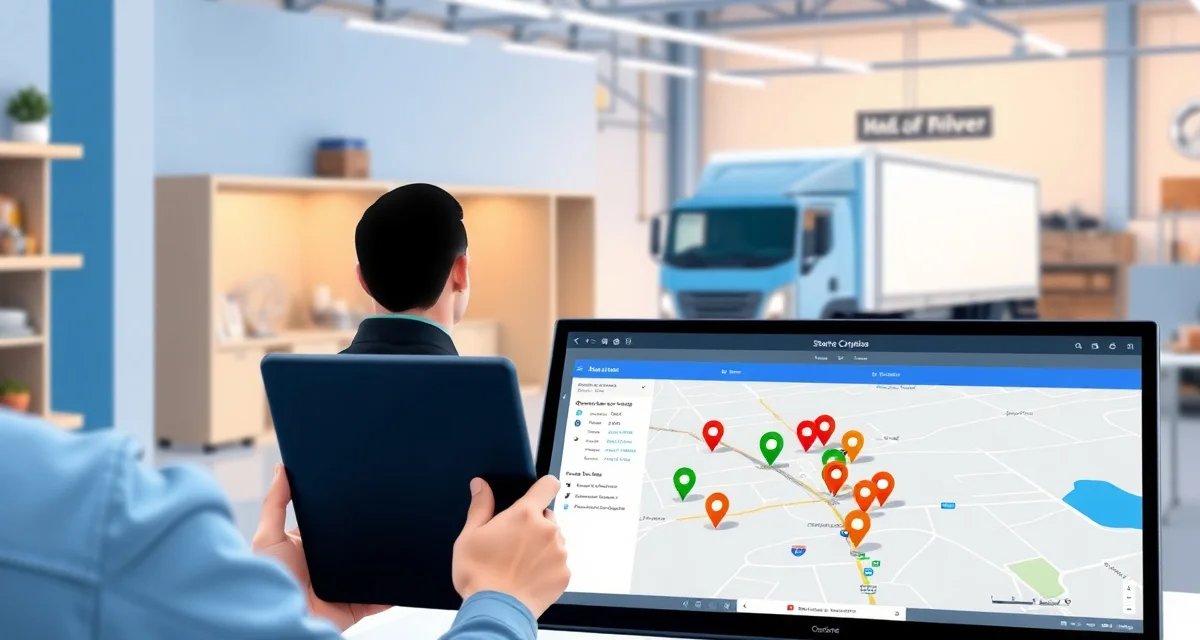
GPS Tracking for Countertop Fabrication Crews
GPS tracking for fabrication crews means equipping your template, delivery, and installation vehicles with real-time location devices so you know where every crew is, how long they spend at each job site, and when they will arrive at the next stop. For countertop fabrication shops running 2-10 vehicles, GPS tracking typically reduces fuel costs by 15-20% and eliminates the constant "where's my installer?" calls from customers.
TL;DR
- GPS tracking costs $15-$40 per vehicle per month and pays for itself within 30 days
- Shops with GPS report 15-20% fuel savings from reduced idle time and better routing
- Real-time crew location cuts customer status calls by 60-70%
- Average fabrication shop with 4 vehicles saves $800-$1,600/month after GPS implementation
- Time-on-site tracking reveals actual job durations vs. estimates with 95% accuracy
- Unauthorized vehicle use drops to near zero once crews know tracking is active
- Insurance companies offer 5-15% fleet discounts for GPS-equipped vehicles
Why Fabrication Shops Need GPS Tracking
Countertop fabrication shops are not typical delivery businesses. Your vehicles carry $5,000-$30,000 worth of finished stone on every trip. Your crews visit 2-6 customer homes per day. And every customer who has taken a day off work to wait for their installer expects you to show up on time.
Calculate your material waste savings
See exactly how much slab material and money you could save with optimized cutting layouts.
Try the free Waste CalculatorWithout GPS tracking, here is what happens in a typical week:
- Your office fields 40-60 calls from customers asking "when will the crew arrive?"
- You call crews 10-15 times per day to check their status
- At least one crew takes an extended lunch or personal detour you never know about
- Route inefficiencies burn an extra 20-30 gallons of fuel per week
- When a customer complains about a late arrival, you have no data to verify or dispute the claim
The Financial Case for GPS Tracking
| Cost/Benefit | 3-Vehicle Shop | 6-Vehicle Shop | 10-Vehicle Shop |
|---|---|---|---|
| Monthly GPS cost | $75-$120 | $150-$240 | $250-$400 |
| Fuel savings (15-20%) | $300-$500 | $600-$1,000 | $1,000-$1,700 |
| Reduced unauthorized use | $100-$300 | $200-$600 | $400-$1,000 |
| Insurance discount (10%) | $50-$100 | $100-$200 | $175-$350 |
| Office time saved (fewer calls) | $200-$400 | $400-$800 | $700-$1,400 |
| Net monthly savings | $575-$1,180 | $1,150-$2,360 | $2,025-$4,050 |
Types of GPS Tracking Systems
Hardware Options
| System Type | Cost | Install | Best For |
|---|---|---|---|
| OBD-II plug-in | $20-$35/device + $15-$25/mo | Self-install, 30 seconds | Small shops, quick setup |
| Hardwired unit | $80-$200/device + $20-$35/mo | Professional install, 1 hour | Tamper-proof, permanent tracking |
| Asset tracker (battery) | $30-$80/device + $10-$20/mo | Attach anywhere | Trailers, A-frame racks, toolboxes |
| Smartphone app | $0 device + $5-$15/mo | Download app | Budget option, less reliable |
Recommendation for most fab shops: OBD-II plug-in trackers for install and template vehicles (easy to move between vehicles), plus a battery-powered asset tracker on each trailer or A-frame rack.
Top GPS Platforms for Small Fleets
| Platform | Monthly/Vehicle | Key Features | Contract |
|---|---|---|---|
| Verizon Connect | $25-$40 | Full fleet suite, driver scoring | 3-year typical |
| Samsara | $27-$33 | AI dashcam option, ELD compliance | 3-5 year |
| GPS Trackit | $20-$30 | No long-term contract, simple interface | Month-to-month |
| Azuga (Bridgestone) | $20-$30 | Driver rewards, insurance integration | 1-year minimum |
| Linxup | $18-$24 | Budget-friendly, basic tracking | Month-to-month |
| Bouncie | $8/mo (OBD-II) | Cheapest option, basic features | Month-to-month |
For fabrication shops with under 10 vehicles, GPS Trackit or Linxup offer the best balance of features and flexibility without long-term contracts. If you want dashcam integration (helpful for documenting property damage claims), look at Samsara.
Key Features for Fabrication Shops
Real-Time Location and ETA
The most immediate value. When a customer calls asking "where's my installer?", your office staff pulls up the map and gives an accurate ETA based on actual location and traffic---instead of calling the crew, waiting for a callback, and relaying the information.
With SlabWise's customer portal, you can take this further: customers see their crew's location and ETA on a map automatically, similar to tracking a rideshare or food delivery. Shops using this feature report a 70% reduction in inbound status calls.
Geofencing
Set virtual boundaries around your shop, customer addresses, and material suppliers. Geofences trigger automatic events:
- Shop geofence: Log when crews leave in the morning and return at day's end
- Job site geofence: Automatically record arrival and departure times for each install
- Supplier geofence: Track time spent picking up materials
This data feeds directly into job costing. If your estimate assumes 2.5 hours on-site for a kitchen install and geofencing shows your crew averaging 3.5 hours, you know your labor estimates need adjustment.
Idle Time Monitoring
Excessive idling wastes fuel and engine life. A truck idling for 1 hour burns approximately 0.5-1.0 gallons of fuel. If your 4-truck fleet averages 2 hours of unnecessary idling per day per vehicle, that is $200-$400/month in wasted diesel or gas.
GPS systems flag excessive idle time and let you address it with specific crews. Most shops see idle time drop 40-60% within the first month of tracking simply because crews know the data is being recorded.
Speed and Safety Monitoring
Your install crew is hauling thousands of dollars of finished stone through residential neighborhoods. Speeding increases slab damage risk, accident liability, and fuel consumption.
Set speed alerts for:
- Over 70 mph on highways
- Over 35 mph in residential zones
- Hard braking events (potential slab damage)
- Rapid acceleration
Implementing GPS Tracking Without Crew Pushback
The biggest obstacle to GPS tracking is not technology---it is crew resistance. Installers and templaters often view tracking as surveillance, not a tool.
How to Introduce GPS Tracking
Frame it around customer service, not monitoring. Explain that GPS helps the office give customers accurate arrival times, which means fewer angry customers when crews show up. Nobody wants to walk into a job site with an upset homeowner.
Lead with the benefits to crews:
- Fewer interrupting phone calls from the office asking "where are you?"
- Accurate mileage records for reimbursement
- Documented proof of on-time arrivals (protection against false complaints)
- Optimized routes mean less time in traffic, earlier finishes
Be transparent: Tell crews exactly what is being tracked and what is not. Most systems track vehicle location, speed, and idle time during work hours. They do not record conversations, track personal vehicles, or monitor after-hours activity (if vehicles go home with crews, set tracking hours).
Use a 30-day adjustment period. Track data for the first month without taking any disciplinary action. This lets crews adjust behavior naturally and builds trust in the system.
Integrating GPS Data with Shop Management
GPS tracking becomes significantly more valuable when it feeds into your overall shop management workflow rather than living in a separate app.
Data Flow: GPS to Job Management
| GPS Data Point | Business Use | Impact |
|---|---|---|
| Crew arrival at job site | Auto-update job status to "install in progress" | Real-time dashboard accuracy |
| Crew departure from job site | Auto-update job status to "install complete" | Triggers final payment request |
| Time on site | Actual labor cost per job | Job costing accuracy |
| Drive time between jobs | Route optimization feedback | Schedule tighter or looser |
| Morning departure from shop | First-job ETA calculation | Customer notification trigger |
SlabWise pulls GPS data into your job dashboard so you see every active crew's location, current job, and next-job ETA on a single screen. When a crew arrives at a site, the job status updates automatically. When they leave, the system can trigger a completion notification and final payment request to the customer.
FAQ
How much does GPS tracking cost for a small fabrication fleet?
For a 3-5 vehicle fleet, expect $60-$175/month total depending on the platform and features. OBD-II plug-in devices like Bouncie start at $8/vehicle/month for basic tracking. Full-featured platforms like Verizon Connect or Samsara run $25-$40/vehicle/month but include dashcams, driver scoring, and maintenance alerts.
Will GPS tracking work on my install trailer?
Yes, but you need a battery-powered asset tracker rather than an OBD-II device (trailers do not have OBD ports). Battery-powered trackers like those from Samsara or GPS Trackit last 3-5 years on a single charge and update location every 1-15 minutes. They cost $30-$80 for the device plus $10-$20/month.
Can customers track their installer in real time?
With the right integration, yes. SlabWise's customer portal can display crew location and ETA to the homeowner, similar to tracking a delivery. This requires your GPS platform to have an API that connects to your shop management system. Standalone GPS apps typically do not offer customer-facing tracking.
Is it legal to GPS-track employee vehicles?
In most US states, employers can track company-owned vehicles without employee consent during work hours. However, if employees take vehicles home, many states require notification that tracking is active. Several states (California, Connecticut, others) have specific employee tracking notification laws. Always inform employees in writing and include GPS tracking in your fleet policy.
How much fuel can I actually save with GPS tracking?
Most fabrication shops see 15-20% fuel savings within the first 90 days. For a shop spending $2,000/month on fuel across 4 vehicles, that is $300-$400/month. Savings come from reduced idle time (40-60% reduction), shorter routes, and less unauthorized personal use. The fuel savings alone typically cover the GPS subscription cost.
Does GPS tracking affect my insurance rates?
Many commercial auto insurers offer 5-15% discounts for GPS-equipped fleets because tracking reduces theft, speeds recovery of stolen vehicles, and correlates with safer driving behavior. Contact your insurer and ask about telematics discounts. Some insurers partner directly with GPS providers for automatic data sharing.
How do I handle employees who object to being tracked?
Address concerns openly. Explain the business reasons (customer service, routing, liability protection) and the crew benefits (fewer interrupting calls, mileage documentation, false-complaint protection). Set clear tracking hours so personal time is private. If an employee refuses after a reasonable explanation, that is a management decision---but most resistance fades within 2-4 weeks once crews experience fewer angry customers and shorter routes.
What happens if the GPS device loses signal?
Modern GPS trackers store location data locally when they lose cellular signal (in tunnels, parking garages, or rural areas) and upload it once signal returns. You may see a brief gap in real-time tracking, but the historical record remains complete. Most devices check in every 30-90 seconds when signal is available.
See Every Crew on One Dashboard
SlabWise shows you every template, install, and delivery crew on a live map---with job status, ETA to next stop, and automatic customer notifications. No more calling crews to check their location.
Start Your 14-Day Free Trial →
Give your customers real-time install tracking and free up your office from constant "where's my installer?" calls.
Try These Free Tools
- Photo to Template -- Snap a photo of an existing countertop and get an AI-generated DXF template.
- Template Compare -- Upload two templates and see every dimension change highlighted instantly.
- AI Template Verification -- Cross-check your template against manufacturer specs before cutting.