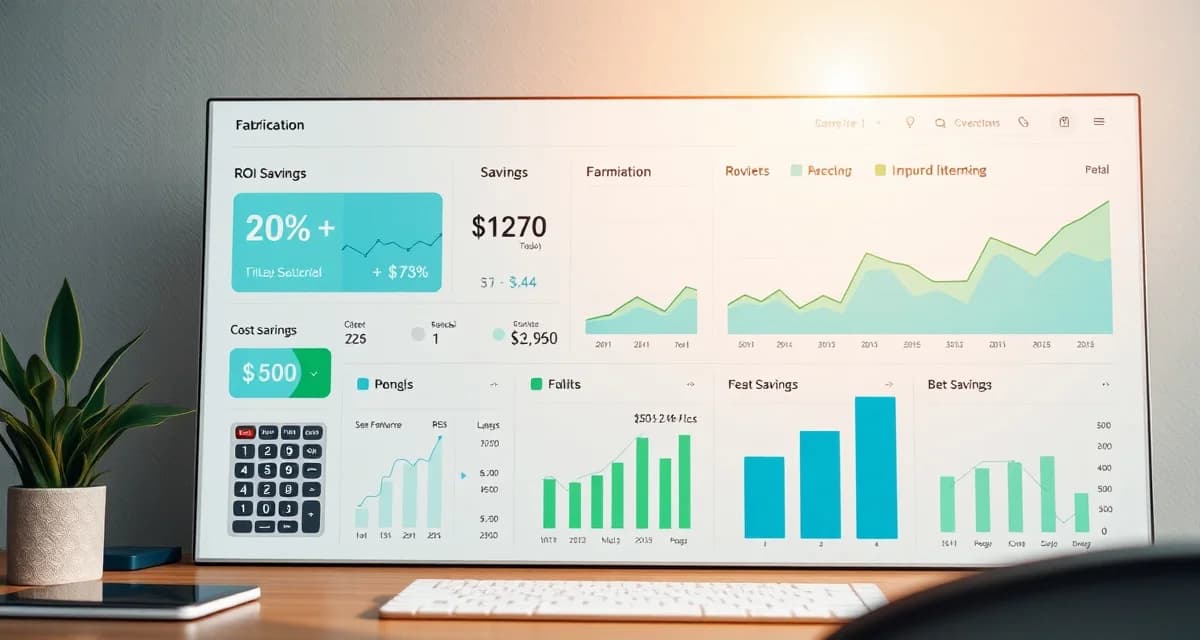
Calculating ROI on Fabrication Software
Fabrication software costs $150-$400 per month. That is $1,800-$4,800 per year. The question isn't whether you can afford it -- it is whether the savings exceed that cost. For the vast majority of countertop fabrication shops doing 10+ kitchens per month, the answer is yes by a factor of 5:1 to 20:1. Here is exactly how to calculate it for your shop.
TL;DR: Fabrication Software ROI
- Average annual software cost: $2,400-$4,200 ($200-$350/month)
- Average annual savings: $36,000-$96,000 ($3,000-$8,000/month)
- Typical ROI: 8:1 to 20:1
- Payback period: Usually within the first month
- Biggest savings areas: Material waste reduction, fewer remakes, faster quoting, fewer customer calls
- Often-missed savings: Reduced overtime, lower insurance premiums, better close rates
The Four Major Savings Categories
1. Material Waste Reduction
This is usually the single largest dollar savings from fabrication software.
Calculate your material waste savings
See exactly how much slab material and money you could save with optimized cutting layouts.
Try the free Waste CalculatorThe math:
- Average US fabrication shop waste rate (manual nesting): 18-25%
- Average waste rate with AI nesting software: 8-15%
- Improvement: 5-15 percentage points
Example for a mid-size shop:
| Factor | Your Numbers |
|---|---|
| Monthly slab purchases | $30,000 |
| Current waste rate | 22% |
| Waste with AI nesting | 12% |
| Waste reduction | 10% |
| Monthly material savings | $3,000 |
| Annual material savings | $36,000 |
Even conservative estimates -- $20,000/month in slab purchases with a 7% waste improvement -- produce $1,400/month in savings. That alone exceeds the software subscription cost.
SlabWise's AI nesting algorithms typically reduce waste by 10-15% compared to manual layout. On a $30,000/month slab budget, that is $3,000-$4,500 in material savings every month.
2. Remake Reduction
Remakes are the silent profit killer in fabrication. Each remake costs the shop $1,500-$4,000 in material, labor, and rescheduling -- and that doesn't count the customer relationship damage.
The math:
| Factor | Manual Process | With Software |
|---|---|---|
| Monthly jobs | 30 | 30 |
| Remake rate | 6% (1.8 remakes/month) | 2% (0.6 remakes/month) |
| Remakes prevented | -- | 1.2 per month |
| Cost per remake | $2,500 average | $2,500 average |
| Monthly savings | -- | $3,000 |
| Annual savings | -- | $36,000 |
Template verification software catches measurement errors, DXF file issues, and dimensional inconsistencies before the slab is cut. SlabWise's 3-layer verification checks geometry, dimensions, and fabrication completeness, catching errors that human review misses -- especially under production pressure.
3. Quoting Speed and Close Rate
Faster quotes win more jobs. When a homeowner or contractor requests quotes from three fabricators, the first accurate response often gets the job.
The math:
| Factor | Manual Quoting | Software-Assisted |
|---|---|---|
| Time per quote | 20 minutes | 3 minutes |
| Quotes per month | 40 | 40 |
| Total quoting hours | 13.3 hours | 2 hours |
| Hours saved | -- | 11.3 hours |
| Labor rate | $25/hour | $25/hour |
| Monthly labor savings | -- | $283 |
But the bigger number is close rate improvement. Shops that respond within an hour close 30-50% more quotes than shops that take 24+ hours:
| Factor | Slow Response | Fast Response |
|---|---|---|
| Monthly quote requests | 40 | 40 |
| Close rate | 25% | 35% |
| Jobs won | 10 | 14 |
| Average job revenue | $3,500 | $3,500 |
| Additional monthly revenue | -- | $14,000 |
Even at 50% profit margin, that is $7,000/month in additional gross profit from faster quoting alone.
4. Customer Communication Efficiency
Status calls consume staff time that could be spent on revenue-generating activities.
The math:
| Factor | Without Portal | With Customer Portal |
|---|---|---|
| Calls per active job | 8-15 | 2-4 |
| Active jobs per month | 30 | 30 |
| Total monthly calls | 300-450 | 60-120 |
| Average call duration | 5 minutes | 5 minutes |
| Total call hours | 25-37.5 hours | 5-10 hours |
| Hours saved | -- | 20-27.5 hours |
| Labor rate | $20/hour | $20/hour |
| Monthly savings | -- | $400-$550 |
SlabWise's Customer Portal reduces status calls by up to 70% by giving customers real-time visibility into their project. When a homeowner can see their countertops are scheduled for installation on Thursday, they don't need to call on Monday, Tuesday, and Wednesday to ask.
Complete ROI Calculation
Putting all four categories together for a mid-size shop (25-30 kitchens/month):
| Savings Category | Monthly Savings | Annual Savings |
|---|---|---|
| Material waste reduction | $3,000 | $36,000 |
| Remake reduction | $3,000 | $36,000 |
| Quoting efficiency | $283 | $3,400 |
| Customer communication | $475 | $5,700 |
| Total savings | $6,758 | $81,100 |
| Software cost | ($299) | ($3,588) |
| Net annual benefit | $6,459/month | $77,512 |
| ROI | 21.6:1 |
Even cutting these estimates in half produces a 10:1 ROI. Even cutting them by 75% still yields a 5:1 return.
Often-Overlooked Savings
Reduced Overtime
When production is better scheduled and fewer remakes disrupt the calendar, overtime hours drop. A shop averaging 10 hours of overtime per week at time-and-a-half saves $15,000-$25,000 annually by reducing overtime by 50%.
Lower Insurance Premiums
Some business insurance providers offer reduced premiums for shops using documented quality control processes. Digital documentation of templates, approvals, and installation photos provides evidence of systematic quality management.
Fewer Legal Disputes
When a customer claims the countertop was installed incorrectly, documented templates, material selections, signed approvals, and timestamped installation photos provide evidence. Without documentation, these disputes often result in free remakes to preserve the relationship.
Better Slab Purchasing Decisions
Inventory tracking reveals which slab types sit in your yard for months versus which sell within days. This data helps you buy more of what sells and less of what doesn't, improving cash flow and reducing dead inventory.
ROI Timeline: When Does It Pay Back?
| Shop Size | Monthly Software Cost | Monthly Savings | Payback Period |
|---|---|---|---|
| Small (10 kitchens/mo) | $199 | $2,000-$4,000 | Month 1 |
| Medium (25 kitchens/mo) | $299 | $5,000-$8,000 | Month 1 |
| Large (50+ kitchens/mo) | $349 | $8,000-$15,000 | Month 1 |
In virtually every scenario, the software pays for itself within the first month of operation. The question is not "can I afford this?" but "can I afford to keep losing this money every month without it?"
How to Measure ROI After Implementation
Track these metrics monthly before and after implementing software:
| Metric | How to Measure | What to Expect |
|---|---|---|
| Slab waste % | Material cost vs. material used per job | 5-15 point improvement |
| Remake rate | Remakes / total jobs | 50-70% reduction |
| Quote response time | Time from request to quote delivery | 80-85% faster |
| Customer calls per job | Total status calls / active jobs | 60-70% reduction |
| Average job profitability | Revenue minus all costs per job | 10-25% improvement |
FAQ
What is the typical ROI of fabrication software?
Most shops report 8:1 to 20:1 ROI, meaning every dollar spent on software returns $8-$20 in savings. The primary savings come from material waste reduction and fewer remakes.
How quickly does fabrication software pay for itself?
Almost always within the first month. Even modest waste reduction or one prevented remake in the first month exceeds the software subscription cost.
Which savings category is biggest?
Material waste reduction and remake prevention are typically tied as the largest savings categories, each producing $2,000-$4,000/month for mid-size shops.
Can I calculate ROI before buying?
Yes. Track your current waste rate, remake rate, quoting time, and customer call volume for one month. Apply the improvement percentages from this guide to estimate your specific savings.
Does shop size affect ROI?
Larger shops see larger absolute dollar savings because they buy more material and run more jobs. Smaller shops see higher percentage improvements because they are typically starting from less efficient manual processes.
What if I already have low waste rates?
If your waste rate is already below 12%, nesting software provides less material savings. But quoting, template verification, and customer portal features still deliver strong ROI from other categories.
Is the ROI different for different materials?
Yes. Shops working with expensive exotic stones ($150-$300/sq ft) see higher material savings from better nesting than shops working primarily with Level 1 granite ($40-$60/sq ft). The percentage improvement is similar, but the dollar amount is proportionally larger.
How do I convince my business partner that software is worth the cost?
Show them this calculation with your shop's actual numbers: monthly slab purchases x waste improvement percentage = material savings. Compare that single number to the monthly subscription cost.
See Your ROI in 14 Days
Start a free SlabWise trial and measure the improvement yourself. Run your nesting, verify your templates, and generate quotes with your real data. Most shops see measurable results within the first week. Visit slabwise.com to start.
Try These Free Tools
- Photo to Template -- Snap a photo of an existing countertop and get an AI-generated DXF template.
- Template Compare -- Upload two templates and see every dimension change highlighted instantly.
- AI Template Verification -- Cross-check your template against manufacturer specs before cutting.
Sources & Further Reading
-
Natural Stone Institute - ADA Compliance Guidelines for Natural Stone Installations
-
National Kitchen & Bath Association - Universal Design and ADA Standards for Kitchen Countertops
-
ASTM International - Standard Practice for Accessible Counter and Work Surface Design