SPEEDlabel Review 2026: Pricing, Features, Pros & Cons
Quick Definition
A thorough speedlabel review helps fabricators make informed decisions.
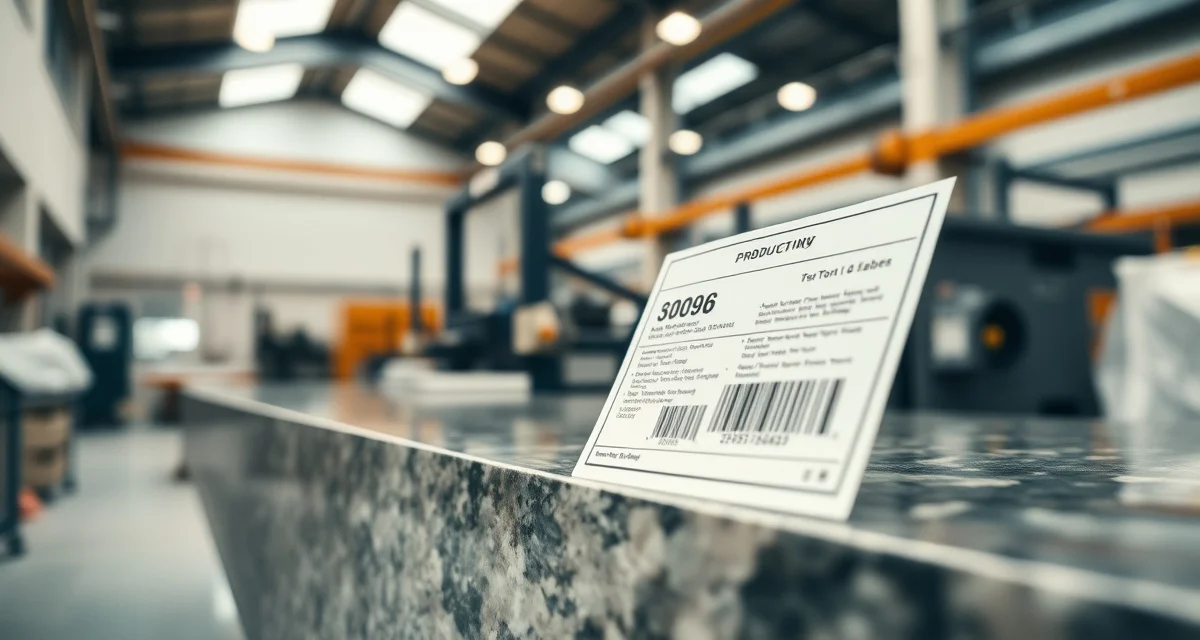
SPEEDlabel is a production labeling and identification system designed for stone fabrication shops that need to track individual pieces through cutting, finishing, and installation. The system generates printed labels with job details, piece identification, edge profiles, and special instructions that travel with each countertop piece on the shop floor. SPEEDlabel helps reduce misidentification errors that cause costly remakes and installation delays.
TL;DR
- Pricing: Approximately $100-$250/month plus label supply costs
- Best for: High-volume shops that need better piece identification and tracking on the production floor
- Biggest strength: Reduces production floor confusion and piece misidentification errors
- Biggest weakness: Single-purpose tool that doesn't manage jobs, quotes, slabs, or customer communication
- Learning curve: Low to moderate; label design and setup takes about 1 week
- Support: Phone and email support during business hours
- Verdict: Effective at solving the specific problem of production floor piece tracking, but adds another point solution to your software stack
What Is SPEEDlabel?
Every fabrication shop has dealt with this scenario: a finished countertop piece ends up on the wrong install truck, or a sink cutout gets applied to the wrong section, or pieces from two different jobs get mixed up on the production floor. These mix-ups lead to remakes ($1,500-$4,000 each), delayed installations, and unhappy customers.
Calculate your material waste savings
See exactly how much slab material and money you could save with optimized cutting layouts.
Try the free Waste CalculatorSPEEDlabel attacks this problem directly by generating detailed identification labels that attach to each piece from the moment it's programmed for cutting through final installation. Each label carries job information, piece identification, edge profiles, special instructions, and routing details.
The concept is simple: if every piece is clearly labeled with everything the production team needs to know, fewer mistakes happen. And in practice, shops using systematic labeling report 30-50% fewer misidentification errors on the production floor.
What SPEEDlabel is not: a full fabrication management platform. It doesn't quote, schedule, manage slabs, communicate with customers, or track jobs through your pipeline. It generates labels. That's its entire purpose.
SPEEDlabel Features Breakdown
Label Generation and Design
SPEEDlabel's core functionality revolves around creating production labels that carry the right information in a format your team can quickly read and act on.
| Feature | SPEEDlabel | Typical Manual Labeling |
|---|---|---|
| Label creation time | Automatic from job data | 2-5 min per piece manual |
| Information included | Job #, piece ID, edge, dimensions, notes | Whatever someone writes |
| Barcode/QR support | Yes | No |
| Waterproof labels | Yes (with proper supplies) | Rarely |
| Error rate reduction | 30-50% fewer mix-ups | Baseline |
| Label templates | 15+ configurable | N/A |
| Batch printing | Yes | N/A |
The label designer lets you configure exactly what information appears on each label and how it's laid out. Standard label content typically includes:
- Job number and customer name
- Piece identification (e.g., "Kitchen Island - Piece 2 of 3")
- Material type and color
- Edge profile specifications
- Sink cutout details
- Special fabrication notes
- Barcode or QR code for scanning
- Installation location reference
Barcode and QR Code Integration
This is where SPEEDlabel adds value beyond simple printed labels. Each piece gets a scannable code that links back to its job record, enabling:
- Quick piece lookup by scanning rather than reading
- Production floor tracking (scan when entering each production stage)
- Installation truck loading verification
- Delivery confirmation scanning
- Error checking (scan to verify the right piece is going to the right job)
The scanning workflow is particularly useful during truck loading. Instead of visually matching piece labels to installation orders, loaders can scan each piece and get a confirmation or alert if something is headed to the wrong truck.
Template Library
SPEEDlabel includes pre-built label templates for different use cases:
- Production labels: Full details for the fabrication team
- Installation labels: Customer-facing details for the install crew
- Remnant labels: Size, material, and quality information for inventory
- Quality control labels: Pass/fail status and inspection notes
- Shipping labels: Delivery address and handling instructions
Each template is customizable, and you can create new templates from scratch for specialized workflows.
Data Import
SPEEDlabel can import job data from several sources to avoid double-entry:
- CSV file imports from other software
- Manual job entry interface
- Limited API connections (varies by version)
- Some CAD/CAM file integration for piece dimensions
The import capability reduces the overhead of maintaining a separate system, but the connections aren't always smooth. Most shops report spending some time each week cleaning up imported data or manually entering jobs that don't transfer cleanly.
SPEEDlabel Pricing
SPEEDlabel pricing includes the software subscription plus ongoing label supply costs:
| Component | Estimated Cost |
|---|---|
| Software subscription | $100-$250/month |
| Label printer (one-time) | $300-$800 |
| Label supplies (monthly) | $50-$150/month |
| Setup and training | $200-$500 (one-time) |
| Total first-year cost | $2,350-$5,900 |
| Ongoing annual cost | $1,800-$4,800 |
The total cost of ownership is higher than the subscription alone because of the label supplies and printer hardware. At 50-200 pieces per week, label supply costs add up.
ROI Calculation
The ROI case rests on error reduction. Consider a shop that experiences 3 misidentification-related remakes per month:
- Monthly remake cost: 3 remakes x $2,000 average = $6,000
- SPEEDlabel monthly cost: ~$200 software + ~$100 supplies = $300
- If SPEEDlabel prevents 50% of mix-ups: $3,000 saved per month
- Net monthly benefit: $2,700
For high-volume shops with frequent mix-up errors, the ROI is strong. For shops that already have low error rates or process fewer than 20 jobs per month, the numbers are harder to justify.
SPEEDlabel Pros
Directly reduces production errors. The core value proposition is proven. Clear, consistent labeling reduces piece misidentification, wrong-truck loading, and fabrication instruction errors by 30-50% according to user reports.
Quick implementation. Unlike full shop management platforms that take weeks to implement, SPEEDlabel can be operational in 3-5 days. Label templates can be configured quickly, and the learning curve is modest.
Barcode scanning adds speed. The QR and barcode capabilities are genuinely useful for truck loading verification and production floor tracking. Scanning is faster and more reliable than visual matching.
Durable labels. The recommended label materials are designed for the wet, dusty fabrication environment. Labels survive water saws, polishing stations, and handling through installation.
Low training requirement. Production floor workers adapt quickly to scanning and reading labels. The system doesn't require significant behavior change beyond adding a scan step to existing workflows.
SPEEDlabel Cons
Another point solution to manage. SPEEDlabel adds another piece of software to your stack without replacing anything. You still need separate tools for quoting, scheduling, slab management, and customer communication.
Ongoing supply costs. Label supplies are a recurring expense that often catches shops off guard. At $50-$150/month for supplies, the true cost is higher than the subscription alone.
Limited data integration. Getting job data into SPEEDlabel from your other systems often requires manual steps. The import options work but aren't fully automated for most setups.
Doesn't prevent the root causes. Labels catch errors at the production floor level, but they don't prevent template errors, quoting mistakes, or scheduling problems. A label can't fix a wrong measurement - it just makes sure the wrong measurement gets communicated clearly.
No AI-powered verification. SPEEDlabel doesn't analyze templates for errors or optimize material usage. It's a labeling tool, not an intelligent verification system. AI-based template verification (like SlabWise's 3-layer check) catches errors before they reach the production floor.
SPEEDlabel vs. Alternatives
| Capability | SPEEDlabel | SlabWise | Moraware | ActionFlow |
|---|---|---|---|---|
| Production labeling | Core feature | Included | Basic | Basic |
| Barcode/QR tracking | Advanced | Yes | Limited | Limited |
| Job management | No | Yes | Yes | Yes |
| Quoting | No | Yes (3 min) | Yes | Yes |
| AI template check | No | Yes (3-layer) | No | No |
| AI slab nesting | No | Yes (10-15% savings) | No | Limited |
| Customer portal | No | Yes | Yes | Limited |
| Scheduling | No | Yes | Yes | Yes |
| Price range | $100-$250/mo + supplies | $199-$349/mo | $200-$400/mo | $200-$350/mo |
The comparison highlights SPEEDlabel's fundamental trade-off: deep labeling capability versus broad operational coverage. Full platforms include labeling as one of many features, while SPEEDlabel does labeling better but nothing else.
Who Should Use SPEEDlabel?
Good fit:
- High-volume shops (50+ jobs/month) with documented misidentification problems
- Operations that already have a full management platform but need better floor-level piece tracking
- Shops with multiple production shifts where communication between shifts is a pain point
- Businesses where truck loading errors are a recurring problem
Not a good fit:
- Shops looking for their primary management software
- Small operations (under 20 jobs/month) where the error rate doesn't justify the cost
- Businesses that need help with quoting, scheduling, and customer communication first
- Shops that already have low error rates and good manual labeling processes
The Bottom Line
SPEEDlabel solves a real problem that costs fabrication shops thousands of dollars per month. If production floor confusion and piece misidentification are among your top operational headaches, SPEEDlabel is a targeted fix that works.
But the question for shops in 2026 is whether investing in another point solution is the right strategy. Modern platforms like SlabWise include production labeling alongside AI-powered template verification (which catches errors before they even reach the floor), slab nesting optimization, quoting, scheduling, and customer portals. The trend in fabrication technology is toward fewer, more capable platforms rather than a collection of single-purpose tools.
What does SPEEDlabel cost per month?
The software subscription runs approximately $100-$250 per month, but you should also budget $50-$150 per month for label supplies and factor in $300-$800 for label printer hardware upfront.
Can SPEEDlabel integrate with my existing shop software?
SPEEDlabel offers CSV import capabilities and limited API connections depending on the version. Integration quality varies by platform. Most shops use a combination of file imports and manual entry to feed job data into the system.
How much can SPEEDlabel reduce my remake costs?
Shops using systematic labeling report 30-50% fewer misidentification-related errors on the production floor. If your shop experiences 2-4 identification-related remakes per month at $1,500-$4,000 each, the savings can be significant.
Do the labels survive the fabrication environment?
Yes. The recommended label materials are designed for wet, dusty conditions common in stone fabrication. Labels withstand water saws, polishing, and handling through installation when printed on the proper materials with appropriate adhesive.
How long does it take to implement SPEEDlabel?
Most shops are operational within 3-5 days. This includes printer setup, label template configuration, and basic team training. The implementation is significantly faster than full shop management platforms.
Does SPEEDlabel work with CNC machines?
SPEEDlabel can import piece dimensions from some CAD/CAM files, but it doesn't directly interface with CNC programming software. The labels are generated alongside CNC programming rather than integrated into it.
Can SPEEDlabel track pieces through my entire workflow?
Yes, using the barcode/QR scanning feature. Each piece can be scanned at each production stage, during truck loading, and at delivery. This creates a tracking history that shows where each piece is and where it's been.
Is SPEEDlabel worth it for small shops?
For shops processing fewer than 20 jobs per month, the cost-benefit analysis is tighter. If your error rate is already low and your team manages piece identification manually without frequent problems, the investment may not be justified.
Does SPEEDlabel include any AI features?
No. SPEEDlabel is a labeling and identification tool without AI capabilities. It doesn't verify templates for errors, optimize slab nesting, or provide predictive analytics. For AI-powered error prevention, you'd need a platform like SlabWise.
Can I customize the label formats?
Yes. SPEEDlabel includes a label designer that lets you control layout, content fields, font sizes, and barcode placement. You can create multiple templates for different purposes (production, installation, remnant tracking, shipping).
Want Error Prevention That Starts Before the Production Floor?
SPEEDlabel catches errors at the labeling stage, but SlabWise catches them before cutting even begins. Our AI template verification runs a 3-layer check on every template, and our AI slab nesting saves 10-15% on material costs. Plus, you get quoting, scheduling, and a customer portal - all starting at $199/month.
Start your 14-day free trial - no credit card required.
Try These Free Tools
- Cost Calculator -- Get instant countertop cost estimates by material, edge profile, and square footage.
- Compare Materials -- Side-by-side material comparison with pricing, durability, and maintenance ratings.
- Edge Profile Selector -- Browse edge profiles with cost impact and visual previews.