Baca Robo SawJet Review 2026: Pricing, Features & Verdict
Quick Definition
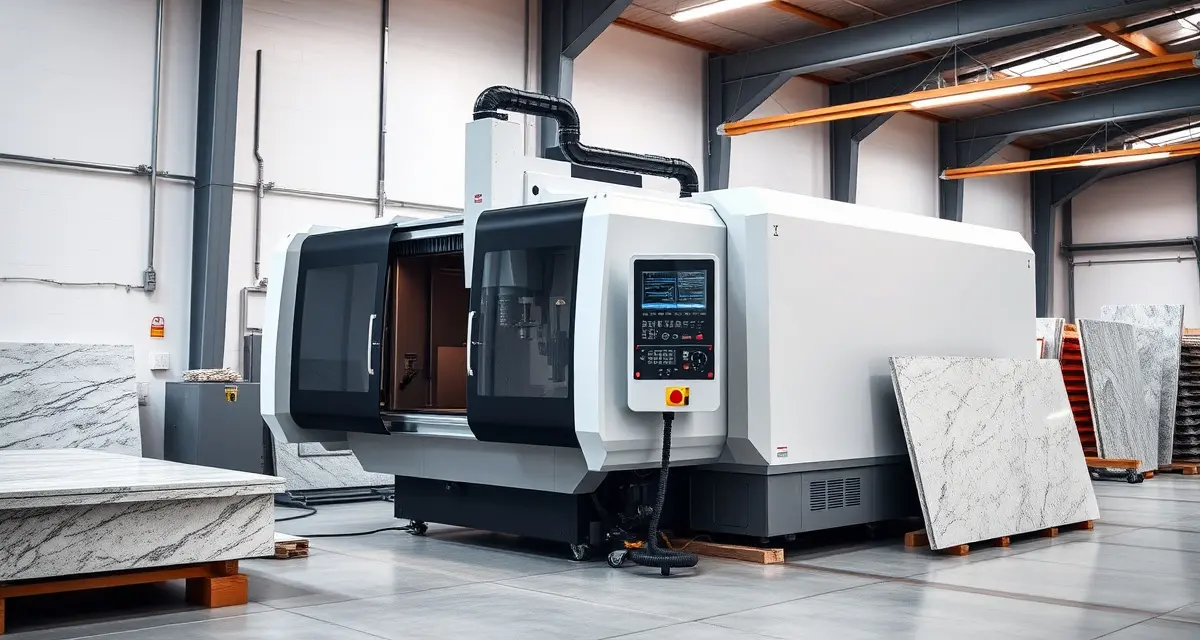
The Baca Robo SawJet is a combined CNC bridge saw and waterjet system manufactured by Baca Systems in the United States. Positioned as a value-oriented alternative to higher-priced European machines, the Robo SawJet offers combined saw and waterjet cutting for countertop fabrication at a price point approximately 20-40% below premium competitors. For shops looking to automate production without a $400,000+ equipment investment, Baca fills a practical gap in the market.
TL;DR
- Pricing: Approximately $200,000-$350,000 depending on configuration
- Best for: Mid-size fabrication shops wanting CNC automation at a lower capital cost
- Biggest strength: Lower entry price with saw and waterjet in one machine
- Biggest weakness: Simpler engineering means slightly lower precision and speed than premium machines
- Learning curve: Moderate; 2-3 weeks for operators with some CNC background
- Support: U.S.-based manufacturing and service
- Verdict: The best value proposition in the CNC sawjet market for shops that don't need premium-tier speed and precision
What Is the Baca Robo SawJet?
Baca Systems is a U.S.-based CNC manufacturer that entered the stone fabrication equipment market with a focus on affordability and practical automation. The Robo SawJet combines a bridge saw and waterjet in a single machine - the same concept as the Park Industries Titan or Breton Combicut, but at a lower price point.
Calculate your material waste savings
See exactly how much slab material and money you could save with optimized cutting layouts.
Try the free Waste CalculatorThe trade-off is straightforward: Baca machines sacrifice some of the precision, speed, and automation features found in higher-priced competitors in exchange for a significantly lower capital requirement. For many mid-size fabrication shops, that trade-off makes sense. A shop processing 25-40 slabs per week doesn't need a $500,000 Breton - it needs a reliable machine that combines saw and waterjet capability without breaking the budget.
Baca's manufacturing is U.S.-based, which provides the same domestic support advantages as Park Industries: faster service response, domestic parts inventory, and no international shipping delays for components.
Baca Robo SawJet Specifications
| Specification | Robo SawJet |
|---|---|
| Work area | Up to 134" x 76" |
| Saw motor | 15-20 HP |
| Waterjet pump | 60,000 PSI |
| Axes | 5-axis |
| Blade diameter | Up to 18" |
| Tool changer | Automatic (6-8 positions) |
| Control system | Baca proprietary |
| Positioning accuracy | +/- 0.008" |
| Floor space | Approximately 24' x 14' |
| Weight | 12,000-16,000 lbs |
| Power requirement | 480V 3-phase |
Comparing specifications to the Park Industries Titan: the Robo SawJet has a slightly smaller work area, lower-powered saw motor, fewer tool changer positions, and looser positioning accuracy (+/- 0.008" vs +/- 0.006"). For standard residential countertop fabrication, these differences rarely affect the finished product. For high-precision commercial work or tight-tolerance architectural stone, the gap becomes more relevant.
Key Features
Combined Saw and Waterjet at Lower Cost
The fundamental value proposition is getting both cutting technologies in one machine at a lower price. The financial comparison is significant:
| Cost Comparison | Separate Machines | Baca Robo SawJet | Park Titan | Breton Combicut |
|---|---|---|---|---|
| Equipment cost | $180K-$280K total | $200K-$350K | $250K-$450K | $350K-$700K |
| Floor space needed | 500+ sqft | ~336 sqft | ~375 sqft | ~540 sqft |
| Operators required | 2 | 1 | 1 | 1 |
| Material handling steps | 2 (slab moves) | 1 | 1 | 1 |
For a shop currently running a standalone bridge saw and a separate waterjet table, upgrading to a Baca Robo SawJet can consolidate two machines into one, free up floor space, and reduce labor requirements - all at a lower cost than premium alternatives.
User-Friendly Software
Baca's control software is designed for operators who may not have extensive CNC programming experience:
- DXF file import for layouts from CAD software
- Pre-built sink cutout library (100+ templates)
- Visual toolpath display before cutting
- Basic nesting module for piece placement
- Simple interface with minimal menu depth
- Job history and reporting
The software won't win awards for sophistication - it lacks the 3D visualization and simulation capabilities of Biesse's B_Solid or the depth of Breton's controllers. But for shops that need to get operators running quickly without weeks of training, the simplicity is an advantage.
Compact Footprint
At approximately 336 square feet (with clearances), the Robo SawJet has the smallest footprint among major CNC sawjets. This matters for shops operating in tight spaces or older buildings where floor space is constrained.
| Machine | Approximate Footprint |
|---|---|
| Baca Robo SawJet | ~336 sqft |
| Park Industries Titan | ~375 sqft |
| Intermac Master 55 | ~450 sqft |
| Breton Combicut | ~540 sqft |
Modular Configuration
Baca offers the Robo SawJet in several configurations, allowing shops to start with basic capability and add features later:
- Base model: Saw and waterjet with manual tool changes
- Mid-range: Automatic tool changer, expanded sink library
- Full configuration: All automation features, enhanced software package
This modular approach lets shops spread the investment over time, starting with the base model and upgrading as volume grows and budget allows.
Baca Robo SawJet Pricing
| Configuration | Estimated Price Range |
|---|---|
| Base Robo SawJet | $200,000-$250,000 |
| Mid-range configuration | $250,000-$300,000 |
| Fully loaded | $300,000-$350,000 |
| Installation and training | $10,000-$20,000 |
| Annual maintenance | $6,000-$12,000 |
5-Year Total Cost of Ownership
| Cost Category | 5-Year Total |
|---|---|
| Machine purchase (mid-range) | $275,000 |
| Installation | $15,000 |
| Training | $5,000 |
| Maintenance (5 years) | $30,000-$60,000 |
| Consumables (5 years) | $50,000-$90,000 |
| 5-Year TCO | $375,000-$445,000 |
The Baca Robo SawJet's 5-year TCO is $50,000-$160,000 less than a Park Industries Titan and $260,000-$330,000 less than a Breton Combicut. That's a meaningful capital savings that can be redirected toward other investments - including AI nesting software that saves 10-15% on material costs.
Baca Robo SawJet Pros
Lowest capital cost for a combined sawjet. At $200,000-$350,000, the Robo SawJet is the most affordable way to get saw and waterjet in one machine from a reputable manufacturer.
U.S.-based manufacturing and support. Domestic production means faster service, easier parts procurement, and no import delays. Baca's service team is responsive and familiar with the U.S. market.
Smallest footprint. At ~336 square feet, the Robo SawJet fits in spaces where larger machines can't. This is a real advantage for shops in urban areas or older industrial buildings.
Short training curve. The simpler control software means operators get productive faster - typically 2-3 weeks compared to 3-6 weeks for more complex European machines.
Good enough for most residential work. The +/- 0.008" positioning accuracy and standard cycle times are perfectly adequate for the kitchen and bathroom countertops that make up the majority of most shops' revenue.
Baca Robo SawJet Cons
Lower precision than premium machines. The +/- 0.008" positioning accuracy is noticeably looser than the +/- 0.004"-0.005" of Breton and Intermac machines. For tight seams and high-end architectural work, this difference can be visible.
Slower cycle times. With a lower-powered saw motor (15-20 HP vs. 25-40 HP), the Baca takes longer per slab than premium machines. Expect cycle times approximately 15-25% longer than a Park Industries Titan for equivalent operations.
Simpler software. The control software lacks 3D visualization, production simulation, and advanced programming features found in higher-end platforms. Operators doing complex custom work may feel limited.
Smaller tool changer. At 6-8 positions (vs. 10-16 on premium machines), the tool changer limits the variety of tools available in a single cycle. Complex jobs with many edge profiles or specialized operations may require manual tool changes.
No AI nesting. Like all CNC machines in this class, the Baca doesn't include AI-powered nesting. The basic nesting module does straightforward piece placement that leaves material savings on the table.
Lower resale value. Baca equipment doesn't hold its value as well as Park Industries or Breton machines in the secondary market. Expect 30-45% retention after 5 years versus 40-65% for premium brands.
Baca vs. Competitors
| Feature | Baca Robo SawJet | Park Titan | Intermac Master | Breton Combicut |
|---|---|---|---|---|
| Price range | $200K-$350K | $250K-$450K | $300K-$500K | $350K-$700K |
| Positioning accuracy | +/- 0.008" | +/- 0.006" | +/- 0.005" | +/- 0.004" |
| Cycle speed | Standard | Standard+ | Fast | Fastest |
| U.S. support | Good | Strong | Good | Moderate |
| Footprint | Smallest | Mid | Large | Largest |
| Tool changer | 6-8 tools | 8-12 tools | 10-14 tools | 12-16 tools |
| Software | Basic | Good | Strong | Good |
| AI nesting | No | No | No | No |
Who Should Buy a Baca Robo SawJet?
Good fit:
- Shops processing 20-40 slabs per week
- Operations upgrading from manual bridge saws or separate saw/waterjet setups
- Budget-conscious shops that can't justify $350,000+ for a CNC
- Shops with limited floor space (under 400 square feet available)
- Businesses focused on residential countertop fabrication
Not a good fit:
- High-volume shops (50+ slabs/week) where cycle time matters most
- Operations focused on high-precision architectural or commercial stone work
- Shops that prioritize resale value in their equipment decisions
- Fabricators doing complex custom work requiring advanced programming
The Bottom Line
The Baca Robo SawJet is the smartest entry point into CNC sawjet fabrication for mid-size shops. It won't match the speed of a Breton or the precision of an Intermac, but for the majority of residential countertop work, it doesn't need to. The machine does what most shops need at a price most shops can afford.
The strongest strategy for a Baca shop is to pair the machine with AI nesting software. A $275,000 Baca with AI nesting (saving 10-15% on material) can match the total profitability of a $400,000 Park Industries Titan using manual nesting. The machine is one part of the equation - the software optimization is the other.
How much does a Baca Robo SawJet cost?
The Baca Robo SawJet ranges from approximately $200,000 for the base configuration to $350,000 for a fully loaded model. Most shops purchase a mid-range configuration for $250,000-$300,000 plus installation.
How does Baca's support compare to Park Industries?
Both are U.S.-based manufacturers with domestic service networks. Park Industries has a larger and more established service infrastructure, but Baca's support team is responsive and accessible. Response times are generally comparable for non-emergency service calls.
Is the Baca accurate enough for quartz fabrication?
Yes. The +/- 0.008" positioning accuracy is adequate for quartz countertop fabrication, including standard sink cutouts, edge profiling, and seam cuts. Very tight seams for high-end installations may benefit from a more precise machine.
How long do Baca machines last?
With proper maintenance, Baca machines are expected to operate for 10-15 years. The machine is relatively newer to the market than Park Industries or Breton, so long-term track record data is still developing.
Can I finance a Baca Robo SawJet?
Yes. Equipment financing is available through Baca's dealer network and third-party lenders. A $275,000 machine financed over 5 years at typical equipment rates runs approximately $5,000-$5,800/month.
Does the Baca include slab nesting software?
The Baca includes a basic nesting module in its control software. For AI-optimized nesting that saves 10-15% on material costs, shops should use dedicated software like SlabWise and import layouts to the machine.
What's the resale value of a Baca machine?
Baca equipment typically retains 30-45% of purchase price after 5 years, which is lower than Park Industries (40-60%) and Breton (45-65%). The brand is newer, and secondary market demand is still maturing.
How does the Baca compare to buying separate saw and waterjet machines?
A Baca Robo SawJet at $250,000-$300,000 replaces a bridge saw ($80,000-$150,000) and a waterjet table ($100,000-$180,000) while using less floor space and requiring one operator instead of two.
Make Every Slab Count - No Matter Your Machine
SlabWise's AI nesting optimizes piece placement for 10-15% better material yield on any CNC. Pair it with AI template verification and full shop management starting at $199/month.
Start your 14-day free trial - no credit card required.
Try These Free Tools
- Cost Calculator -- Get instant countertop cost estimates by material, edge profile, and square footage.
- Compare Materials -- Side-by-side material comparison with pricing, durability, and maintenance ratings.
- Edge Profile Selector -- Browse edge profiles with cost impact and visual previews.