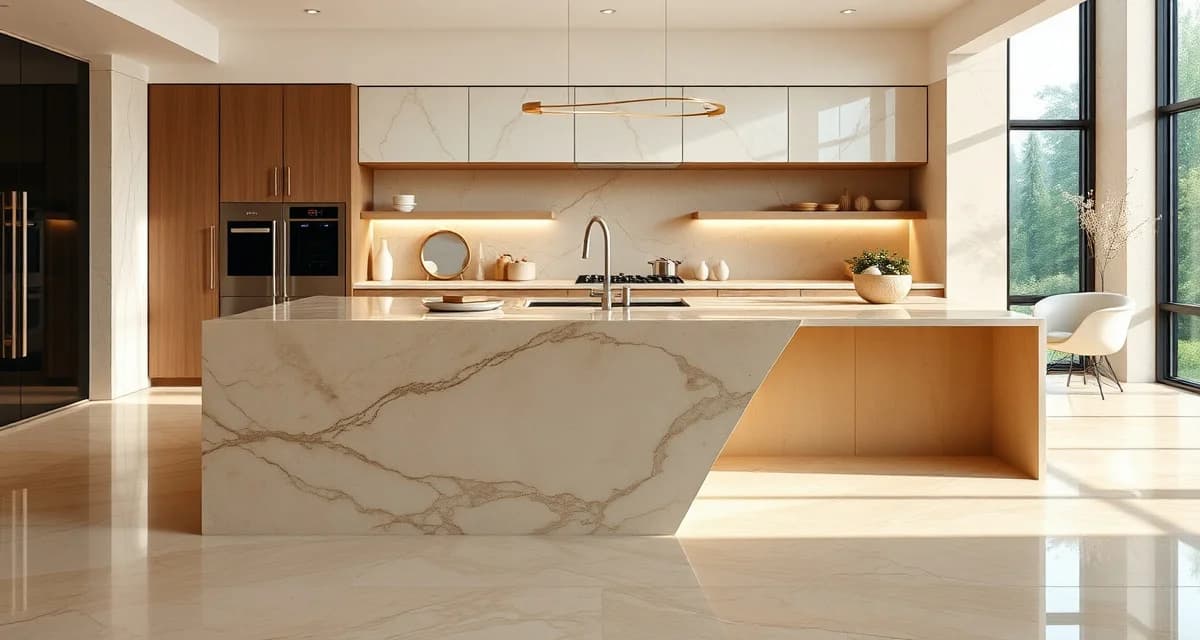
What Is a Waterfall Island?
A waterfall island is a kitchen island where the countertop material continues vertically down one or both sides, flowing from the horizontal surface to the floor like a waterfall. Instead of the countertop ending at the island's edge with a standard overhang, the stone wraps around the side panel, creating a dramatic, uninterrupted surface. Waterfall islands have become one of the most popular design features in modern and contemporary kitchens, adding visual weight and showcasing the beauty of the stone material.
TL;DR
- A waterfall island has stone that continues from the countertop down the side to the floor
- One-sided waterfall adds $1,500-$4,000 in material and labor; two-sided adds $3,000-$8,000
- Requires additional slab material (typically 12-18 sq ft per waterfall side)
- Best with dramatic veined materials (marble, quartzite, veined quartz) for visual impact
- The stone meets at a mitered 45-degree joint at the edge, requiring precise fabrication
- Waterfall sides are purely decorative and don't add structural support
- Most popular in modern, contemporary, and transitional kitchen designs
How a Waterfall Island Is Built
The waterfall effect requires two separate pieces of stone joined at the countertop edge:
Calculate your material waste savings
See exactly how much slab material and money you could save with optimized cutting layouts.
Try the free Waste CalculatorThe Miter Joint
The horizontal countertop and the vertical panel meet at the edge of the island. In most waterfall installations, this joint is a 45-degree miter:
- The horizontal countertop is cut with a 45-degree bevel along the edge where the waterfall will be
- The vertical panel is cut with a corresponding 45-degree bevel along its top edge
- The two beveled edges are glued together with color-matched epoxy
- When assembled, the joint creates what appears to be a seamless right angle
The miter joint is the most critical fabrication step. A well-executed miter is nearly invisible and gives the illusion of a single piece of stone bending from horizontal to vertical.
Alternative: Butt Joint
A simpler approach where the vertical panel sits directly beneath the horizontal countertop edge. This creates a visible seam line at the transition. It's less expensive (no mitering required) but less visually impressive. The butt joint is more common with thicker stone (3cm+) where the edge transition is more noticeable.
Mounting the Vertical Panel
The vertical waterfall panel is supported by:
- The island cabinet structure behind it
- A metal bracket or cleat system attached to the cabinet
- The miter joint adhesive connecting it to the horizontal piece
- Sometimes a hidden metal support frame within the island
The panel doesn't carry structural load. It's decorative, so the mounting system only needs to hold the panel's weight (typically 100-200 lbs for a 36" x 36" panel in 3cm stone).
Waterfall Island Configurations
| Configuration | Description | Extra Material Needed | Cost Addition |
|---|---|---|---|
| Single waterfall (one side) | Stone flows down one end of the island | 12-18 sq ft | $1,500-$4,000 |
| Double waterfall (both sides) | Stone flows down both ends | 24-36 sq ft | $3,000-$8,000 |
| Full wrap (three sides) | Stone on both ends and the back | 40-55 sq ft | $5,000-$12,000 |
| Partial waterfall | Stone flows partway down the side (not to floor) | 8-12 sq ft | $1,000-$2,500 |
The single waterfall on one end is the most common configuration, striking a balance between visual impact and cost. The exposed end (where guests approach or sit) gets the waterfall treatment, while the other end is a standard overhang or flat panel.
Best Materials for Waterfall Islands
Waterfall islands work with any countertop material, but some create more impact than others:
High Impact Materials
Veined marble (Calacatta, Statuario): The gold standard for waterfall islands. Continuous veining flowing from the horizontal to vertical surface creates a show-stopping effect. When bookmatched, the veining creates symmetry across the miter joint.
Veined quartzite (Taj Mahal, Super White): Similar visual impact to marble with better durability. The natural veining creates beautiful continuity across the waterfall joint.
Veined quartz (Cambria Brittanicca, Caesarstone Calacatta Maximus): Offers the marble look with zero maintenance. The engineered veining is designed to flow naturally across seams.
Moderate Impact Materials
Bold granite (Titanium, Cosmic Black): Dark granites with metallic flecks create a luxurious, modern waterfall. The speckled pattern is forgiving at the miter joint.
Porcelain slab (large format): Porcelain can mimic marble or concrete and is extremely durable. Lighter weight (1.2cm typical) makes installation easier.
Lower Impact Materials
Solid-color quartz: A white or gray solid creates a clean, minimalist waterfall but doesn't have the drama of veined materials. The miter joint may be more visible without pattern to disguise it.
Concrete: Creates an industrial, modern look. Color is consistent but has natural variation that helps hide the joint.
Vein Matching Across the Waterfall
The most impressive waterfall islands have veining that flows continuously from the countertop to the side panel. Achieving this requires:
- Selecting the right slab: The fabricator needs to identify a section of the slab where the veining runs toward the edge at an appropriate angle
- Careful cutting: The horizontal and vertical pieces are cut from adjacent sections of the slab so the veining aligns at the miter
- Bookmatching (optional): For two-sided waterfalls, bookmatched slabs create mirror-image veining on each side
- Precise installation: The pieces must be aligned within 1/32" to maintain vein continuity
This level of precision requires an experienced fabricator. Not all shops have the expertise or equipment for flawless waterfall work. Ask to see photos of previous waterfall installations before choosing a fabricator.
Design Considerations
Island Size and Proportion
A waterfall panel should look proportional to the island:
- Standard island (3' x 6'): Single waterfall on the short end works well. The 36" height creates a balanced vertical panel.
- Large island (4' x 8'+): Double waterfall can work if the island is prominent enough to support the visual weight.
- Narrow island (2' x 6'): Waterfall can look overwhelming on a narrow island. Consider a partial waterfall (stopping 6-12" above the floor).
Seating Integration
Waterfall ends don't accommodate seating because there's no overhang. If your island needs bar seating, place it on the non-waterfall side(s). Common configurations:
- Waterfall on one end, seating overhang on the other end and/or front
- Waterfall on both ends, seating overhang on the long side
- Waterfall on one end, cabinet access on the other three sides
Toe Kick and Floor Meeting
The bottom of the waterfall panel needs a clean termination at the floor:
- Stone to floor: The panel extends to the floor (or slightly above with a small gap for floor cleaning). This is the cleanest look.
- Base trim: A small base molding covers the gap between the stone and floor.
- Floating: The panel stops 3-4" above the floor, creating a floating effect. Modern and visually light.
Cost Breakdown
Here's what a waterfall island adds to a standard island countertop project:
| Cost Component | Standard Island | With Single Waterfall | With Double Waterfall |
|---|---|---|---|
| Countertop material (top) | $720-$2,160 | $720-$2,160 | $720-$2,160 |
| Waterfall material | $0 | $480-$2,160 | $960-$4,320 |
| Fabrication (mitering) | $0 | $300-$800 | $600-$1,600 |
| Installation | $200-$400 | $400-$800 | $600-$1,200 |
| Total | $920-$2,560 | $1,900-$5,920 | $2,880-$9,280 |
Based on a 3' x 6' island with materials ranging from $40-$120/sq ft
The waterfall feature roughly doubles the cost of an island countertop, primarily due to additional material and the specialized mitering work.
FAQ
Is a waterfall island worth the cost? It depends on your design priorities. A waterfall creates a dramatic focal point and can increase perceived kitchen value. For homeowners who want a bold, modern statement, the $1,500-$8,000 investment creates significant visual impact. For budget-focused remodels, the money may be better spent elsewhere.
Can any fabricator do a waterfall island? Not well. Waterfall mitering requires precision equipment and experience. Ask specifically about waterfall experience and request photos of completed projects. Poorly executed miters are extremely visible and costly to fix.
Do waterfall islands increase home value? Waterfall islands are perceived as a premium feature and can contribute to a higher kitchen valuation. However, the cost-to-value ratio depends on your local market and the overall quality of the kitchen. In high-end markets, waterfall islands are expected; in mid-range markets, they're a differentiator.
Can I add a waterfall to an existing island? Technically possible but very difficult. The existing countertop edge would need to be re-cut with a miter, and the vertical panel must be precisely matched. Most fabricators recommend replacing the entire island countertop.
How thick is a waterfall panel? Standard 3cm (1-3/16") thickness matches the countertop. Some designs use 2cm for the panel (lighter, less expensive) with a hidden support frame. The mitered joint works best when both pieces are the same thickness.
Does a waterfall island block access to the cabinet? Yes, the waterfall side covers the cabinet. Plan your island layout so that cabinet doors and drawers face away from the waterfall panel(s).
Can I do a waterfall with granite? Yes. Granite waterfalls are less common than marble or quartz but work well with dramatic granite varieties. The speckled or veined pattern of certain granites can look striking as a waterfall.
What if the vein pattern doesn't match at the miter? Some degree of pattern discontinuity is normal, especially with natural stone. The miter joint creates a natural visual break that the eye accepts. Perfect vein continuity is the goal but not always achievable.
Estimate Your Island Countertop Cost
Planning a waterfall island? Use our cost calculator to see material and fabrication pricing for your specific island dimensions and material choice, including the waterfall upgrade.
[Try the SlabWise Cost Calculator →]
Try These Free Tools
- Cost Calculator -- Get instant countertop cost estimates by material, edge profile, and square footage.
- Compare Materials -- Side-by-side material comparison with pricing, durability, and maintenance ratings.
- Edge Profile Selector -- Browse edge profiles with cost impact and visual previews.