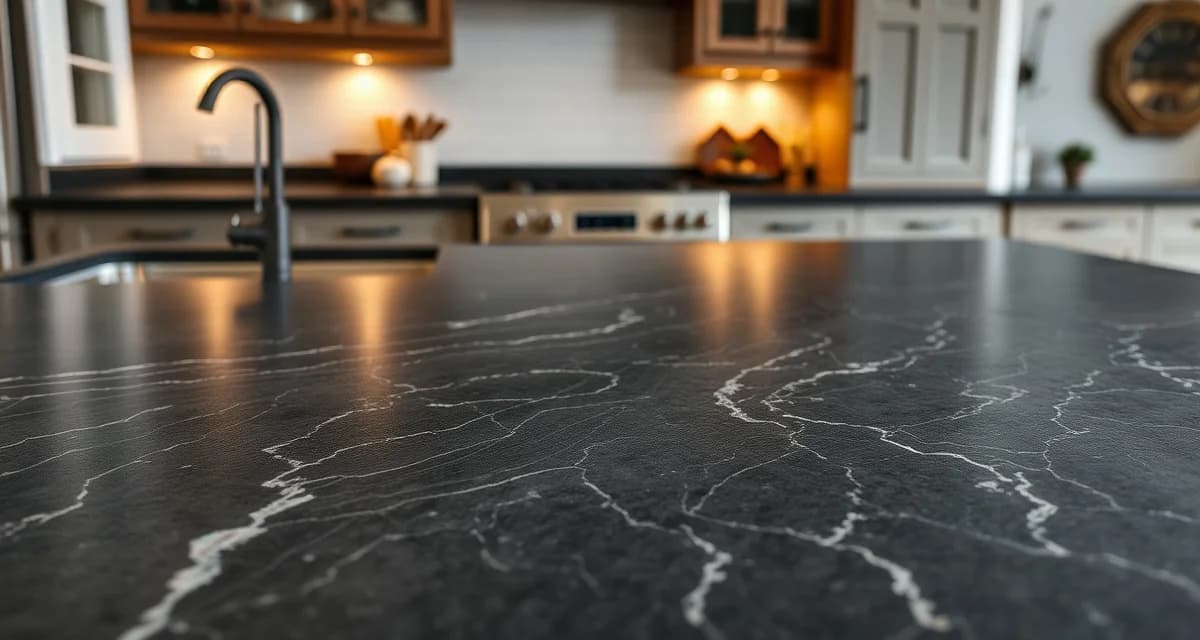
How Much Do Soapstone Countertops Cost in 2026?
Soapstone countertops cost $70-$120 per square foot installed in 2026, with the national average falling between $80-$100 per square foot. For a typical 40 sq ft kitchen, expect to pay $2,800-$4,800 total including materials, fabrication, and installation. Soapstone is a naturally antibacterial, heat-resistant stone that never needs sealing -- but its softness, limited color range, and tendency to darken over time make it a polarizing choice.
TL;DR: Soapstone Countertop Cost at a Glance
- Material only: $35-$70 per sq ft depending on grade, color, and origin
- Installed price: $70-$120 per sq ft (national average $80-$100)
- Average kitchen (40 sq ft): $2,800-$4,800 total
- Average bathroom vanity (15 sq ft): $1,050-$1,800 total
- Architectural grade (high talc, softer): $70-$90/sq ft installed
- Countertop grade (lower talc, harder): $85-$120/sq ft installed
- No sealing required: Soapstone is naturally non-porous
- Lifespan: 50-100+ years (it was used in 19th-century laboratories)
What Is Soapstone?
Soapstone is a natural metamorphic rock composed primarily of talc, along with varying amounts of chlorite, pyroxene, magnesite, and other minerals. The talc content determines the stone's softness and feel -- high-talc soapstone (used for carving and woodstoves) feels smooth and almost waxy, while lower-talc countertop-grade soapstone is noticeably harder.
Calculate your material waste savings
See exactly how much slab material and money you could save with optimized cutting layouts.
Try the free Waste CalculatorThe name comes from the smooth, soapy feel of the stone when you run your hand across it. This same quality that gives soapstone its tactile appeal also makes it one of the softest natural stones used for countertops.
Soapstone Grades and Hardness
Not all soapstone is the same. The talc content determines the grade, hardness, and suitability for countertop use.
| Grade | Talc Content | Mohs Hardness | Best Use | Price Range |
|---|---|---|---|---|
| Artistic/carving grade | 80%+ talc | 1-2 Mohs | Sculptures, carvings | Not for countertops |
| Architectural grade | 50-70% talc | 2-3 Mohs | Woodstoves, sinks, hearths | $70-$90/sq ft installed |
| Countertop grade | 30-50% talc | 3-5 Mohs | Kitchen and bath countertops | $85-$120/sq ft installed |
Important: Always confirm that your soapstone supplier is providing countertop-grade material (3-5 Mohs hardness). Architectural-grade soapstone is too soft for kitchen countertop use and will scratch excessively.
Soapstone Countertop Cost by Grade and Region
Cost by Grade
| Grade | Material/sq ft | Installed/sq ft | 40 sq ft Kitchen |
|---|---|---|---|
| Standard countertop grade | $35-$50 | $70-$95 | $2,800-$3,800 |
| Premium countertop grade | $45-$60 | $85-$110 | $3,400-$4,400 |
| Exotic/rare coloring | $55-$70 | $100-$120 | $4,000-$4,800 |
Cost by Region
Soapstone pricing varies significantly by geography due to transportation costs (soapstone is heavy) and local demand.
| Region | Typical Installed Cost/sq ft | Notes |
|---|---|---|
| Northeast (traditional market) | $75-$100 | Highest availability, most fabricators |
| Southeast | $80-$110 | Moderate availability |
| Midwest | $85-$115 | Limited fabricators, higher transport costs |
| West Coast | $90-$120 | Limited supply, longest shipping distances |
| Mountain West | $90-$120 | Fewest fabricators, highest transport costs |
The Northeast has historically been the strongest market for soapstone countertops due to New England's long history with the material (Vermont was once a major soapstone quarrying state). If you live in the Northeast, you will typically find more competitive pricing and more experienced fabricators.
Soapstone Countertop Cost Breakdown
Here is where your money goes on a 40 sq ft kitchen project.
| Component | Cost | Notes |
|---|---|---|
| Soapstone slab material | $1,400-$2,800 | Based on grade, color, and origin |
| Fabrication | $400-$800 | CNC or hand cutting, edge profiling, cutouts |
| Edge profiling | $150-$400 | Eased edge is standard; bullnose and ogee cost more |
| Sink cutout(s) | $150-$300 | Standard undermount cutout |
| Installation | $400-$700 | Delivery, placement, leveling, caulking |
| Initial oiling | $50-$100 | Mineral oil application to even out color |
| Old countertop removal | $200-$500 | Demolition and disposal |
| Total (40 sq ft) | $2,750-$5,600 | $69-$140/sq ft all-in |
What Is NOT Included in Most Quotes
- Plumbing disconnect/reconnect: $100-$300
- Backsplash installation: $15-$40/linear foot (soapstone backsplash or tile)
- Cabinet reinforcement: Typically not needed (soapstone weighs about the same as granite)
- Ongoing mineral oil: $10-$20/year for oil (optional, not required)
Soapstone Countertops: Pros and Cons
Advantages
- Naturally antibacterial: Soapstone is one of the few natural countertop materials that is inherently non-porous and antibacterial. This is why it has been used in laboratory countertops for over 150 years -- hospitals, chemistry labs, and morgues all relied on soapstone for its hygienic properties
- Heat resistant: You can place hot pots, pans, and baking sheets directly on soapstone without trivets. The stone absorbs and dissipates heat without cracking, scorching, or discoloring. Soapstone was traditionally used to line fireplaces and wood-burning stoves
- No sealing required, ever: Unlike granite, marble, and concrete, soapstone never needs chemical sealers. The stone is naturally non-porous with virtually zero absorption. This is a lifetime maintenance advantage over nearly every other natural stone
- Chemical resistant: Soapstone is unaffected by acids, alkalis, and most chemicals. Lemon juice, vinegar, wine, and tomato sauce -- substances that etch marble and can stain granite -- have zero effect on soapstone
- Beautiful patina with age: Soapstone darkens naturally over time, developing a rich, deep patina that many homeowners find increasingly beautiful. A new gray soapstone countertop will gradually deepen to near-black over months to years
- Repairable: Scratches in soapstone can be buffed out with sandpaper (220-320 grit) and mineral oil. This is one of the few countertop materials where you can truly DIY surface repairs
- Timeless aesthetic: Soapstone has been used in homes for centuries. It does not go in and out of style the way trend-driven materials do
- Warm to the touch: Unlike granite or quartz, soapstone feels warm and inviting. The stone absorbs and retains ambient heat
Disadvantages
- Soft and scratches easily: At 3-5 on the Mohs hardness scale, soapstone is significantly softer than granite (6-7), quartz (7), and quartzite (7-8). Daily kitchen use will produce visible scratches. These can be sanded out, but the maintenance is ongoing
- Limited color range: Soapstone comes in shades of gray, from light silver-gray to dark charcoal and near-black. Some varieties include subtle green, blue, or brown undertones. If you want white, beige, brown, or dramatic veining, soapstone is not for you
- Darkens over time: New soapstone starts lighter gray and darkens to near-black over months to years. Mineral oil accelerates this process (and many owners prefer the darker look), but the color change is not optional. You will not keep a light gray soapstone countertop looking light gray
- Fewer fabricators: Not all countertop shops work with soapstone. Finding an experienced soapstone fabricator may be difficult outside of the Northeast
- Fewer edge profile options: Soapstone's softness limits the complexity of edge profiles. Eased and bullnose edges work well; detailed profiles like ogee are possible but chip more easily
- Weight: Soapstone weighs about the same as granite (approximately 18 lbs per sq ft at 3cm), requiring standard cabinet support
- Can dent from heavy impact: Dropping a cast iron pan on the edge of a soapstone countertop can cause a dent or gouge, not just a chip. The softness that makes it repairable also makes it more vulnerable to impact damage
Soapstone Color and Appearance Guide
Common Soapstone Colors
| Color | Origin | Description | Relative Cost |
|---|---|---|---|
| Dark charcoal/black | Brazil (Pedra Sabao) | Deep black-gray with subtle veining | Standard |
| Medium gray | Brazil, India | True medium gray with mineral flecks | Standard |
| Green-gray | India (Rajasthan) | Gray with distinctive green undertones | Premium |
| Blue-gray | Brazil | Cool blue undertones, lighter base | Premium |
| Light silver-gray | Finland, Vermont | Lightest soapstone, darkens fastest with oil | Standard |
| Veined varieties | Brazil | White or light veins through dark base | Premium |
The Darkening Process
All soapstone darkens naturally with exposure to oils, water, and general use. Here is what to expect:
- Day 1: Light to medium gray, dry matte appearance
- Month 1 (with mineral oil): Noticeably darker, more uniform color
- Month 3-6 (with oil): Approaching near-black, deep rich color
- Year 1-2 (without oil): Uneven darkening based on use patterns (areas near the sink darken faster)
- Year 3-5 (without oil): Eventually reaches full, natural darkness throughout
Most homeowners apply mineral oil to accelerate and even out the darkening process. This is purely cosmetic -- oiling does not affect the stone's performance, durability, or stain resistance.
Soapstone Maintenance: What You Actually Need to Do
Mineral Oil Application (Optional, Cosmetic Only)
Applying food-grade mineral oil is the most commonly discussed aspect of soapstone maintenance. Here is the reality:
- Oiling is cosmetic, not protective. Unlike sealing granite (which is structurally necessary), oiling soapstone only affects the appearance. It accelerates the natural darkening and creates a uniform, rich color
- Frequency: Every 1-2 weeks for the first month, then monthly for the first year, then every few months or whenever you want to refresh the look
- Product: Food-grade mineral oil ($5-$10 per bottle, one bottle lasts 6-12 months)
- Application: Wipe oil across the surface with a soft cloth, let it sit 15-30 minutes, wipe off excess. Takes 10 minutes
Scratch Repair
Scratches are inevitable on soapstone. Here is how to deal with them:
- Light scratches: Apply mineral oil. Many shallow scratches become invisible when oiled
- Moderate scratches: Sand with 220-grit sandpaper in the direction of the scratch, then follow with 320-grit. Apply mineral oil
- Deep scratches or gouges: Sand with 120-grit, then 220, then 320. Apply mineral oil. For very deep damage, contact your fabricator
The ability to DIY scratch repairs is a genuine advantage of soapstone. With granite or quartz, scratches typically require professional repair.
Daily Cleaning
- Wipe with warm water and mild dish soap
- No special cleaners needed (and no cleaners to avoid, since soapstone resists all chemicals)
- Dry with a soft cloth to minimize water spots
- That is it. Soapstone is one of the easiest countertop materials to clean
Soapstone vs. Granite: Detailed Comparison
| Feature | Soapstone | Granite |
|---|---|---|
| Cost/sq ft installed | $70-$120 | $50-$150 |
| Hardness | 3-5 Mohs (soft) | 6-7 Mohs (hard) |
| Sealing required | Never | Every 1-3 years |
| Heat resistance | Excellent | Excellent |
| Scratch resistance | Poor (scratches easily) | Good |
| Stain resistance | Excellent (non-porous) | Good (when sealed) |
| Chemical resistance | Excellent (acid-proof) | Good (acids can etch) |
| Color range | Gray to black only | Full spectrum |
| Repairability | Excellent (sand and oil) | Moderate (epoxy fill) |
| Antibacterial | Yes (naturally) | No (requires sealing) |
| Darkens over time | Yes (patina) | No (color stable) |
| Fabricator availability | Limited | Widespread |
The Bottom Line on Soapstone vs. Granite
Choose soapstone if you value the warm feel, antibacterial properties, zero-sealing lifestyle, and find beauty in a stone that ages and changes character over time. Choose granite if you want color variety, harder scratch resistance, a wider fabricator selection, or a surface that looks the same in 10 years as it does on day one.
Soapstone vs. Quartz Comparison
| Feature | Soapstone | Quartz |
|---|---|---|
| Cost/sq ft installed | $70-$120 | $50-$150 |
| Material type | Natural stone | Engineered (93% quartz, 7% resin) |
| Sealing | Never | Never |
| Heat resistance | Excellent (unlimited) | Good (up to 300F) |
| Scratch resistance | Poor | Good |
| Color range | Gray to black | Full spectrum |
| Pattern consistency | Natural variation | Consistent batch to batch |
| Repairability | Excellent | Moderate |
| Outdoor use | Yes | No (UV damage) |
| Feel | Warm, soapy | Cool, smooth |
| Antibacterial | Yes (naturally) | Yes (non-porous) |
| Patina/aging | Yes (darkens) | No (color stable) |
Sourcing Soapstone: Where It Comes From
Brazil
Brazil is the largest soapstone producer in the world and the source of most countertop-grade material sold in the US. Brazilian soapstone (known locally as Pedra Sabao) is available in a wide range of grays, from light silver to deep charcoal. Brazilian material is generally the most affordable and the most available. Major quarries are located in Minas Gerais state.
India
Indian soapstone, primarily from Rajasthan, tends to be harder and sometimes shows distinctive green or blue-gray undertones. Indian soapstone is generally classified as high-quality countertop grade due to its lower talc content and higher hardness. It typically costs 10-20% more than comparable Brazilian material.
Finland
Finnish soapstone (often sold under the brand Tulikivi) is the premium choice, particularly known for its thermal mass properties (used in masonry heaters). For countertops, Finnish soapstone offers a lighter, more silver-toned color. It is the most expensive option and the hardest to source in the US market.
Domestic (Vermont, Virginia)
The US has a limited domestic soapstone supply, primarily from Vermont (where soapstone has been quarried since the 1800s) and Virginia. Domestic soapstone is available in small quantities and commands a premium of 20-40% over imported material. Vermont Soapstone is the best-known domestic brand.
Best Applications for Soapstone Countertops
Where Soapstone Excels
- Farmhouse and traditional kitchens: The matte, handcrafted look complements traditional, farmhouse, and colonial-style homes
- Historical home renovations: Soapstone is historically appropriate for homes built before 1950 and adds authentic period character
- Homes with serious cooks: The heat resistance means you never need trivets. Home bakers and cooks who move hot pans frequently appreciate this
- Chemical-heavy environments: Home labs, craft rooms, and darkrooms benefit from the acid and chemical resistance
- Bathroom vanities: Lower wear and scratching risk compared to kitchens, plus the warm feel is pleasant in bathrooms
Where Soapstone Is Not Ideal
- Modern/contemporary kitchens wanting white: The gray-to-black color range does not suit every aesthetic
- Homeowners who dislike patina: If you want your countertop to look the same in 5 years as day one, soapstone is not for you
- Households with heavy knife use: If you regularly cut directly on the counter (without a cutting board), soapstone will show deep scratches quickly
- Budget projects: At $70-$120/sq ft, soapstone is not a budget material. Granite offers a similar natural stone look with more color options starting at $50/sq ft
How to Save Money on Soapstone Countertops
Buy Brazilian Soapstone
Brazilian soapstone costs 10-30% less than Indian or Finnish material and is available in the widest range of colors and sizes. Unless you specifically need the harder Indian grade or the lighter Finnish tone, Brazilian is the best value.
Choose Standard Colors
The most common dark charcoal and medium gray slabs are the least expensive. Exotic veined patterns, green-toned, and blue-toned soapstone command a 15-30% premium.
Get Quotes from Soapstone Specialists
General countertop fabricators who occasionally work with soapstone may charge more due to unfamiliarity with the material. Soapstone specialists (like Vermont Soapstone, Bucks County Soapstone, or M. Teixeira) have better material pricing and more efficient fabrication.
Use Remnants for Small Projects
Soapstone remnants are available from fabricators at 30-50% off full slab prices. For bathroom vanities, laundry counters, or fireplace surrounds, remnants provide excellent value.
See Also
- Granite Countertop Cost Guide -- Natural stone pricing by type and color
- Quartz Countertop Cost Guide -- Engineered stone pricing and brand comparison
- Marble Countertop Cost Guide -- Premium marble pricing breakdown
- Quartzite Countertop Cost Guide -- Natural quartzite pricing and comparison
- Kitchen Countertop Replacement Cost -- Full project cost for kitchen renovation
- Best Quartz Countertop Brands -- Top quartz brands ranked by price and quality
- Laminate Countertop Cost Guide -- Budget alternative pricing
FAQ: Soapstone Countertop Costs
How much do soapstone countertops cost?
Soapstone countertops cost $70-$120 per square foot installed in 2026. Standard countertop-grade soapstone runs $70-$95/sq ft, while premium grades and exotic colors cost $100-$120/sq ft. For a typical 40 sq ft kitchen, expect to pay $2,800-$4,800 total including materials, fabrication, and installation.
Is soapstone more expensive than granite?
Soapstone is generally more expensive than granite on average. Soapstone starts at $70/sq ft installed versus $50/sq ft for budget granite. However, the ranges overlap: premium granite ($100-$150/sq ft) exceeds premium soapstone ($100-$120/sq ft). The key cost difference is long-term: soapstone never needs sealing (saving $50-$100/year in maintenance), while granite needs sealing every 1-3 years.
Does soapstone scratch easily?
Yes. Soapstone is one of the softest natural stones used for countertops, rating 3-5 on the Mohs hardness scale compared to 6-7 for granite. Kitchen knives, ceramic plates, and abrasive cleaners will leave visible scratches. The good news is that scratches can be easily repaired by sanding with 220-320 grit sandpaper and applying mineral oil. Most soapstone owners sand and oil their countertops every few months to maintain a fresh appearance.
Does soapstone need to be sealed?
No. Soapstone is naturally non-porous and never requires sealing. This is one of its biggest advantages over granite, marble, and concrete, all of which require regular chemical sealing to prevent stains. Many homeowners apply mineral oil to soapstone, but this is purely cosmetic (it enhances color and accelerates the natural darkening patina) -- it is not a protective treatment.
What colors does soapstone come in?
Soapstone is limited to the gray-to-black spectrum. Colors range from light silver-gray to medium charcoal to near-black, with some varieties showing subtle green, blue, or brown undertones. Veined varieties feature lighter streaks through a darker base. All soapstone darkens over time, with lighter stones showing the most dramatic color shift. If you want white, beige, or warm-toned natural stone, granite, quartzite, or marble are better options.
How long do soapstone countertops last?
Soapstone countertops last 50-100+ years. The material is extremely durable structurally and does not degrade from heat, chemicals, UV exposure, or moisture. Soapstone has been used in science laboratories since the 1800s, and many of those original countertops are still in service. The practical lifespan is essentially unlimited as long as you can tolerate the natural patina and occasional scratch repair.
Does soapstone change color over time?
Yes. All soapstone darkens naturally over time due to oxidation and exposure to oils, water, and general use. New soapstone typically starts as a medium gray and gradually deepens to near-black over months to years. Applying food-grade mineral oil accelerates this process and creates a more uniform color. Some homeowners prefer the lighter, un-oiled look -- but the stone will still darken gradually with use, just less evenly.
Is soapstone antibacterial?
Yes. Soapstone is one of the few naturally antibacterial countertop materials. Its non-porous surface does not allow bacteria to penetrate, which is why soapstone has been the standard countertop material in laboratories, hospitals, and commercial kitchens for over a century. Unlike granite (which requires sealing to prevent bacterial growth), soapstone provides this protection without any treatment.
Can you cut on soapstone countertops?
You can, but you should not. While cutting directly on soapstone will not damage your knife the way quartz or granite would, it will leave clearly visible cut marks and scratches in the stone. Always use a cutting board. If you do accidentally cut on the surface, the scratches can be sanded out with 220-320 grit sandpaper and mineral oil.
Where does the best soapstone come from?
Brazil is the largest producer and offers the best value for countertop-grade soapstone. Indian soapstone (from Rajasthan) is generally harder and available with unique green or blue-gray tones, making it excellent for kitchen countertops. Finnish soapstone is the premium option with a lighter silver tone, but it is the most expensive and hardest to find in the US. Vermont Soapstone is the leading domestic source, offering locally quarried material at a premium price.
Get an Accurate Countertop Estimate
Soapstone pricing depends on grade, origin, and your local fabricator market. Not all soapstone is equal, and not all fabricators have experience with this material.
For homeowners: Visit a soapstone specialty showroom if one exists in your area. Handle the stone, see oiled vs. un-oiled samples, and ask about the specific grade and origin of each slab. Request quotes from fabricators who specifically list soapstone experience -- the cutting and finishing techniques are different from granite.
For fabricators: If your customers are comparing soapstone to granite or quartz, accurate side-by-side pricing helps them make informed decisions. SlabWise's Quick Quote Engine generates material comparison estimates in about 3 minutes, including maintenance cost projections that show the long-term value of zero-sealing surfaces.
Try These Free Tools
- Cost Calculator -- Get instant countertop cost estimates by material, edge profile, and square footage.
- Compare Materials -- Side-by-side material comparison with pricing, durability, and maintenance ratings.
- Edge Profile Selector -- Browse edge profiles with cost impact and visual previews.