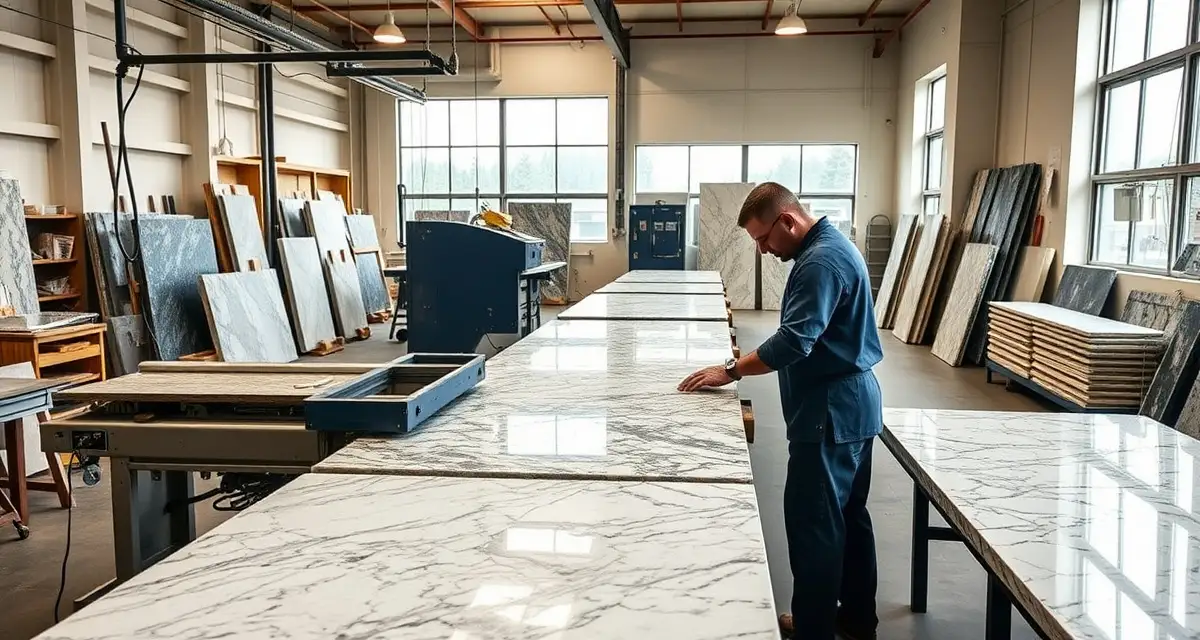
What Is a Countertop Fabricator?
A countertop fabricator takes raw stone slabs - granite, quartz, marble, quartzite, or porcelain - and transforms them into finished countertops through cutting, shaping, polishing, and installation. The greater Seattle area has approximately 90-130 active fabrication shops serving King County, Snohomish County, and Pierce County. With that many options, knowing what separates a quality fabricator from a rush job operation saves you real money and headaches.
TL;DR - Choosing a Seattle Countertop Fabricator
- Seattle has 90-130 countertop fabrication shops serving the metro area
- Template to install turnaround averages 4-5 weeks
- Pricing runs 20-30% above national averages
- Compare Seattle fabricators using SlabWise's Quick Quote tool for fast, accurate estimates
- Get at least 3 quotes and compare material, fabrication, and installation line items
Seattle's Countertop Fabrication Market
Seattle's housing market drives strong demand for countertop fabrication. King County processes roughly 15,000 residential remodel and building permits annually, and the metro area's median home price - still hovering above $800,000 - means homeowners invest heavily in kitchen and bath upgrades. Countertops are the single most impactful kitchen upgrade for resale value, returning 60-80% of cost at sale according to multiple industry surveys.
Calculate your material waste savings
See exactly how much slab material and money you could save with optimized cutting layouts.
Try the free Waste CalculatorWhat Drives Pricing in Seattle?
| Cost Factor | Impact on Your Quote |
|---|---|
| Material grade | $45-$220+/sq ft depending on stone type and rarity |
| Edge profile | Eased edge typically included; ogee or mitered adds $18-$40/linear ft |
| Cutout count | Each undermount sink or cooktop cutout adds $175-$400 |
| Seam placement | Complex layouts (L-shape, U-shape, island) need more seams and labor |
| Old counter removal | Adds $350-$900 depending on existing material |
| Delivery distance | Beyond 25 miles from the shop, expect $3-$6/mile surcharges |
| Seattle cost of living | Shop overhead (rent, labor, insurance) is 15-25% higher than national averages |
The typical Seattle kitchen countertop project (35-50 sq ft) runs between $3,000 and $7,500 installed. Seattle's higher cost of living directly impacts fabrication pricing - shop rents in industrial areas like SODO, Georgetown, and Ballard industrial corridors run 20-30% above the national average for comparable space.
How to Evaluate Seattle Fabricators: Step by Step
Step 1: Assess Their Technology and Equipment
Equipment determines quality more than anything else in stone fabrication. Key questions:
- Digital templating? Laser and LiDAR systems measure within 1/16" accuracy. Stick templates (cardboard strips) introduce human error. Digital files feed directly into CNC machines, eliminating manual transcription mistakes.
- CNC bridge saw and router? Shops with CNC equipment produce tighter tolerances and more consistent edge profiles. Manual shops can do good work but are less consistent across high volumes.
- Template verification process? The best shops run template files through verification software that checks dimensions, edge profiles, and cutout placement before the saw ever touches stone. This prevents $1,500-$4,000 remakes.
Step 2: Examine Their Work and References
Request a portfolio of completed projects - particularly on the material you're considering. A shop that excels with quartz may struggle with large-format porcelain or heavily veined marble.
Ask for 3-5 references from the past 60-90 days. Recent references reflect the shop's current team, equipment condition, and workflow capacity.
Step 3: Demand a Detailed Written Quote
A professional Seattle fabricator's quote should break down:
- Material name, color, thickness, and supplier (e.g., "Caesarstone Calacatta Nuvo, 3cm, from Pacific Shore Stones")
- Exact square footage with waste factor
- Edge profile and total linear footage
- Cutout specifications (undermount, drop-in, cooktop)
- Demolition and disposal costs
- Installation schedule with specific date ranges
- Separate fabrication and material warranty terms
If a quote just says "quartz countertops - $4,800" with no line items, keep looking. You can't compare quotes without matching details.
Step 4: Map the Timeline
| Stage | Typical Seattle Timeline |
|---|---|
| Initial quote | Same day to 2 business days |
| Template appointment | 4-8 days after deposit |
| Fabrication | 4-8 business days after template |
| Installation | 1-3 days after fabrication |
| Total | 9-18 business days typical |
Seattle's busy season runs March through September. During this window, some shops push to 4-5 week lead times. A fabricator promising template-to-install in 3 days during summer is either underbooked (concerning) or rushing (dangerous for quality).
Step 5: Confirm Licensing and Insurance
Washington State requires contractors performing installation to register with the Department of Labor & Industries. Verify:
- Active contractor registration (L&I lookup tool)
- General liability insurance ($1M+ minimum)
- Workers' compensation coverage
- Bonding (Washington requires surety bonds for registered contractors)
Run the shop through L&I's contractor verification system - it takes 2 minutes and can save you from a nightmare scenario.
Seattle Neighborhoods and Fabricator Landscape
Geography matters for pricing, convenience, and material availability:
- SODO / Georgetown: The highest concentration of fabrication shops in the metro. Industrial rents keep overhead manageable, and most major slab distributors have yards nearby.
- Ballard / Fremont: A handful of mid-size and boutique fabricators. Tends to serve higher-end residential projects.
- Eastside (Bellevue / Kirkland / Redmond): Growing cluster of fabricators serving the tech-corridor housing boom. Pricing tends 5-10% above Seattle proper due to higher expectations and material preferences.
- South King County (Kent / Renton / Tukwila): Several large-volume shops with competitive pricing. Slab distributors like MSI and Arizona Tile have showrooms in this corridor.
- Tacoma / Pierce County: Lower pricing (10-20% less than Seattle) with capable shops, but fewer high-end material options in local yards.
Red Flags When Choosing a Seattle Fabricator
Avoid fabricators who:
- Have no verifiable L&I registration. This is a legal requirement in Washington for shops doing installation work.
- Request more than 50% upfront. Industry standard is 40-50% deposit, balance at installation.
- Can't provide a written warranty. Expect 1-5 years on workmanship, separate from material manufacturer warranties.
- Won't let you visit the shop. If you can't tour the facility and see equipment, question why.
- Show no recent project photos. An inactive portfolio suggests the shop is either new, struggling, or not proud of recent output.
- Promise same-week turnaround. Quality fabrication requires proper template verification, dry-fitting, and curing time for seams.
Technology Reshaping Seattle Fabrication
Forward-thinking Seattle fabricators invest in tools that directly improve your outcome:
- AI-driven slab nesting calculates the optimal arrangement of pieces on each slab, reducing material waste by 10-15%. That's meaningful when a single Calacatta marble slab costs $3,000-$8,000.
- Customer portals give you real-time project tracking - template status, fabrication progress, installation scheduling - without calling the shop. Shops using portals report 70% fewer inbound customer calls.
- Quick-quote technology generates detailed, line-item estimates in 3 minutes instead of the 20+ minutes manual estimating requires. Faster quotes mean you can compare options without waiting days.
- Three-layer template verification checks every template file for dimension accuracy, edge profile correctness, and cutout placement before fabrication starts. This catches mistakes before they become $1,500-$4,000 remakes that delay your project by weeks.
Seattle shops adopting this technology produce fewer errors. The industry average is 2-4 remakes per month at $1,500-$4,000 each. Shops with strong verification systems cut that number significantly - and pass the savings through to pricing.
Questions to Ask Every Seattle Fabricator
Before signing any agreement:
- Are you registered with Washington L&I? What's your registration number?
- Do you use laser or LiDAR digital templating?
- What CNC equipment do you operate?
- What's your current template-to-install timeline?
- Can I visit the shop during fabrication?
- What happens if there's a measurement error or fabrication defect?
- Can I hand-select my slab from your inventory?
- Do you provide project tracking or status updates online?
How much do countertops cost in Seattle?
Installed granite in Seattle runs $50-$130 per square foot. Quartz costs $60-$160 per square foot. A standard 40 sq ft kitchen project averages $3,000-$6,500 depending on material selection and edge profile complexity.
How long does countertop fabrication take in Seattle?
Most Seattle fabricators complete the process from template to installation in 9-18 business days. Peak season (March-September) can push timelines to 3-5 weeks. Rush service is available at most shops for a 15-30% premium.
Should I use the fabricator my general contractor recommends?
Always get independent quotes for comparison. Many contractors receive referral commissions (5-15%) from their preferred fabricator. The recommended shop may do great work, but verify with your own research and competitive pricing.
What's the difference between a fabricator and a stone yard?
A stone yard sells raw slabs. A fabricator cuts, shapes, polishes, and installs those slabs as finished countertops. Some operations combine both (vertically integrated), which can mean better pricing. Others buy from distributors and focus purely on fabrication and installation.
Do Seattle fabricators sell remnant pieces?
Yes. Most shops offer remnants (leftover slab pieces) at 30-60% discounts. Remnants are ideal for bathroom vanities, wet bars, laundry rooms, or any surface under 20 sq ft.
Is quartz or granite better for Seattle kitchens?
Seattle's damp climate doesn't significantly favor one over the other. Quartz is non-porous and requires zero sealing. Granite needs resealing every 1-2 years but offers unique natural patterns. Both are durable for daily kitchen use - the choice is primarily aesthetic and maintenance preference.
How do I check a Seattle fabricator's reputation?
Verify their L&I registration, read recent Google reviews (last 6 months), check BBB complaints, visit the shop in person, and request references for projects using your chosen material.
What warranty should a Seattle fabricator provide?
Expect 1-5 years on fabrication and installation workmanship. Material warranties come from the manufacturer (10-15 years for quartz brands, limited lifetime for granite). Ensure both warranties are documented in your contract.
Can I bring my own slab to a Seattle fabricator?
Some shops accept customer-supplied material at fabrication-only rates ($28-$50/sq ft). Most won't warranty the slab itself against defects or breakage. Confirm this policy before purchasing material independently.
What edge profiles are most popular in Seattle?
Eased and beveled edges account for about 55% of Seattle installations. Mitered edges are increasingly popular in modern and contemporary renovations, especially on the Eastside. Waterfall edges remain a top choice for kitchen islands in higher-end projects.
Get a Fast, Accurate Countertop Estimate
Done researching? Use the SlabWise countertop calculator to build a detailed estimate for your Seattle project in under 3 minutes. Compare granite, quartz, marble, and quartzite pricing with real Pacific Northwest market data.
Try the Free Countertop Calculator →
Try These Free Tools
- Photo to Template -- Snap a photo of an existing countertop and get an AI-generated DXF template.
- Template Compare -- Upload two templates and see every dimension change highlighted instantly.
- AI Template Verification -- Cross-check your template against manufacturer specs before cutting.
Sources & Further Reading
- Natural Stone Institute - Fabrication Guidelines and Best Practices
- International Surface Fabricators Association - Fabricator Resources and Training
- OSHA - Silica in Construction Standards
- National Kitchen & Bath Association - Industry Standards and Certification