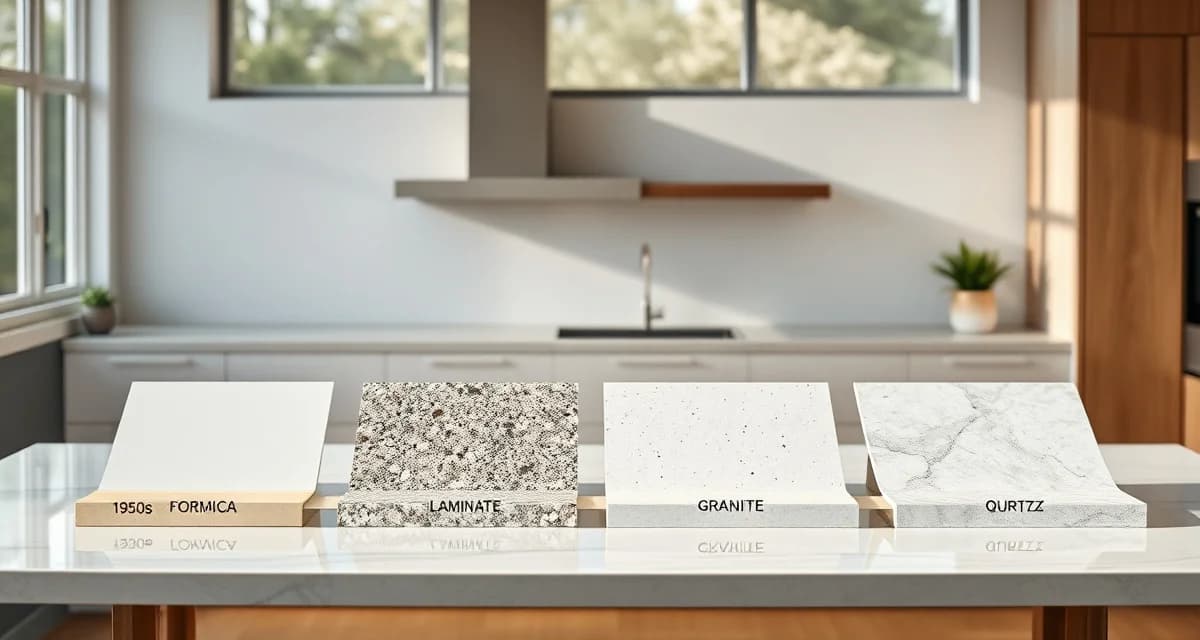
Countertop Trends Through the Decades
What Is the History of Countertop Trends?
Countertop trends trace the evolution of kitchen and bathroom surfaces from basic wood and metal workspaces to the engineered quartz and porcelain surfaces dominating today's market. Each decade brought new materials, new manufacturing methods, and shifting homeowner priorities that reshaped what Americans put in their kitchens.
TL;DR
- Tile and wood dominated kitchens through the early 1900s before laminate arrived in the 1950s
- Formica laminate owned the market from the 1950s-1980s, peaking at over 90% of kitchen countertops
- Granite rose from a luxury niche in the 1980s to mainstream dominance by the early 2000s
- Quartz (engineered stone) overtook granite around 2018 and now holds the largest market share
- Each decade's trends reflected broader cultural shifts: post-war efficiency, 1970s earth tones, 1990s luxury aspirations, 2020s sustainability
- Understanding trend cycles helps fabricators predict demand and stock accordingly
- The current market is fragmenting, with porcelain, concrete, and recycled materials gaining share alongside quartz
1900s-1940s: Function Over Form
The Working Kitchen Era
Before 1950, kitchens were utility rooms. Countertops were an afterthought - a surface to prepare food on, nothing more.
Calculate your material waste savings
See exactly how much slab material and money you could save with optimized cutting layouts.
Try the free Waste CalculatorCommon materials:
- Wood butcher block - The original countertop. Pine, maple, or oak boards nailed or glued together. Found in virtually every American kitchen before 1940.
- Zinc and tin - Metal surfaces were common in wealthier homes. Easy to clean, resistant to stains, but dented easily.
- Tile - Individual ceramic tiles set in mortar. Popular in the 1920s-1940s, especially in California and the Southwest.
- Soapstone - Regional favorite in the Northeast, used since colonial times.
- Marble - Reserved for the wealthy. Used primarily in butler's pantries and baking stations.
Key Context
These kitchens had no dishwashers, no garbage disposals, and often no running hot water until the 1930s-1940s. Countertop material needed to survive heavy daily scrubbing and constant water exposure. Aesthetics mattered far less than durability.
1950s: The Formica Revolution
Laminate Changes Everything
The 1950s saw the single biggest shift in countertop history. Formica, which had been used for industrial purposes since the 1920s, entered the residential kitchen market and completely transformed expectations.
Why laminate won:
- Affordable ($1-$3 per square foot in 1950s dollars)
- Available in hundreds of colors and patterns
- Waterproof surface
- Easy to clean with new household cleaners
- Matched the era's obsession with modernity and convenience
By 1959, Formica brand laminate appeared in over 60% of new American kitchens. The company's "Skylark" and "Boomerang" patterns became icons of mid-century design.
Colors and Patterns
- Turquoise, pink, yellow, and mint green
- Boomerang and starburst patterns
- Faux woodgrain (the first "look-alike" material)
- Chrome edging became the standard trim detail
1960s: The Space Age Kitchen
Going Bold
The 1960s pushed laminate design further with influences from the space race and pop art:
- Avocado green and harvest gold began their reign
- Geometric patterns replaced the organic boomerang shapes
- Textured laminates imitated leather and fabric
- Edge treatments became more varied (self-edge, beveled, metal)
Tile Makes a Comeback
Mexican tile and hand-painted ceramic surfaces gained popularity as the decade's interest in global culture and craft influenced home design. Tile countertops would remain a significant trend through the 1980s, especially in Sun Belt states.
1970s: Earth Tones and Natural Materials
The Back-to-Nature Movement
The environmental movement and 1970s cultural shifts brought natural-looking materials into demand:
- Butcher block returned as a countertop surface (not just a cutting station)
- Slate and soapstone appeared in early "country kitchen" designs
- Ceramic tile with earth-tone glazes (brown, rust, olive) dominated new construction
- Laminate shifted to woodgrain patterns and warm tones
Color Palette
The 1970s palette was unmistakable:
- Avocado green (peaking then beginning its decline)
- Harvest gold
- Burnt orange
- Chocolate brown
- Earthy rust
Corian Arrives
DuPont introduced Corian solid surface in 1971 - originally only in white. This material would eventually grow into a major countertop category, but in the 1970s it was expensive and available in limited colors. Early adoption was mostly in commercial settings and high-end homes.
1980s: Granite Goes Mainstream
The Luxury Kitchen Begins
The 1980s economic boom transformed the kitchen from a utility room into a status symbol. Two major shifts defined the decade:
Granite arrives:
- Previously reserved for commercial buildings and mansions
- Improved quarrying and shipping technology made granite affordable for upper-middle-class homes
- White, black, and green granite became aspirational materials
- A granite countertop signaled success in the 1980s real estate market
Corian expands:
- DuPont introduced more colors and patterns
- Solid surface became the "better than laminate, cheaper than granite" middle option
- The ability to integrate sinks attracted designers
Laminate Fights Back
Laminate wasn't ready to give up market share. Manufacturers responded with:
- Beveled edges and sophisticated profiles
- Stone-look patterns (early attempts to imitate granite)
- Color-through laminate that hid edge lines
- Higher-end pricing tiers
The 1980s Color Palette
- Almond and bisque (the "neutral" of the 1980s)
- Mauve and dusty rose
- Light oak wood tones
- Teal accents
- Black granite (the power kitchen)
1990s: The Granite Gold Rush
Stone Becomes Standard
The 1990s witnessed granite's march from luxury to expectation. Several factors drove this:
- Globalization opened quarries in Brazil, India, and China, dropping prices 30-40%
- Home improvement TV (This Old House, early HGTV) showcased granite installations
- Real estate competition made granite a standard selling feature in upper-market homes
- Fabrication technology improved with CNC machines and diamond tooling
By 1999, granite accounted for roughly 30% of new kitchen countertops, up from under 5% in 1990.
Other 1990s Trends
- Tile remained strong but shifted to larger format tiles and natural stone tiles
- Concrete countertops emerged as a niche trend among early adopters and design-forward homeowners
- Stainless steel appeared in residential kitchens influenced by professional kitchen aesthetics
- Laminate began its long market share decline but remained the volume leader
Color Shifts
- Warm beiges and tans
- Green granite (ubiquitous in 1990s tract homes)
- Cherry and mahogany cabinet tones paired with gold/brown granite
- Tuscan-inspired warm palettes
2000s: Peak Granite and the Quartz Emergence
Granite's Apex
The early-to-mid 2000s housing boom brought granite to its absolute market peak:
- By 2007, granite held approximately 35-40% of the countertop market
- "Granite countertops" became a standard bullet point in real estate listings
- Fabrication shops multiplied; the number of US fabricators nearly doubled between 2000 and 2007
- Popular granites: Giallo Ornamental, Santa Cecilia, Ubatuba, New Venetian Gold
Quartz Enters the Game
Engineered quartz (Silestone, Caesarstone, Cambria) launched serious marketing campaigns in the US market during the 2000s:
- Silestone's national advertising brought brand awareness
- Caesarstone gained traction through designer partnerships
- The "no maintenance" pitch directly attacked granite's sealing requirement
- Market share grew from under 5% in 2000 to roughly 12-15% by 2009
The 2008 Crash
The financial crisis and housing crash had a major impact:
- New construction dropped 70%+
- Fabrication shops closed by the hundreds
- Renovation budgets shrank, briefly boosting laminate sales
- Surviving fabricators had to diversify or consolidate
2010s: Quartz Takes Over
The Great Material Shift
The 2010s saw quartz overtake granite as the most-specified countertop material in new construction:
Timeline:
- 2010: Granite ~35%, Quartz ~15%, Laminate ~25%
- 2015: Granite ~30%, Quartz ~25%, Laminate ~20%
- 2018: Quartz ~33%, Granite ~25%, Laminate ~17%
Why quartz won:
- Consistent color and pattern (no "slab selection anxiety")
- Zero maintenance messaging resonated with busy homeowners
- Design versatility - manufacturers created convincing marble looks
- Social media and Pinterest drove demand for white/light kitchens, where quartz excelled
The White Kitchen Phenomenon
Instagram and Pinterest exploded in the mid-2010s, and the most-pinned kitchen images featured:
- White quartz countertops (especially marble-look varieties)
- White shaker cabinets
- Subway tile backsplashes
- This combination dominated new construction and renovations from roughly 2014-2020
Other 2010s Developments
- Porcelain slab countertops entered the US market from Europe
- Concrete countertops grew beyond niche to a small but stable category
- Quartzite (natural stone, distinct from quartz) gained a following among homeowners wanting natural stone with better durability than marble
- Recycled glass surfaces (IceStone, Vetrazzo) attracted sustainability-focused buyers
- Ultra-compact surfaces (Dekton by Cosentino) created a new high-performance category
2020s: Fragmentation and Sustainability
Where We Are Now
The 2020s market is more diverse than any previous decade. No single material dominates the way laminate did in the 1960s or granite did in the 2000s.
Current approximate market share (2025-2026):
| Material | Market Share | Trend Direction |
|---|---|---|
| Quartz | 35-38% | Stable/slight decline |
| Granite | 20-23% | Slow decline |
| Laminate | 14-16% | Stable |
| Solid Surface | 8-10% | Stable |
| Porcelain | 5-7% | Growing |
| Quartzite | 3-5% | Growing |
| Marble | 3-4% | Stable |
| Other (concrete, recycled, etc.) | 3-5% | Growing |
Key 2020s Trends
- Warm tones returning: After a decade of cool whites and grays, warm whites, creams, and earth tones are gaining ground
- Textured finishes: Honed, leathered, and brushed finishes are replacing polished as the default
- Sustainability: Recycled content, local sourcing, and carbon footprint are entering purchasing decisions
- Full-height backsplashes: The same slab material running from counter to ceiling
- Waterfall edges: Countertop material wrapping down to the floor on island ends
- Mixed materials: Different countertop materials on different surfaces within the same kitchen
What Fabricators Can Learn from Trend History
Patterns That Repeat
-
Every dominant material eventually gets challenged. Laminate was replaced by granite, which was replaced by quartz. The next challenger is likely porcelain or a material we haven't seen yet.
-
Trends follow 15-20 year cycles. Butcher block was popular in the 1970s, fell out of favor, and returned in the 2010s. Terrazzo countertops from the 1960s are showing up in design magazines again.
-
Technology drives adoption. CNC machines made granite affordable. Engineered stone manufacturing made quartz possible. Large-format printing made porcelain slabs realistic. Each material breakthrough opens a new market.
-
The "low maintenance" pitch always wins eventually. Consumers consistently gravitate toward materials that require less work, which is why quartz beat granite and why porcelain is gaining share.
Stocking and Training Implications
Fabricators who watch trends can:
- Shift material inventory ahead of demand curves
- Train staff on emerging materials before they become mainstream orders
- Market expertise in trending materials to attract design-forward clients
- Avoid over-investing in declining material categories
Digital fabrication tools help shops adapt faster to changing material demand. When your nesting software and template systems handle any material type, switching from granite-heavy to quartz-heavy production doesn't require retooling your entire process.
FAQ
When did granite countertops become popular?
Granite entered the residential market in the 1980s as a luxury material. It became mainstream in the mid-to-late 1990s as global quarry access dropped prices and home improvement media showcased stone kitchens. Peak granite popularity occurred around 2005-2010.
What countertops were popular in the 1970s?
The 1970s featured laminate (Formica) in earth tones and woodgrain patterns, ceramic tile with brown and rust glazes, butcher block making a comeback, and early solid surface (Corian). Avocado green and harvest gold dominated the color palette.
When did quartz countertops become popular?
Quartz began gaining serious US market share around 2008-2010. By 2018, quartz had overtaken granite as the most specified countertop material in new residential construction. The material's zero-maintenance pitch and consistent color options drove adoption.
Are granite countertops outdated?
Granite isn't outdated, but it's no longer the default choice. It still holds roughly 20-23% market share and remains popular for homeowners who prefer natural stone's unique patterns. The "basic" granites of the 2000s (Giallo Ornamental, Santa Cecilia) feel dated, but exotic granites and modern finishes keep the material relevant.
What's the next big countertop trend?
Porcelain slab countertops are the fastest-growing category. Their extreme durability, UV resistance, and ability to mimic any natural stone pattern make them attractive. Recycled and sustainable materials are also growing, driven by younger buyers prioritizing environmental impact.
Why did laminate fall out of favor?
Laminate didn't disappear - it still holds 14-16% market share. But as granite prices dropped in the 1990s and quartz offered stone-like appearance with easier maintenance, homeowners in the mid-to-upper market shifted away from laminate. The material retains a strong position in budget renovations and rental properties.
How long do countertop trends typically last?
Major material trends run 15-25 years from emergence to peak to decline. Color and pattern trends cycle faster, typically 5-10 years. Edge profile trends move even faster - ogee edges popular in the 2000s gave way to eased and mitered edges by the mid-2010s.
What countertop material has lasted the longest?
Marble has been used for countertops and work surfaces for thousands of years and has never fully gone out of style. In the modern era, laminate has the longest continuous market presence, remaining a viable option for over 70 years since its 1950s residential debut.
Did the 2008 recession change countertop trends?
Yes. The recession briefly boosted laminate sales as renovation budgets shrank. More importantly, it accelerated the granite-to-quartz transition. As the market recovered, buyers who might have defaulted to granite chose quartz instead, finding its maintenance-free pitch appealing during a period of cost consciousness.
What countertop materials are trending in 2026?
Warm-toned quartz (creams, taupes, soft browns), textured finishes (honed and leathered), porcelain slabs, and quartzite are all gaining popularity. The all-white kitchen trend has softened in favor of warmer, more varied color palettes. Full-height backsplashes and waterfall edges remain strong design features.
Stay Ahead of Material Trends
Fabricators who adapt to shifting trends faster win more business. SlabWise helps you manage any material type with the same digital workflow - from templating to nesting to customer communication. When the market shifts, your process doesn't need to.
Start your 14-day free trial →
Try These Free Tools
- Kitchen Visualizer -- Upload a kitchen photo and preview different countertop materials in place.
- AR Overlay -- See the actual stone pattern on your customer's cabinets using AR.
- Sink Finder -- Search compatible sink models by countertop dimensions and cutout specs.
Sources & Further Reading
- Natural Stone Institute - Bathroom Design Guidelines
- National Kitchen & Bath Association - Countertop Selection Guide
- Marble Institute of America - Bathroom Stone Applications
- International Surface Fabricators Association - Residential Bathroom Standards