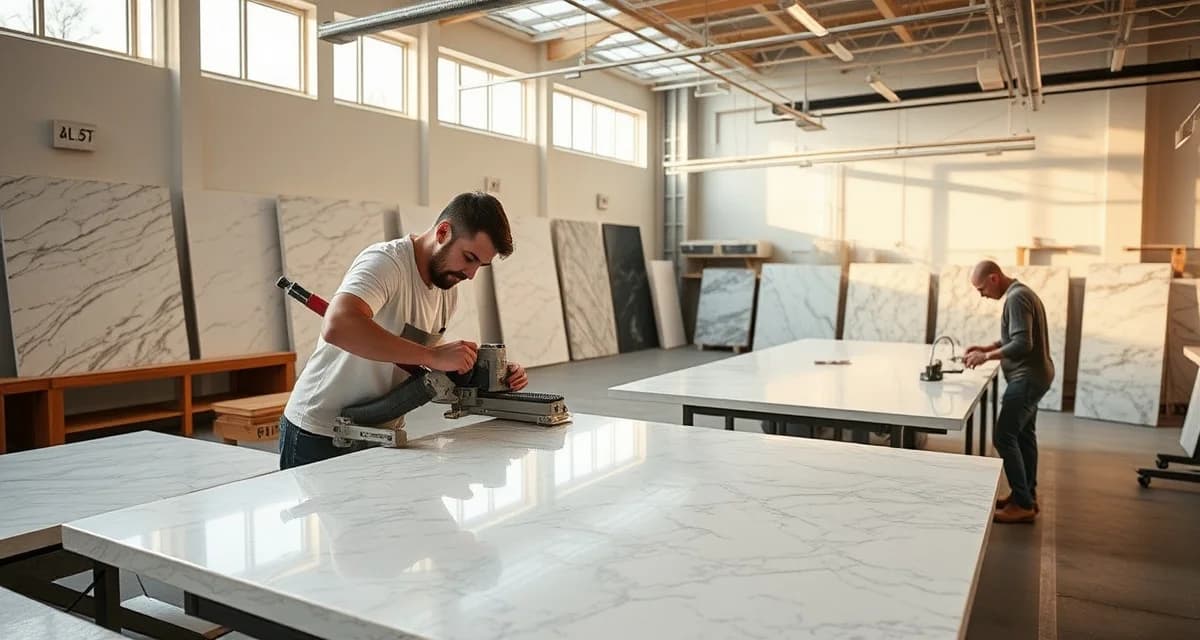
Countertop Fabrication in Connecticut: Guide for Shops
Countertop fabrication in Connecticut serves one of the wealthiest and most renovation-active markets in the Northeast. With high median home values, an aging housing stock that constantly needs updating, and homeowners who expect premium materials, Connecticut fabricators operate in a high-margin, high-expectation environment. This guide covers what shop owners need to know about the state's market, costs, and technology trends.
TL;DR
- Connecticut has an estimated 130-170 active countertop fabrication shops
- Local market factor: active luxury and premium market segment
- Local market factor: state licensing or registration required for fabrication work
- Fabrication labor runs $24-$35/hour in Connecticut
- AI-powered fabrication tools are helping Connecticut shops cut waste and reduce remakes - SlabWise offers a 14-day free trial
Connecticut Countertop Market Overview
Connecticut's countertop market benefits from several structural factors: high household incomes, an older housing stock that generates constant renovation demand, and proximity to New York City, which influences design trends and spending levels. The state's small geography means fabricators often serve customers across county lines, creating a competitive but accessible market.
Calculate your material waste savings
See exactly how much slab material and money you could save with optimized cutting layouts.
Try the free Waste CalculatorRegional Market Breakdown
| Region | Estimated Shops | Market Profile |
|---|---|---|
| Fairfield County (Greenwich, Stamford, Norwalk) | 40-55 | Highest project values, NYC commuter wealth, luxury kitchens |
| Hartford metro | 30-40 | State capital, balanced residential/commercial, mid-to-high range |
| New Haven metro | 25-35 | University influence (Yale), coastal homes, design-forward buyers |
| Southeastern CT (New London, Norwich) | 15-20 | Casino/resort economy, military (sub base), moderate market |
| Northwest Hills (Litchfield) | 10-15 | Second homes, rural luxury, seasonal demand |
Fairfield County: Connecticut's Premium Market
Fairfield County is where Connecticut's fabrication market truly stands apart. Towns like Greenwich, Darien, Westport, and New Canaan feature homes with kitchen countertop needs of 50-120 square feet. Homeowners in this market routinely select quartzite, premium marble, and exotic granite - materials priced at $80-$150 per square foot installed.
A single Fairfield County kitchen project can generate $8,000-$20,000 in revenue. But the expectations match the price point: flawless seams, exact edge profiles, and zero tolerance for measurement errors.
Challenges for Connecticut Fabricators
Premium Costs Across the Board
Connecticut ranks among the most expensive states to operate a fabrication shop:
- Skilled labor: CNC operators earn $24-$35/hour; installers command $26-$38/hour
- Industrial space: $10-$20/sq ft annually depending on region
- Energy: Connecticut has the 3rd-highest electricity rates in the continental U.S.
- Insurance: Workers' comp and liability premiums run above national averages
- Materials: Premium material preferences push average slab costs to $50-$120/sq ft
These costs create a dynamic where efficiency isn't optional - it's the difference between profit and loss.
Costly Remakes on Expensive Stone
When your average material cost is $60-$100 per square foot, a single remake can easily exceed $3,000-$4,500. The replacement slab, re-fabrication labor, scheduling disruption, and second installation trip add up quickly.
Connecticut shops report 2-4 remakes per month. At the higher end, that's $9,000-$18,000 in monthly losses - nearly enough to cover a full-time employee's salary.
Common remake triggers:
- Template measurement errors on complex layouts
- Sink cutout sizing mismatches with undermount models
- Edge profile miscommunication between sales and fabrication
- Seam placement disagreements with homeowners
- Backsplash height variations between counters and windows
Waste on Premium Materials
The industry-standard waste rate of 25-30% becomes financially devastating when materials cost $50-$120 per square foot. A Connecticut shop purchasing $80,000 in slabs monthly at 28% waste is discarding $22,400 in material per month - over $268,000 annually.
Even a modest improvement from 28% to 20% waste saves $6,400 per month or $76,800 per year. That's the financial equivalent of winning 8-10 additional mid-range projects annually.
Material Preferences in Connecticut
Quartz Leads in Premium Markets
Quartz has taken the top position in Fairfield County and is gaining throughout the state. Brands like Cambria, Caesarstone, and Dekton appeal to Connecticut homeowners who want consistent appearance, low maintenance, and modern aesthetics. Installed prices range from $55-$110/sq ft.
Quartzite: The Luxury Choice
Quartzite - natural stone with superior hardness to marble - has become the material of choice for Connecticut's highest-end kitchens. Colors like Taj Mahal, Calacatta, and Mont Blanc quartzite command $80-$150/sq ft installed. Fabrication is more challenging than granite or quartz, requiring experienced CNC operators and careful seam planning.
Granite Holds Strong in the Middle Market
Granite remains popular in Hartford, southeastern Connecticut, and budget-to-mid-range projects statewide. Popular choices include White Ice, Colonial White, and Giallo Ornamental at $45-$75/sq ft installed.
Marble: A Bathroom and Accent Staple
Connecticut homeowners, particularly in Fairfield County, still request marble for bathrooms, butler's pantries, and kitchen accents. Calacatta and Statuario marbles are the most requested, running $70-$130/sq ft installed.
Technology's Role in Connecticut Fabrication
In a high-cost state, technology serves as a margin multiplier. Every waste reduction percentage point and every prevented remake is worth more in Connecticut than in lower-cost markets.
Software Comparison
| Platform | Monthly Cost | Primary Advantage | AI Capabilities |
|---|---|---|---|
| Moraware | $200-$400 | Industry veteran, 2,600+ users | None |
| ActionFlow | $200-$350 | Workflow automation | Limited |
| EasyStoneShop | ~$150 | Low price point | None |
| SlabWise | $199-$349 | AI template verification, slab nesting, customer portal | Full AI suite |
AI-Powered Tools for High-Value Markets
AI Template Verification provides a 3-layer automated check on every template file. In a market where a single remake costs $3,000-$4,500, preventing just one remake per month pays for the software many times over.
AI Slab Nesting optimizes part layout to achieve 10-15% better material yield. On Connecticut's premium materials, that translates to $5,000-$10,000+ in monthly savings for a busy shop.
Customer Portal gives homeowners self-service access to project status, design approvals, and communication. This reduces the typical 8-15 daily inbound calls by up to 70%, freeing staff for higher-value activities.
Quick Quote generates accurate estimates in about 3 minutes versus the 20-minute industry standard. When Connecticut homeowners are gathering quotes from 3-4 fabricators, the shop that responds first often wins the job.
Business Requirements in Connecticut
Licensing and Registration
- Home Improvement Contractor Registration: Required by the Connecticut Department of Consumer Protection for residential work exceeding $200 in combined labor and materials
- Business Registration: File with the Connecticut Secretary of State
- Sales Tax: State rate of 6.35%; labor for residential work is generally exempt from sales tax, but materials are taxable
- OSHA Compliance: Silica dust regulations apply to all stone cutting and fabrication operations
- Environmental Permits: CT DEEP (Department of Energy and Environmental Protection) may require permits for wastewater discharge from stone cutting
Insurance Requirements
- Workers' compensation insurance is mandatory for all Connecticut employers
- General liability insurance: $1M-$2M coverage is standard for fabrication shops
- Commercial auto insurance for delivery and installation vehicles
- Inland marine coverage for stone in transit
Competitive Advantages in Connecticut
What separates the most successful Connecticut fabricators from the rest:
- Response speed: Quoting within hours rather than days
- Material expertise: Knowing quartzite from marble from look-alike quartz, and educating customers on the differences
- Digital communication: Email confirmations, digital layout approvals, online project tracking - Connecticut homeowners expect these
- Precision: Zero-tolerance execution on seams, edge profiles, and cutouts
- Referral networks: Kitchen designers, builders, and architects control significant project flow in Connecticut's luxury markets
Financial Case for Technology
For a Connecticut shop processing 30-45 jobs per month:
| Category | Without Technology | With Technology | Monthly Savings |
|---|---|---|---|
| Remakes (2-3/month) | $7,500-$13,500 | $2,500-$4,500 | $5,000-$9,000 |
| Slab waste (28% to 18%) | $22,400 | $14,400 | $8,000 |
| Admin/phone time | 55+ hours | 16 hours | 39 hours saved |
| Quoting | 14 hours | 3.5 hours | 10.5 hours saved |
| Total | $13,000+/mo |
The savings in Connecticut are amplified by the state's premium material costs and higher labor rates. Technology pays for itself within days, not months.
How many fabrication shops are in Connecticut?
Connecticut has approximately 130-170 active countertop fabrication shops. The highest concentrations are in Fairfield County (40-55 shops) and the Hartford metro area (30-40 shops).
What materials are most popular in Connecticut?
Quartz leads in the state's premium markets (Fairfield County, shoreline communities), while granite remains strong in Hartford and eastern Connecticut. Quartzite is growing fast in the luxury segment, and marble is a staple for bathrooms.
How much do countertops cost in Connecticut?
Average residential kitchen projects range from $4,000 to $10,000. Fairfield County projects frequently exceed $12,000-$20,000 due to premium materials and larger kitchen sizes. Installed prices range from $45/sq ft for basic granite to $150/sq ft for exotic quartzite.
Do Connecticut fabricators need a license?
Yes. Connecticut requires Home Improvement Contractor registration through the Department of Consumer Protection for residential work exceeding $200. You also need standard business registration, sales tax permits, and OSHA compliance.
Why is waste so expensive in Connecticut?
Connecticut homeowners prefer premium materials averaging $50-$120/sq ft. At industry waste rates of 25-30%, a shop purchasing $80,000/month in slabs discards $20,000-$24,000 in material. AI nesting tools can recover a significant portion of this loss.
What are labor costs for fabrication workers in Connecticut?
Connecticut fabrication wages are 15-30% above national averages. CNC operators earn $24-$35/hour, installers make $26-$38/hour, and templaters earn $22-$30/hour.
How competitive is Connecticut's fabrication market?
Very competitive. The state's small size means customers can easily compare 3-5 fabricators. Speed, precision, and digital communication capabilities are the primary differentiators.
How can Connecticut shops protect their margins?
Focus on three areas: (1) reduce material waste through AI nesting, (2) prevent remakes with AI template verification, and (3) cut administrative overhead with customer portals and automated quoting. These three changes can add $8,000-$15,000 per month in savings.
What makes Fairfield County different for fabricators?
Fairfield County features the state's highest home values, wealthiest buyers, and most premium material choices. Projects average $8,000-$20,000, but expectations for perfection are extremely high. One mistake can cost $4,000+ in remakes and reputation damage.
How long do countertop projects take in Connecticut?
Most residential projects take 2-3 weeks from template to installation. Shops that consistently deliver in 7-10 business days have a meaningful competitive advantage, especially for kitchen remodels where homeowners are living without countertops.
Protect Your Margins in Connecticut's Premium Market
SlabWise helps Connecticut fabrication shops save $3,000-$8,000+ per month through AI template verification, slab nesting, and a customer portal that cuts phone calls by 70%. Start your 14-day free trial - no credit card required.
Try These Free Tools
- Photo to Template -- Snap a photo of an existing countertop and get an AI-generated DXF template.
- Template Compare -- Upload two templates and see every dimension change highlighted instantly.
- AI Template Verification -- Cross-check your template against manufacturer specs before cutting.