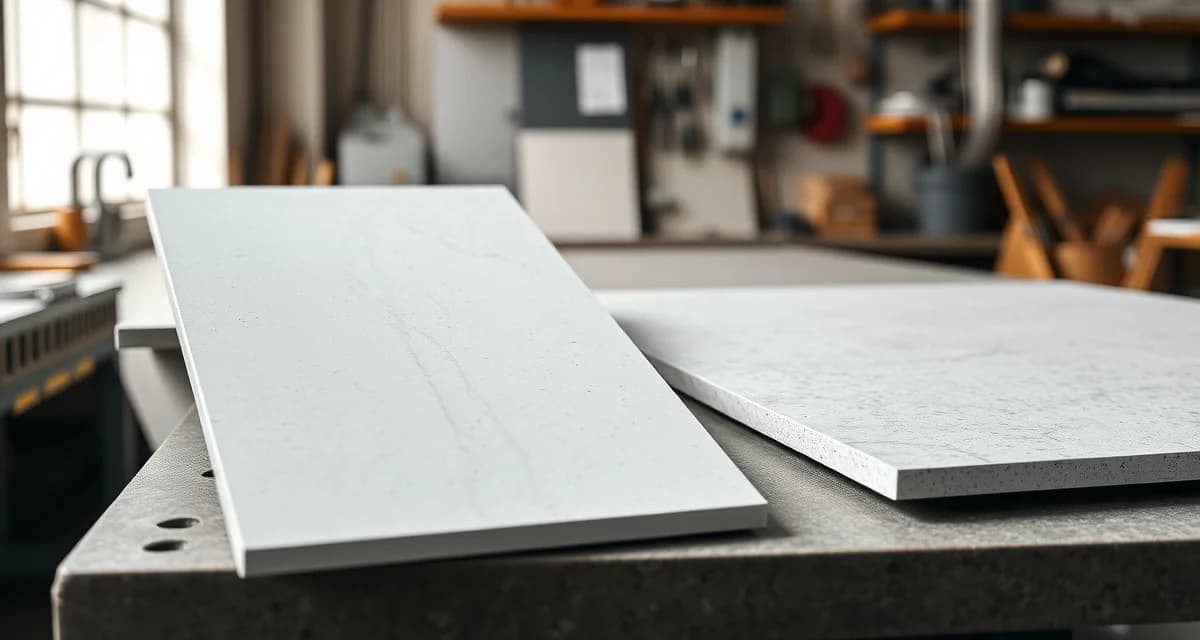
SlabWise for Porcelain Fabricators
SlabWise supports porcelain slab fabricators working with the countertop industry's fastest-growing material category - sintered stone, ultra-compact surfaces, and large-format porcelain. Brands like Dekton (Cosentino), Neolith, and Lapitec are gaining market share for their durability, UV resistance, and heat tolerance, but they bring fabrication challenges that differ from quartz and natural stone: thinner profiles, higher breakage risk, and slab sizes that don't match traditional stone fabrication workflows. SlabWise's AI nesting, template verification, and inventory management adapt to porcelain's specific requirements.
TL;DR
- Porcelain/sintered stone is the fastest-growing countertop material category
- Slabs are thinner (12mm-20mm vs. 20mm-30mm for stone) and more breakage-prone during fabrication
- Breakage rates run 5-10% for porcelain vs. 1-2% for quartz - driving higher remake costs
- AI nesting maximizes yield on large-format slabs (up to 126" x 63")
- Template verification prevents remakes on material with zero repair options
- Inventory tracking handles multiple thicknesses and formats per color
- Plans from $199/mo; 14-day free trial
The Porcelain Fabrication Opportunity
Porcelain slabs represent one of the fastest-growing segments in countertop fabrication. The material offers properties that neither quartz nor natural stone can match:
Calculate your material waste savings
See exactly how much slab material and money you could save with optimized cutting layouts.
Try the free Waste Calculator- UV stable: Doesn't fade in sunlight (ideal for outdoor kitchens)
- Heat resistant: Tolerates direct hot pan contact (400°F+ without damage)
- Stain resistant: Non-porous surface resists wine, oil, and chemical stains
- Thin profiles: Available in 12mm (1/2"), 14mm, and 20mm thicknesses
- Large format: Standard slabs up to 126" x 63" (vs. 120" x 65" for typical stone)
For fabrication shops, porcelain represents a new revenue stream and a way to serve demand that quartz and stone can't fill - particularly outdoor applications and commercial installations where UV and heat resistance are required.
But Porcelain Is Harder to Fabricate
| Challenge | Impact |
|---|---|
| Thinner material (12-20mm) | Higher breakage risk during cutting and handling |
| Brittleness | Chipping at cut edges if tools/speeds are wrong |
| Zero repair option | Chips and cracks cannot be filled like natural stone |
| Specialty tooling | Requires specific blades and CNC parameters |
| Edge treatment | Limited edge profiles (primarily flat, mitered) |
| Breakage rate | 5-10% of slabs break during fabrication (vs. 1-2% for quartz) |
A 5-10% breakage rate means that for every 20 porcelain slabs cut, 1-2 break during fabrication. At $1,200-$3,000 per slab, that's $1,200-$6,000 in monthly breakage losses for a mid-volume shop.
How SlabWise Addresses Porcelain Challenges
AI Nesting for Large-Format Slabs
Porcelain slabs come in larger formats than typical stone, and the nesting considerations differ:
- Minimal waste zones: Porcelain doesn't have fissures or inclusions, so the entire slab surface is usable
- Pattern matching: Modern porcelain mimics marble veining; nesting must account for pattern direction
- Thickness optimization: A shop may stock the same color in 12mm, 14mm, and 20mm; nesting selects the right format
- Edge proximity: Pieces need extra clearance from slab edges to reduce chipping risk during cutting
SlabWise's nesting algorithm handles these factors to achieve 88-93% material yield on porcelain - compared to 75-82% with manual nesting.
Monthly savings example (15 porcelain jobs):
- Monthly slab spend: $18,000
- Manual nesting waste (22%): $3,960
- SlabWise AI nesting waste (9%): $1,620
- Monthly savings: $2,340
Template Verification to Prevent Breakage-Inducing Remakes
When a porcelain piece is fabricated incorrectly and needs replacement, the fabricator faces:
- Buying a new slab ($1,200-$3,000)
- Cutting the replacement piece (with another 5-10% breakage risk)
- Delaying the customer's installation
- No repair option - the wrong piece goes in the dumpster
SlabWise's template verification is especially valuable here because it prevents the remake scenario entirely. Every template is checked for dimensional accuracy, geometric feasibility, and material fit before the CNC runs. One prevented remake on porcelain saves the cost of the platform for 6-15 months.
Multi-Thickness Inventory Management
Porcelain shops stock the same color in multiple thicknesses:
| Application | Typical Thickness | Slab Size |
|---|---|---|
| Kitchen countertops | 20mm (3/4") | 126" x 63" |
| Bathroom vanities | 12mm (1/2") | 126" x 63" |
| Backsplash panels | 6mm (1/4") | 120" x 60" |
| Shower walls | 6mm-12mm | Various |
| Flooring | 6mm-12mm | Various |
SlabWise's inventory distinguishes between thicknesses, formats, and lot numbers within the same color. When assigning material to a job, the system ensures the correct format is selected for the application.
Mitered Edge Tracking
Porcelain countertops frequently use mitered edges - two thin pieces bonded at a 45-degree angle to create a thicker appearance. A 12mm slab mitered gives the appearance of a 40mm (1.5") thick countertop.
SlabWise's nesting accounts for mitered edge pieces:
- The main countertop piece + the mitered edge strip are nested together
- Material usage includes both pieces, preventing shortfall
- Template verification confirms the miter dimensions match the installation requirements
Porcelain-Specific Quick Quote
Porcelain pricing differs from stone in several ways:
- Thinner material is cheaper per slab but may need mitering (adding labor)
- Edge options are limited (mostly mitered, flat, or pencil)
- Outdoor applications may require specific brands/thicknesses
- Installation requires specialized adhesives and handling
SlabWise Quick Quote includes porcelain-specific line items:
- Material cost by brand, color, and thickness
- Mitered edge fabrication charge
- Specialty cutting charges (curved pieces, large cutouts)
- Installation premium (porcelain requires more careful handling)
Brand Compatibility
SlabWise works with all major porcelain slab brands:
| Brand | Parent Company | Common Products |
|---|---|---|
| Dekton | Cosentino | Countertops, facades, flooring |
| Neolith | TheSize | Countertops, wall cladding |
| Lapitec | Breton | Countertops, furnishings |
| Porcelanosa | Porcelanosa | Countertops, wall panels |
| SapienStone | Iris Ceramica | Kitchen countertops |
Each brand's pricing, slab dimensions, and available thicknesses can be configured in your SlabWise material catalog.
Does SlabWise account for porcelain breakage risk in nesting?
Yes. You can set edge clearance parameters that keep pieces away from slab edges where breakage risk is highest. The nesting algorithm also avoids placing pieces where the cutting path would require the blade to exit and re-enter the slab - a common cause of edge chipping.
Can SlabWise track my breakage rate?
Yes. When a slab breaks during fabrication, you log it in SlabWise as a breakage event. Over time, you can see breakage rates by material, thickness, operator, and job type. This data helps identify whether breakage is a material issue, a tooling issue, or an operator training issue.
How does the template verification handle 12mm material?
Template verification for thin porcelain includes additional checks for minimum piece width and minimum distance from cutouts to edges. These are tighter constraints than for 20mm or 30mm stone because thin material is less tolerant of narrow sections.
Does SlabWise support porcelain backsplash and wall panel tracking?
Yes. Any slab-based fabrication job - countertops, backsplash, wall panels, shower walls - can be tracked in SlabWise. Each application has its own template, nesting, and fabrication workflow.
Can I track specialty tooling requirements for porcelain?
SlabWise job packets include fabrication notes where you can specify tooling requirements - blade type, CNC speed settings, and handling instructions. For porcelain, these notes alert your CNC team to switch to porcelain-specific tooling before cutting begins.
How does Quick Quote handle mitered edge pricing?
Mitered edges are priced as a line item in Quick Quote. You set the per-linear-foot charge for mitering, and the system calculates the total based on the edge lengths specified in the quote. The material needed for the miter strips is included in the nesting calculation.
Is porcelain nesting different from quartz nesting?
The algorithm is the same, but the parameters differ. Porcelain nesting uses wider edge clearances, accounts for different slab dimensions, and handles pattern matching for designs that mimic natural stone veining. You set these parameters during material setup.
What's the ROI for porcelain-focused shops?
For a shop doing 15 porcelain jobs per month, typical ROI from AI nesting and remake prevention is $3,000-$5,000/month against a $199-$349 subscription. The high breakage rate in porcelain fabrication makes error prevention particularly valuable.
Cut Porcelain With Confidence
Start a 14-day free trial and run your next porcelain jobs through SlabWise. See how AI nesting and template verification reduce waste and breakage on the industry's most challenging material.
Start Your 14-Day Free Trial → No credit card required.
Try These Free Tools
- Photo to Template -- Snap a photo of an existing countertop and get an AI-generated DXF template.
- Template Compare -- Upload two templates and see every dimension change highlighted instantly.
- AI Template Verification -- Cross-check your template against manufacturer specs before cutting.
Sources & Further Reading
-
Natural Stone Institute - Commercial Fabrication Standards and Best Practices
-
International Surface Fabricators Association - Digital Tools for Stone Fabricators
-
Marble Institute of America - Technology Solutions for Commercial Stone Operations
-
ASTM International - Standards for Natural Stone Testing and Fabrication