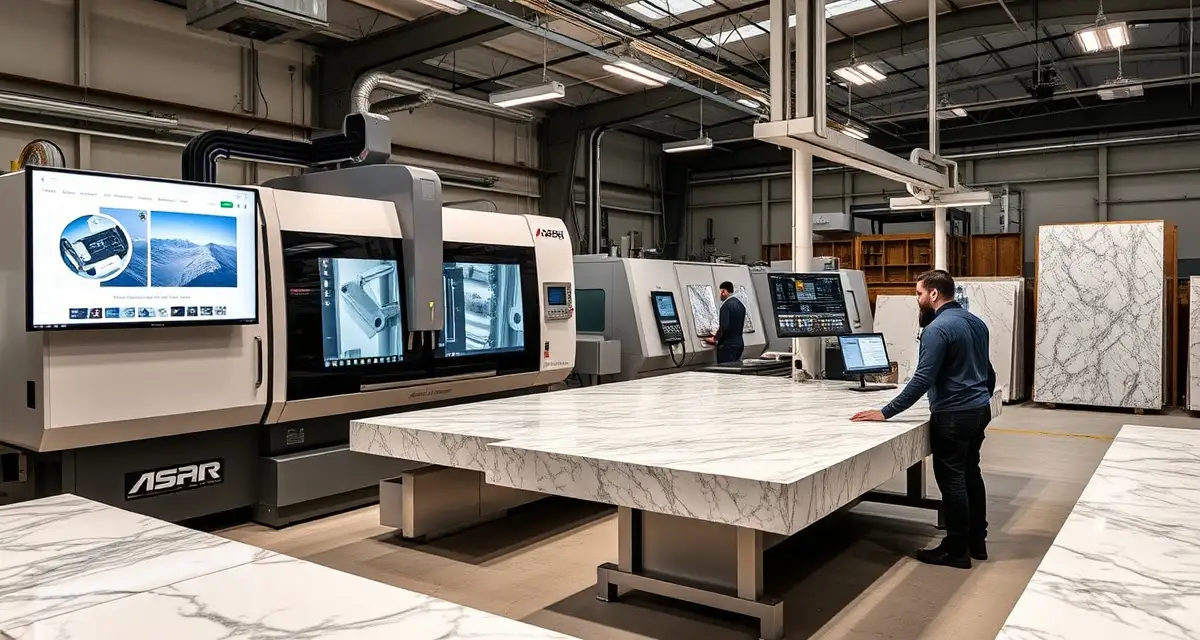
Fabrication Technology Trends 2026
Quick Definition
Countertop fabrication technology is changing faster than at any point in the industry's history. From AI-powered nesting to automated CNC lines, the tools available to fabrication shops in 2026 can dramatically reduce waste, speed up production, and cut operating costs. For shop owners evaluating technology investments, understanding which innovations deliver real ROI -- and which are hype -- is the difference between growing your business and burning cash.
TL;DR
- AI-powered slab nesting is the highest-ROI technology available to fabricators, saving 10-15% material waste
- Digital templating has reached near-universal adoption in professional shops; manual templating is disappearing
- Cloud-based shop management software replaces paper job tracking and disconnected spreadsheets
- Automated CNC saw/router combos handle cutting and edge profiling in a single setup
- Customer-facing portals reduce phone call volume by 60-70%, freeing office staff for productive work
- Automated quoting tools compress quote time from 15-20 minutes to 3 minutes per project
- The total technology investment for a mid-sized shop runs $50,000-$200,000 but pays back within 12-24 months through efficiency gains
1. AI-Powered Slab Nesting
The single biggest waste expense in countertop fabrication is inefficient material use. The average shop wastes 30-40% of every slab, turning $15-$60/sq ft material into scrap. AI nesting changes that equation.
Calculate your material waste savings
See exactly how much slab material and money you could save with optimized cutting layouts.
Try the free Waste CalculatorHow it works: AI nesting software analyzes the irregular dimensions of each slab, maps the cut pieces needed for current and upcoming jobs, and optimizes placement to minimize waste. Unlike manual nesting or basic software nesting, AI algorithms consider:
- Slab edge irregularities and natural shape
- Vein direction and color zone matching
- Cutout placement (sinks, cooktops) within pieces
- Remnant sizes that can be used on future jobs
- Material thickness variations across the slab
Performance data:
| Nesting Method | Average Yield | Waste % | Annual Waste Cost (200 slabs/yr at $40/sq ft) |
|---|---|---|---|
| Manual layout | 60-65% | 35-40% | $112,000-$128,000 |
| Basic software | 68-72% | 28-32% | $89,600-$102,400 |
| AI-optimized | 75-82% | 18-25% | $57,600-$80,000 |
Annual savings with AI nesting: $32,000-$70,000 for a shop processing 200 slabs per year. The software subscription cost is a fraction of this savings.
SlabWise's nesting engine is built specifically for countertop fabrication -- it understands vein matching, sink cutout placement, and edge grain direction in ways that generic industrial nesting software does not.
2. Digital Templating Systems
Digital templating has gone from optional to expected. In 2026, fewer than 10% of professional fabrication shops still use physical strip templates. The rest have moved to laser or digital projection systems.
Current technology options:
| System Type | Accuracy | Speed | Price Range |
|---|---|---|---|
| Laser digital (LT-2D/Proliner) | +/- 1/16" | 15-30 min/kitchen | $15,000-$35,000 |
| Photogrammetric (camera-based) | +/- 1/8" | 10-20 min/kitchen | $3,000-$10,000 |
| LiDAR scanning (emerging) | +/- 1/16" | 5-15 min/kitchen | $5,000-$15,000 |
| Manual strips | +/- 1/4" | 30-60 min/kitchen | $200-$500 |
ROI calculation: A single template error on a $40/sq ft granite countertop (45 sq ft) costs $1,800 in material waste plus 6-8 hours of re-fabrication labor ($210-$280). If digital templating prevents just 2 remakes per month, it pays for itself within 6-12 months.
2026 development: LiDAR scanning (the same technology in modern smartphones and autonomous vehicles) is emerging as a faster, more portable alternative to laser digital systems. Early adopter shops report 30-50% faster template capture times with comparable accuracy.
3. Cloud-Based Shop Management Software
Paper job folders and whiteboard scheduling are being replaced by cloud-based systems that track every job from first contact to installation. The market has several options at different price points:
What shop management software tracks:
- Lead capture and quoting
- Job scheduling and production workflow
- Material inventory and slab allocation
- Templating schedule coordination
- Fabrication status and quality checks
- Installation scheduling and crew dispatch
- Invoicing and payment tracking
- Customer communication history
Market landscape:
| Platform | Monthly Cost | Target Shop Size | Key Strength |
|---|---|---|---|
| Moraware | $200-$400/mo | Mid to large (10+ employees) | Scheduling, established user base |
| ActionFlow | $200-$350/mo | Small to mid | Workflow automation |
| EasyStoneShop | ~$150/mo | Small shops | Simplicity, lower cost |
| SlabWise | $199-$349/mo | All sizes | AI nesting, template verification, customer portal |
Adoption impact: Shops that move from paper to cloud management typically report 15-25% productivity improvement within the first 6 months, driven by reduced double-entry, fewer scheduling conflicts, and better material tracking.
4. Automated CNC Saw + Router Combinations
CNC technology has evolved from dedicated bridge saws and separate routers to combined machines that cut, route edges, drill holes, and polish in a single setup:
What combination machines handle:
- Slab cutting (straight and curved cuts)
- Edge profiling (all standard and custom profiles)
- Sink and cooktop cutouts
- Faucet hole drilling
- Surface texturing (honed, leathered finishes)
- Miter cuts for waterfall and laminated edges
2026 machine pricing:
| Machine Category | Price Range | Production Capacity |
|---|---|---|
| Entry CNC bridge saw | $60,000-$120,000 | 3-5 kitchens/day |
| Mid-range CNC combo | $150,000-$300,000 | 5-8 kitchens/day |
| High-end automated line | $400,000-$800,000+ | 10-20+ kitchens/day |
Trend: 5-axis CNC machines are becoming more accessible to mid-sized shops. Five-axis capability allows complex 3D machining (integrated sinks, sculptural edges, angled miters) that previously required hand work or outsourcing.
5. Customer-Facing Digital Portals
One of the most underrated technology shifts in fabrication is the customer portal -- a digital interface where homeowners and contractors can track their project status without calling the shop.
The problem portals solve: The average fabrication shop handles 8-15 phone calls per day asking "Where is my countertop?" or "When is my installation?" Each call takes 3-5 minutes and interrupts production workflow. That is 30-75 minutes of daily office time spent answering status questions.
What a customer portal provides:
- Real-time job status (templated, in fabrication, ready for install)
- Installation date and time confirmation
- Material selection photos and approval
- Digital layout review and sign-off
- Payment and invoice access
- Direct messaging (reducing phone tag)
Impact data: Shops using customer portals report 60-70% reduction in inbound status calls. That frees 3-5 hours of office staff time per week for quote follow-up, sales, and other productive work.
SlabWise's Customer Portal is built specifically for countertop fabrication workflows -- it shows clients their slab selection, layout, and project timeline without requiring any setup from the fabricator beyond normal job entry.
6. Automated Quoting and Estimation
Manual quoting is one of the biggest time drains in countertop fabrication:
| Quoting Method | Time per Quote | Quotes per Day | Error Rate |
|---|---|---|---|
| Manual (spreadsheet/calculator) | 15-20 min | 10-15 | 5-10% |
| Template-based software | 8-12 min | 15-25 | 3-5% |
| AI-assisted (SlabWise Quick Quote) | 2-3 min | 50+ | <2% |
Why speed matters: In residential countertop sales, the first shop to deliver a professional quote often wins the job. When a homeowner requests quotes from three fabricators, the shop that responds within hours (not days) has a significant close-rate advantage.
What automated quoting calculates:
- Material cost based on square footage and material type
- Edge profile pricing per linear foot
- Sink and cooktop cutout charges
- Backsplash material and fabrication
- Installation labor based on job complexity
- Waste factor based on material and layout
- Margin and markup application
SlabWise's Quick Quote compresses 15-20 minutes of manual estimation into 3 minutes, producing a professional PDF estimate that can be emailed directly to the client.
7. Template Verification Systems
Template errors remain the leading cause of costly remakes. In 2026, template verification adds a quality check layer between templating and fabrication:
Three-layer verification approach:
- Field measurement validation: Digital template is checked against original room measurements for dimensional accuracy
- Layout validation: The digital cut layout is verified against the template for correct piece placement, seam locations, and cutout positions
- Slab validation: The layout is verified against the actual slab dimensions before cutting begins
Each verification layer catches errors that the previous step might miss. A single-check process catches 80-85% of errors. A three-layer process catches 95-99%.
Cost of not verifying: The average countertop remake costs $1,500-$4,000 in material, labor, and customer goodwill. A shop experiencing 2-3 remakes per month loses $3,000-$12,000 in monthly profit. Template verification systems that prevent even half of those remakes pay for themselves immediately.
8. Mobile and Tablet-Based Field Tools
Field crews (templaters and installers) are increasingly equipped with mobile technology:
- Tablet-based templating integration: Templates captured digitally in the field sync to the shop's production system without manual file transfer
- Mobile photo documentation: Installation photos captured on-site automatically attach to the job record
- Real-time scheduling updates: Field crew schedules update in real time, allowing dynamic rerouting when jobs run long or short
- Digital sign-off: Clients sign acceptance digitally at installation completion, eliminating paper callbacks
Efficiency gain: Mobile field tools reduce the gap between field work and shop work. A template captured at 10 AM can be in the production queue by 10:15 AM instead of waiting for the templater to return to the shop and upload files.
Technology Investment Planning
Prioritization for Different Shop Sizes
| Shop Size | First Investment | Second Investment | Third Investment |
|---|---|---|---|
| 1-3 employees | Quoting software | Digital templating | Shop management |
| 4-10 employees | Shop management + quoting | AI nesting | CNC upgrade |
| 10+ employees | AI nesting + customer portal | CNC automation | Template verification |
ROI Timeline
| Technology | Investment | Monthly Savings | Payback Period |
|---|---|---|---|
| Quoting software | $200-$350/mo | $500-$1,500 (time saved) | Immediate |
| AI nesting | $200-$500/mo | $2,000-$6,000 (waste reduction) | 1-2 months |
| Digital templating | $15,000-$35,000 | $1,000-$3,000 (remake prevention) | 6-18 months |
| Customer portal | $100-$300/mo | $500-$1,000 (call reduction) | Immediate |
| CNC upgrade | $60,000-$300,000 | $3,000-$10,000 (productivity) | 12-36 months |
What technology should a new fabrication shop invest in first?
Start with quoting software and a basic shop management system. These have the lowest cost and fastest ROI. Add digital templating as soon as volume justifies the investment (typically 3-5+ kitchens per week).
How much does fabrication technology cost per year?
A mid-sized shop's technology stack (shop management, quoting, nesting, customer portal) typically runs $5,000-$15,000 per year in software subscriptions. Hardware (digital templater, CNC machine) is a separate capital investment.
Is AI nesting worth it for a small shop?
Yes, if you process more than 3-4 slabs per week. At $40/sq ft average material cost, saving even 5% waste on each slab adds up to $200-$400/month in recovered material value for a small shop.
How long does it take to learn new fabrication software?
Most modern fabrication software is designed for quick adoption. Basic quoting and job management can be learned in 1-2 days. More complex features (AI nesting optimization, CNC integration) typically require 1-2 weeks of regular use to become proficient.
Can technology replace skilled fabricators?
No. Technology amplifies skilled workers' productivity but does not replace judgment, problem-solving, and craftsmanship. A CNC machine still needs a skilled operator to handle material-specific adjustments, quality checks, and exception handling.
What is the biggest technology gap in most fab shops?
Quoting speed and accuracy. Many shops still calculate quotes manually, which is slow, error-prone, and costs sales when competitors respond faster.
How does template verification prevent remakes?
Template verification adds checkpoints between the field measurement and the saw. Each layer catches different error types: dimensional mistakes, layout errors, and slab-fit problems. Multi-layer verification catches 95-99% of errors before material is cut.
Should I buy or lease CNC equipment?
Leasing preserves cash and provides upgrade flexibility. Buying builds equity and eliminates monthly payments long-term. Most shops with stable volume (5+ kitchens/day) benefit from purchasing. Growing shops with uncertain volume are better served by leasing.
How do customer portals affect client satisfaction?
Shops using customer portals report higher client satisfaction scores and fewer complaints. Clients value transparency -- knowing their project status without having to call creates a more professional experience.
What fabrication technology trends should I watch for 2027?
Robotic material handling (automatic slab loading and unloading), machine vision quality inspection (automated surface flaw detection), and predictive maintenance (software that flags equipment issues before failures occur) are the technologies most likely to reach mainstream fabrication shops by 2027-2028.
See What SlabWise Technology Can Do for Your Shop
SlabWise combines AI nesting, automated quoting, template verification, and a customer portal in a single platform built specifically for countertop fabricators. Start your 14-day free trial and see the impact on your waste, quoting speed, and customer call volume.
Try These Free Tools
- Photo to Template -- Snap a photo of an existing countertop and get an AI-generated DXF template.
- Template Compare -- Upload two templates and see every dimension change highlighted instantly.
- AI Template Verification -- Cross-check your template against manufacturer specs before cutting.
Sources & Further Reading
- International Surface Fabricators Association - Business Management Resources
- Natural Stone Institute - Fabricator Business Best Practices
- National Kitchen & Bath Association - Industry Financial Guidelines
- Marble Institute of America - Fabrication Business Operations
Internal Links
- Slab Waste Calculator -- Calculate your current waste costs
- ROI Calculator -- Estimate your return on technology investment
- Stone Industry Outlook 2026 -- Broader industry trends affecting fabrication
- Nesting Yield Calculator -- See your potential yield improvement