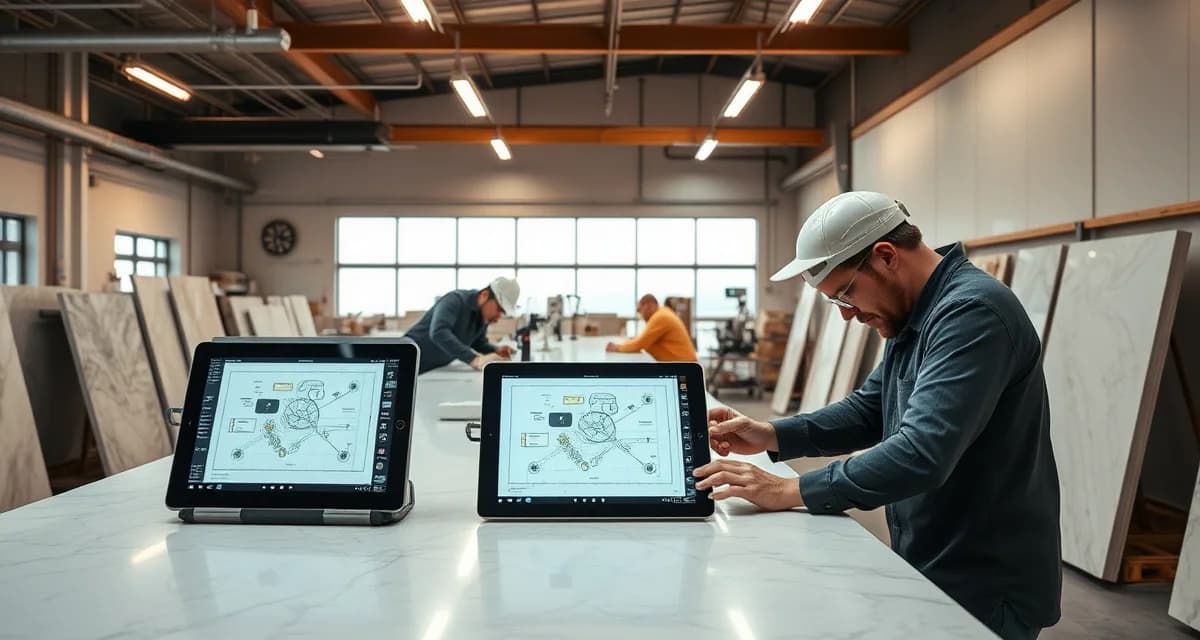
Better Alternatives to Paper Templates for Countertop Shops
Paper template alternatives for countertop shops include digital laser templating systems, digital measuring devices, and AI-powered verification software that replaces physical cardboard or wood strip templates. Modern digital templating produces accurate measurements in less time, reduces human error, and feeds data directly into CNC machines and fabrication management platforms.
TL;DR
- Paper templates produce errors on 5-10% of jobs, costing $1,500-$4,000 per remake
- Digital laser templating improves accuracy to within 1/16 inch consistently
- SlabWise ($199/mo) adds AI verification on top of digital templates - catching errors that even digital tools miss
- Laser templating hardware costs $10,000-$30,000 but pays back in 3-6 months through prevented remakes
- AI template verification from SlabWise catches 2-4 additional errors per month that digital tools alone miss
- Digital templates feed directly into CNC machines - no manual tracing or re-measuring
- The combination of digital templating + AI verification is the most accurate system available
The True Cost of Paper Templates
Paper templates - strips of wood, cardboard cutouts, or hand-drawn field measurements - have been the standard for decades. But their costs are higher than most shops acknowledge:
Calculate your material waste savings
See exactly how much slab material and money you could save with optimized cutting layouts.
Try the free Waste CalculatorAccuracy Problems
| Error Type | Frequency (Paper) | Cost Per Incident |
|---|---|---|
| Dimension off by 1/4"+ | 5-10% of jobs | $1,500-$4,000 (remake) |
| Wrong sink cutout position | 2-5% of jobs | $1,500-$4,000 (remake) |
| Incorrect edge profile noted | 3-7% of jobs | $500-$2,000 (rework) |
| Missing backsplash measurement | 5-8% of jobs | $300-$800 (return trip) |
| Template damaged in transport | 1-3% of jobs | $200-$500 (re-template) |
For a shop doing 40 jobs per month, even a 5% error rate means 2 remakes monthly - $3,000-$8,000 in losses.
Time Problems
- Field templating: 45-90 minutes per kitchen with paper strips
- Shop transfer: 20-30 minutes to trace paper templates onto slab
- CNC programming: Manual data entry from paper measurements into CNC software
- Storage: Physical templates take up shop space and degrade over time
Hidden Problems
- Paper templates can't be verified by software - errors only surface during dry-fitting or installation
- Multiple people interpret handwriting differently
- Humidity, folding, and transportation damage physical templates
- No backup if a template is lost or damaged
Top Paper Template Alternatives
Digital Laser Templating Hardware
These devices replace physical templates with digital measurements:
LPI (Laser Products Industries)
- Industry-leading laser templating system
- Accuracy within 1/16 inch
- Creates DXF files for CNC machines
- Cost: $15,000-$25,000
Proliner
- Portable digital measuring system
- 3D measurement capability
- DXF/DWG output
- Cost: $15,000-$30,000
Prodim
- Digital templating with pen-based measurement
- Multiple industry applications
- Standard file format output
- Cost: $12,000-$25,000
Software That Processes Digital Templates
Once you have digital template data, these platforms manage what happens next:
1. SlabWise - Best AI-Powered Template Processing
Price: $199/mo (Standard) | $349/mo (Enterprise)
SlabWise doesn't replace your templating hardware - it makes the data from that hardware more valuable. Its 3-layer AI template verification catches errors that even digital templating misses.
What it adds to digital templating:
- AI Dimension Verification (Layer 1): Cross-checks measurements against the original quote, standard countertop dimensions, and physics-based constraints. Catches errors like a 37-inch depth when standard is 25.5 inches.
- AI Cutout Verification (Layer 2): Confirms sink cutout positions against manufacturer specs, verifies cooktop openings match the model ordered, and checks faucet hole placement.
- AI Edge/Finish Verification (Layer 3): Validates that specified edge profiles and surface finishes match the quoted job and are compatible with the selected material.
- AI Slab Nesting: Once verified, template shapes get optimally placed on slabs for 10-15% better yield.
- Full Shop Management: Quoting, scheduling, CRM, and customer portal included.
Pros:
- 3-layer verification catches errors digital tools alone miss
- Prevents 2-4 additional remakes per month
- AI nesting saves 10-15% on materials
- Full shop management platform
- 14-day free trial
Cons:
- Requires digital template input (not a templating device)
- Enterprise tier for full AI nesting
2. Moraware - Best for Template-to-Schedule Flow
Price: $200-400/mo
Moraware accepts digital template files and connects them to scheduling and production management. It's the industry standard for processing template data into job workflows.
Pros:
- 2,600+ shops, proven platform
- Template-to-schedule workflow
- CounterGo drawing module
- Industry-standard integrations
Cons:
- No template verification
- No AI nesting
- Manual quoting
- Higher total cost
3. ActionFlow - Best for Template Workflow Management
Price: $200-350/mo
ActionFlow tracks templates as one stage in a multi-stage workflow. Template completion triggers the next steps automatically.
Pros:
- Structured template workflow
- Automated stage transitions
- Good notification system
- ~500 users
Cons:
- No template verification
- No AI features
- Basic material management
- No nesting
Paper Templates vs. Digital + AI: Full Comparison
| Capability | Paper Templates | Digital Templating | Digital + AI Verification |
|---|---|---|---|
| Measurement accuracy | +/- 1/4" typical | +/- 1/16" | +/- 1/16" + AI cross-check |
| Field time per kitchen | 45-90 min | 20-40 min | 20-40 min |
| Error rate | 5-10% of jobs | 1-3% of jobs | <1% of jobs |
| CNC compatibility | Manual data entry | Direct DXF output | Verified DXF output |
| Template storage | Physical space | Digital files | Digital + cloud backup |
| Verification | None (human eye only) | None | 3-layer AI automatic |
| Monthly remake cost | $3,000-$8,000 | $1,500-$4,000 | $0-$1,500 |
| Template backup | None | Digital copies | Cloud + version history |
The biggest jump in accuracy comes from going paper to digital. The biggest jump in error prevention comes from adding AI verification on top of digital.
ROI on Switching from Paper Templates
Hardware Investment
| Item | Cost | Payback Period |
|---|---|---|
| Laser templating system | $15,000-$25,000 | 3-6 months |
| SlabWise (AI verification) | $199/mo | 1-2 months |
| Training | 8-16 hours | Immediate |
Monthly Savings After Switch
| Source | Monthly Savings |
|---|---|
| Prevented remakes (paper error rate drops) | $3,000-$6,000 |
| Faster field templating | $500-$1,000 (labor) |
| Eliminated manual CNC entry | $300-$600 (labor) |
| Material savings from AI nesting | $2,500-$3,750 |
| Total monthly savings | $6,300-$11,350 |
At these savings rates, even the most expensive laser templating system pays for itself within 3-4 months. SlabWise pays for itself on the first prevented remake.
How to Transition from Paper Templates
Phase 1: Digital Templating Hardware (Weeks 1-4)
- Week 1: Research and order a digital templating system
- Week 2-3: Train your templater (most systems require 2-3 days of focused training)
- Week 4: Run digital alongside paper for 5-10 jobs to build confidence
Phase 2: Management Software (Weeks 2-4, overlapping)
- Week 2: Sign up for SlabWise trial, import existing data
- Week 3: Process first digital templates through AI verification
- Week 4: Train team on new workflow
Phase 3: Full Digital (Week 5+)
- Retire paper templates entirely
- All templates processed through digital + AI verification
- AI nesting optimizes layouts from verified templates
- Monthly remakes drop significantly
How accurate are digital templates compared to paper?
Digital laser templating achieves accuracy within 1/16 inch consistently. Paper templates typically produce accuracy within 1/4 inch when done carefully, but 5-10% of paper templates contain significant errors due to human factors, material shifting, or interpretation mistakes.
How much does a digital templating system cost?
Major systems like LPI, Proliner, and Prodim range from $10,000-$30,000 depending on the model and features. The investment typically pays back in 3-6 months through prevented remakes and faster field time.
Can I use AI verification without digital templates?
AI verification works best with digital template data (DXF files). If you're still using paper templates, you'd need to digitize the measurements first. The strongest workflow is digital templating hardware + AI verification software.
How many remakes does AI verification prevent?
Shops using SlabWise's AI verification report catching 2-4 errors per month that would have become remakes. At $1,500-$4,000 per remake, that's $3,000-$16,000 in prevented losses monthly - on top of what digital templating already prevents.
Do my templaters need computer skills for digital systems?
Digital templating systems are designed for field use by trade professionals. Most templaters learn the basics within 2-3 days. The systems use touchscreens and guided workflows, not complex software interfaces.
Will my CNC machine accept digital template files?
Almost all CNC machines used in countertop fabrication accept DXF files, which is the standard output of digital templating systems. SlabWise also accepts DXF files and outputs optimized layouts in compatible formats.
How long does digital templating take compared to paper?
Digital templating typically takes 20-40 minutes per kitchen compared to 45-90 minutes for paper. The time savings come from faster measurement capture and elimination of the manual tracing step at the shop.
Can I start with software and add hardware later?
Yes, but with limitations. If you're currently using paper templates, you can start with SlabWise for quoting, scheduling, and shop management. AI template verification becomes fully effective once you switch to digital templating hardware that produces DXF files.
What's the biggest mistake shops make when switching from paper?
Trying to run paper and digital simultaneously for too long. A 2-week parallel period is sufficient. After that, commit fully to digital - keeping paper as a backup only undermines adoption and doesn't build the muscle memory your team needs.
Is the templating hardware difficult to maintain?
Digital templating devices are industrial tools designed for job-site conditions. Most require minimal maintenance - regular calibration checks and basic care. Manufacturers typically offer support contracts. Compared to paper strips that degrade, get lost, and take up space, digital devices are more reliable.
Calculate Your Paper Template Costs
Every paper template error that becomes a remake costs $1,500-$4,000. Digital templating + AI verification from SlabWise brings your error rate below 1%. The math isn't complicated.
Start your 14-day free trial at SlabWise.com - no credit card required. Process your first digital template through AI verification and see what it catches.
Try These Free Tools
- Photo to Template -- Snap a photo of an existing countertop and get an AI-generated DXF template.
- Template Compare -- Upload two templates and see every dimension change highlighted instantly.
- AI Template Verification -- Cross-check your template against manufacturer specs before cutting.
Sources & Further Reading
-
International Surface Fabricators Association - Digital Templating Best Practices
-
Natural Stone Institute - Modern Fabrication Technologies and Templates
-
National Kitchen & Bath Association - Precision Measuring and Templating Guidelines
-
Marble Institute of America - Advanced Templating Methods for Stone Fabrication